Basic Information
Scientific classification
- Chinese name: Red-tailed Swallow
- Scientific name: Red-tailed Tropical Bird
- Classification: Birds of prey
- Genus and species: Red-tailed Wren
Vital signs data
- Body length: 450-460 mm
- Weight: 600-830 grams
- life:
Significant features
It possesses a certain degree of territoriality and a single-spouse system.
Distribution and Habitat
Origin: Australia, Bangladesh, British Indian Ocean Territory, Canada, Chile, China, Christmas Island, Cocos (Keeling) Islands, Comoros, French Polynesia, Guam, India, Indonesia, Japan, Madagascar, Marshall Islands, Mauritius, Mayotte, Mexico, Federated States of Micronesia, Mozambique, New Caledonia, New Zealand, Norfolk Island, Northern Mariana Islands, Palau, Philippines, Pitcairn, Reunion Island, Seychelles, Solomon Islands, South Africa, China, Tonga, United States (Hawaii Islands), Outer Islands of the United States, Wallis and Futuna Islands.
Wandering: Brazil, Fiji, Kenya, Peru, and Thailand.
Uncertain: American Samoa, Cook Islands, French Southern Territory, Kiribati, Malaysia, Maldives, Nauru, Niue, Papua New Guinea, Samoa, Somalia, United Republic of Tanzania, East Timor, Tokelau, Tuvalu, and Vanuatu.
Appearance
The Red-tailed Pitta averages 95 to 104 cm (37 to 41 inches) in length, including a 35 cm (14-inch) tail ribbon, and weighs approximately 800 g (30 oz). Its wingspan is 111 to 119 cm (44 to 47 inches). It has a streamlined yet robust body, with almost entirely white plumage, complemented by long red tail feathers and a vermilion bill. Males and females have similar plumage. The iris is brown. A dark brown comma-shaped stripe extends from behind the area in front of the eye, across and covering the eye, and extends to the ear coverts. The pupil is dark brown. The bill is red or orange-red, bright red with a slightly paler base, the front half of the bill is slightly curved, and the edges are serrated for hunting fish. The area around the nostrils is black. The legs are short with small toes, and are fully webbed; the base of the legs and toes is pale bluish-purple, while the rest of the webs and toes are black. The white feathers on the head and rump are concealed by dark brown bases, while the bases of the rachis of the scapula, back, tail feathers, and tail coverts are dark brown. The two long tail feathers are orange-red, with about one-tenth of their base being white, which may be difficult to see in flight. The white wings have dark V-shaped patterns, are long, and the rachis of the primary flight feathers is visible. The upper wing feathers often have a more pronounced pinkish tinge. Molting occurs outside the breeding season, with the tail ribbon replacing the other feathers. The tail ribbon may also be replaced at any time; one grows while another falls out, and the shed tail ribbon may be scattered around the breeding grounds, making it a very beautiful seabird.
Size measurements: Weight 600-830 grams; body length 450-460 mm, including the elongated tail 960-1020 mm; bill 66-69 mm; wing 330-339 mm; tail 360-428 mm; tarsus 30-69 mm.
Detailed introduction
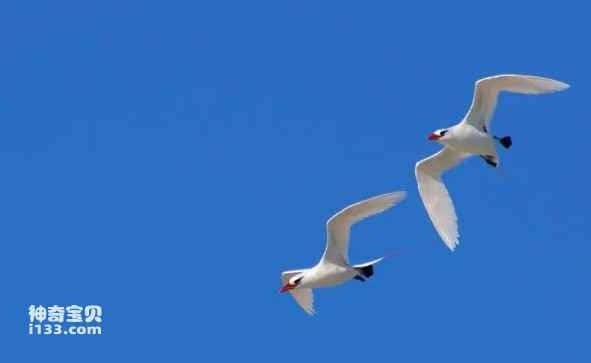
The Red-tailed Wren (scientific name: *Phaethon rubricauda *) is a bird belonging to the family Phaethonidae in the order Phaethoniformes. It is a seabird native to the tropical Indian and Pacific Oceans. It is one of three closely related tropical birds (Phaethontidae) , resembling a tern in appearance, with almost entirely white plumage, a black veil, and a red beak. Males and females have similar plumage. As the name suggests, adults have a red tail ribbon approximately twice the length of their body. The type locality of this species is Mauritius in the Indian Ocean.
The Red-tailed Pitta averages 95 to 104 cm ( 37 to 41 inches) in length, including a 35 cm ( 14- inch) tail ribbon, and weighs approximately 800 g ( 30 oz ). Its wingspan is 111 to 119 cm ( 44 to 47 inches). It has a streamlined yet robust body, with almost entirely white plumage, complemented by long red tail feathers and a vermilion bill. Males and females have similar plumage. The iris is brown. A dark brown comma-shaped stripe extends from behind the area in front of the eye, across and covering the eye, and extends to the ear coverts. The pupil is dark brown. The bill is red or orange-red, bright red with a slightly paler base, the front half of the bill is slightly curved, and the edges are serrated for hunting fish. The area around the nostrils is black. The legs are short with small toes, and are fully webbed; the base of the legs and toes is pale bluish-purple, while the webs and the rest of the toes are black. The white feathers on the head and rump are concealed by dark brown bases, while the bases of the rachis of the scapula, back, tail feathers, and tail coverts are dark brown. The two long tail feathers are orange-red, with about one-tenth of their base being white, which may be difficult to see in flight. The white wings have dark V- shaped patterns, are long, and the rachis of the primary flight feathers is visible. The upper wing feathers often have a more pronounced pinkish tinge. Molting occurs outside the breeding season, with the tail ribbon replacing the other feathers. The tail ribbon may also be replaced at any time; one grows while another falls out, and the shed tail ribbon may be scattered around the breeding grounds, making it a very beautiful seabird.
Size measurements: Weight 600-830 grams; body length 450-460 mm, including the elongated tail 960-1020 mm; bill 66-69 mm; wing 330-339 mm; tail 360-428 mm; tarsus 30-69 mm.
Red-tailed pheasants are considered monogamous, with pairs remaining together throughout the breeding season. They nest in loose colonies on offshore islands and rocky outcrops, cliffs, coral atolls, and islets. They rarely nest on land, and the nest itself is a shallow burrow located in shady sand or rock crevices, or under bushes. Due to their limited mobility, red-tailed pheasants fly against the wind, landing after losing momentum. Nests are typically located within one meter ( 3.3 feet) of the edge of bushes (or other shady areas) to minimize walking distance. Tropical birds generally choose bushes with fewer trunks for easier access.
This species exhibits a degree of territoriality, actively protecting its nesting area and surrounding foraging range, starting about three months before breeding. They become more aggressive in areas with large populations or fewer suitable nesting sites. They adopt defensive postures, including raising their humerus and bringing their wrists together, retracting their necks into their bodies, shaking their heads from side to side, raising their head feathers, and emitting a screeching sound. Pecking and fighting may erupt, with two opponents pecking at each other and banging their bodies for up to 90 minutes.
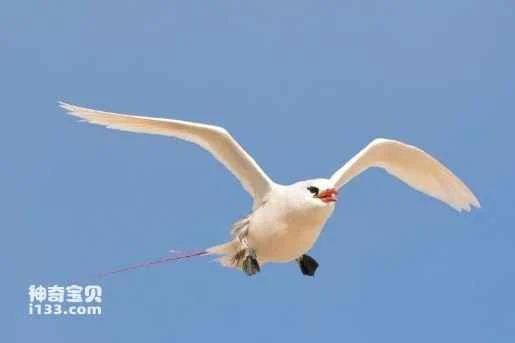
These tropical birds may also select their mates based on the length of their tail feathers, meaning that mates may have similar tail feather lengths, with birds having longer tail feathers being more attractive.
During courtship, the male and female birds stand on the edge of a cliff near their nest, one above and one below, using rising thermals to spread their tails and bend them downwards, extending their legs to the sides of their tails in a vertical circular flight – a truly spectacular courtship display. The male initiates an aerial courtship display, flying in large circles. After several circles, they alternate gliding, interspersed with brief, rapid wing flapping and low-flying maneuvers a few meters above the water, emitting sharp, cawing calls, before gliding together a considerable distance over the sea. Initially, they fly in small flocks, then repeat the display in pairs, eventually forming a pair. Once a pair has successfully paired and established a nest, they cease this display. During the breeding season, they typically return to their original breeding grounds and mate with their original mates.
Breeding seasons may not be fixed for birds south of the equator. On islands near the equator, eggs are typically laid from June to November, with most chicks leaving the nest around January or February. On Christmas Island, the breeding season varies depending on local weather conditions. Some birds may remain at their breeding grounds year-round. On the subtropical Lydiellite Island outside Queensland, they nest in winter, which scientists believe may be to avoid the common breeding season of most migratory seabirds, such as the noisy wedge-tailed shearling. Little is known about their habits.
The female Redtail Lorebird lays one egg, which is incubated by both parents for 42 to 46 days. The male usually incubates the egg first after it is laid. The egg is 5.4 to 7.7 cm ( 2.1 to 3.0 inches) long (averaging between 6.3 and 6.8 cm ( 2.5 and 2.7 inches) depending on location) and 4.5 to 4.8 cm ( 1.8 to 1.9 inches) wide. It is oval, pale brown, with brown and reddish-black markings, which are more prominent at the larger end of the egg.
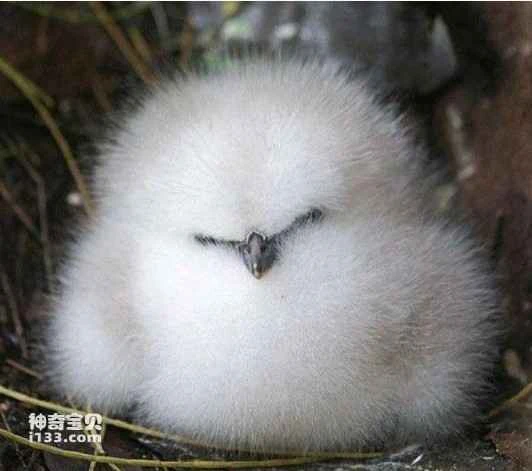
Newborn chicks are helpless and unable to move (nesting and semi-alteric), and have zero vision at birth, opening their eyes after 2 to 3 days. Until about a week old, they will only open their beaks when touched, so parents must stroke the base of their beaks to encourage feeding. Feeding occurs once or twice a day, usually around midday. The chicks are incubated by their parents until they are a week old, after which they will hide under their parents' wings. They will also stand up and beg for food from any nearby birds. Both parents feed the chicks together, inserting their beaks into the chick's esophagus and regurgitating food. The chicks are initially covered in grey or white down, and their first feathers—shoulder feathers—grow in 16 to 20 days. Their feet and beaks grow rapidly, exceeding the growth rate of the rest of their bodies. The chicks remain in the nest for 67 to 91 days until they are fully grown.
Newly hatched chicks are covered in sparse, long, greyish-white down, with a paler head. The area in front of their eyes is bare. Older chicks have greyer down. By the third week, the primary feathers, contour feathers, and scapular feathers begin to appear. By six weeks, most chicks have grown feathers, with some remaining down on their abdomen and under their wings. By eleven weeks, they are fully feathered. Young birds have a glossy white forehead, chin, throat, and abdomen, while the crown, nape, shoulders, back, rump, and upper wing coverts have distinct black horizontal bars and scaly patterns. Their beaks are blackish-grey with a pale bluish-grey base, and their legs and feet are grey.
Red-tailed pheasants are generally silent in flight. Except during courtship displays, the birds may give short greetings to their mates when arriving at or leaving the nest. The birds emit a low growl as a defense call, and the chicks will continuously chirp and beg for food when their parents approach.
The Redtail is distributed across the southern Indian Ocean and the western and central Pacific, from the coast of East Africa to Indonesia, south to the southern waters of Japan, across Chile, and the Hawaiian Islands, with a higher prevalence in the northwestern islands. It is commonly found in waters with temperatures below 24–30 ° C ( 75–86 ° F ), with salinity below 35% in the Southern Hemisphere and below 33.5% in the Northern Hemisphere. In the Pacific Ocean, its southern boundary of distribution follows the summer surface isotherm of 22 ° C ( 72 ° F ).
After breeding, birds disperse widely. Evidence suggests that Indian Ocean birds migrate westward with prevailing winds, with young individuals tagged at Sugarloaf Rock in Sumatra and Western Australia, and recovered in Mauritius and Réunion respectively. Tagged individuals at Kure Atoll indicate that North Pacific birds migrate eastward with prevailing winds there. Strong winds sometimes blow them inland, explaining some observations outside the coast and their preferred habitats.
Johnston Atoll is the world's largest breeding ground for red-tailed pheasants, with 10,800 nests in 2020. In the Pacific, the bird breeds on Australia's offshore territories of Norfolk Island and Lord Howe Island, as well as on Queensland's coral islands (including Raine Island and Lady Elliott Island). In mid- 2020 , Australian scientists discovered a bird on Lady Elliott Island that had been tagged as a chick 23 years earlier but had not been seen since; the bird returned to the island to breed. On New Zealand territory, the bird breeds in the Kermadec Islands. In other parts of the Pacific, it breeds in Fiji, New Caledonia, French Polynesia, Hawaii (with a large colony on Kure Atoll), the Cook Islands, Pitcairn Island, and islands in Japan and Chile.
Large breeding colonies exist on Europa Island , Aldabra Atoll, and Christmas Island in the Indian Ocean, with smaller colonies in Madagascar. The bird breeds on Nossieve Island. It is also found in the Seychelles and Mauritius. It is also present in the Cocos Islands, an Australian territory in the Indian Ocean. The warm waters of the Lee Current promote breeding for this species at Cape Lewyn in southwestern Australia, but it is rarely seen on the east coast of New South Wales at the corresponding latitude. It also breeds on the Ashmore and Carter Islands, Rottnest Island, and along the coastlines of Sugarloaf Rock, Natural Roll Head, and Busselton in Western Australia.
A resident bird. After the breeding season, it wanders short distances. It is a skilled swimmer and diver, and even more adept at flying, spending most of its time in the air. It is solitary, returning to its original breeding grounds and seeking mates during the breeding season; otherwise, it flies alone over the sea in search of food. It can both flap its wings and glide at high altitudes. It has exceptional eyesight, able to spot underwater food from the air. When it spots food at sea, it can suddenly dive from a height of over 14 meters to catch it, remaining submerged for about 25 seconds. Its diet consists mainly of flying fish and squid, but it also eats crustaceans.
Red-tailed pheasants are powerful fliers, but have difficulty walking on land, using a wobbly gait. They can soar through the air by flying against the wind; during courtship displays, paired birds may even fly backward and circle each other.