Basic Information
Scientific classification
- Chinese name: Brown-bellied Woodpecker
- Scientific name: Dendrocopos hyperythrus, Rufous-bellied woodpecker
- Classification: Climbing birds
- Family and genus: Order Vulpetiformes, Family Woodpeckers, Genus *Woodpecker*
Vital signs data
- Body length: 18-23 cm
- Weight: 41-65g
- Lifespan: No verification data available.
Significant features
It is a brightly colored woodpecker
Distribution and Habitat
The Brown-bellied Woodpecker is found in Bangladesh, Bhutan, China, India, Lao People's Democratic Republic, Myanmar, Nepal, Thailand, and Vietnam.
The Brown-bellied Woodpecker is found from southeastern Tibet to northwestern, western, and southern Sichuan and Yunnan in China, migrating vertically at altitudes of 1500-4300 meters. It is distributed throughout most of Yunnan, primarily in secondary broad-leaved forests, mixed coniferous and broad-leaved forests, and fir-moss forests. It is found singly or in pairs, feeding mainly on insects. The Tibetan subspecies breeds in western Tibet; the nominate subspecies is found from southeastern Tibet to northwestern, western, and southern Sichuan and Yunnan, migrating vertically at altitudes of 1500-4300 meters. The common subspecies breeds in mid-altitude areas of Heilongjiang, wintering in southern China via eastern China. It prefers coniferous or mixed forests.
Appearance
The Brown-bellied Woodpecker measures 17-20 cm in length and weighs 25-35 grams. Its crown and neck are deep red; its back is striped with alternating black and white bars; the rump to the central tail feathers are black; the outer pair of tail feathers are white with black bars. The eye stripe and chin are white, and the rest of the underparts are mostly pale ochre, except for the pink undertail coverts. The lesser wing coverts are black, and the rest of the wings are mostly black with white spots; the inner tertiaries have white bars. The female's crown is a mix of black and white.
The Brown-bellied Woodpecker is a brightly colored woodpecker. Its back, wings, and tail are black with rows of white spots; the sides of its head and underparts are a deep reddish-brown, a distinguishing feature; its rump is red. The male has a red crown and nape. The female has a black crown with white spots. The Tibetan subspecies has red on the nape extending behind the ear coverts; the nominate subspecies has more yellowish-brown underparts than the other two subspecies.
The iris is dark brown, with the female being wine-red; the upper mandible is black, and the lower mandible is pale yellow with a slight green tinge; the tarsi and toes are dark lead-colored, and the claws are dark brown.
Size measurements: Weight: ♂ 41-65 g, ♀ 50-63 g; Body length: ♂ 193-236 mm, ♀ 184-238 mm; Bill length: ♂ 23-28 mm, ♀ 24-29 mm; Wing length: ♂ 115-135 mm, ♀ 117-132 mm; Tail length: ♂ 80-95 mm, ♀ 79-91 mm; Tarsus length: ♂ 19-23 mm, ♀ 20-23 mm. (Note: ♂ male; ♀ female)
Detailed introduction
The brown-bellied woodpecker, scientifically known as *Dendrocopos hyperythrus*, has four subspecies.
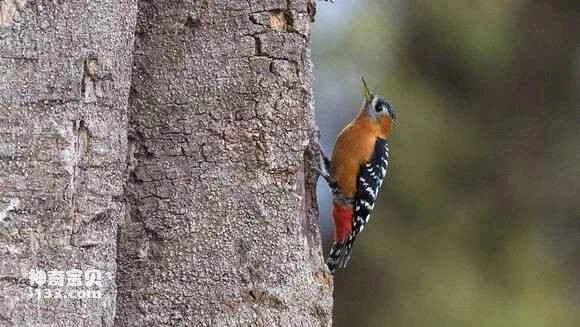
The Brown-bellied Woodpecker's call is a drawn-out, staccato kii-iiiiii call, gradually weakening until it ends; it is similar to the Great Spotted Woodpecker, but is mostly encountered in mountain forests. It is timid and often flies alone during migration. Its call is also similar to the Great Spotted Woodpecker's, but it is not very vocal. Both males and females chisel wood, producing a sound.
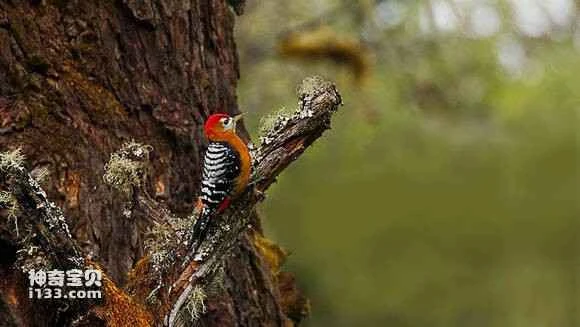
The brown-bellied woodpecker feeds on insects, especially ants, but also eats stink bugs, weevils, lepidopteran larvae, and ground beetles.
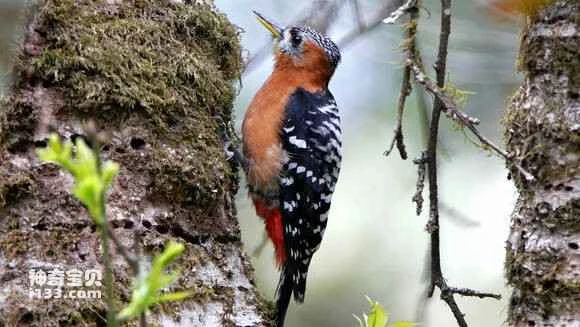
The brown-bellied woodpecker breeds from April to June. They nest in cavities in decaying or semi-decaying tree trunks, about 3-5 meters above the ground. Drilling this cavity can sometimes take up to a month. Their nest openings are slightly oval, unlike the round openings of other woodpeckers. They usually lay 3 eggs per clutch, rarely only 2 or up to 4. The average size of 15 eggs is 22.2 × 16.5 mm. Both parents take turns incubating the eggs; the chicks are altricial.
It is listed in the "List of Terrestrial Wild Animals of Beneficial or Important Economic and Scientific Research Value under State Protection" issued by the State Forestry Administration of China on August 1, 2000.
Listed as Least Concern (LC) on the IUCN Red List of Threatened Species 2012 ver3.1.
Protect wild animals and ban the consumption of wild game.
Maintaining ecological balance is everyone's responsibility!