Basic Information
Scientific classification
- Chinese name: Sharp-feathered Tree Duck
- Scientific name: Dendrocygna eytoni, Plumed Whistling Duck, Plumed Whistling-duck, Grass Whistling Duck
- Classification: Waterfowl
- Family and genus: Anseriformes, Anatidae, Anatolia
Vital signs data
- Body length: 40-45 cm
- Weight: 680-900g
- Lifespan: No verification data available.
Significant features
The chest and abdomen have oval-shaped, upward-curving stripes of pale yellow and black on both sides; the anus and tail are white ice cream color.
Distribution and Habitat
It is found in Australia and New Zealand, including Tasmania and its nearby islands.
They inhabit swamps, lagoons, lakes, reservoirs, mangroves, and other bodies of water, as well as forest edge swamps and ponds and streams surrounded by vegetation. They prefer to hide in tall grass or under lotus leaves, and also live in groups on the water surface, but usually avoid open lakes.
Appearance
The Sharp-feathered Tree Duck is 40-45 cm long and weighs 680-900 grams. Sexes are similar. Adults have a brown crown, neck, and breast; the head and neck are bluish-grey. The most distinctive feature is the upward-curving, oval-shaped stripes of pale yellow and black on the sides of the breast and abdomen. The vent and tail are off-white. The underwing coverts are pale brown. The forewings are olive-grey-brown, darkening slightly towards the hindwings. The tail has dark yellow spots. The rump and tail are dark brown. The bill is pinkish-flesh with black spots. The legs and feet are pink. The iris is pale yellow.
Detailed introduction
The Plumed Whistling Duck (scientific name: Dendrocygna eytoni), also known as the Grass Whistling Duck, has no subspecies.
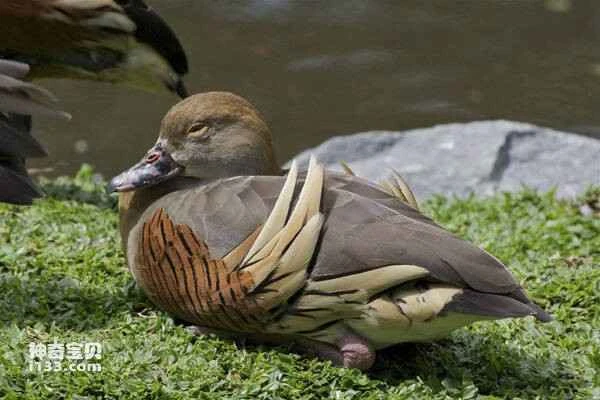
When resting, the Sharp-feathered Tree Duck stands upright, with several frequently craning their necks to look around. Upon encountering humans or predators, it is the first to take flight, followed by the others, demonstrating its extremely alert nature. They typically forage in groups of several to dozens, but large flocks of hundreds are also common. Their flight is weak, and their speed is slower than other ducks. They are also adept swimmers and divers, possessing exceptional diving abilities, capable of diving for over ten minutes at a time. During the hot daytime, they often sleep and rest in reed beds or other tall aquatic plants. Their habitat changes depending on the rainy season and drought, sometimes migrating in flocks to areas with abundant water and food for short distances.
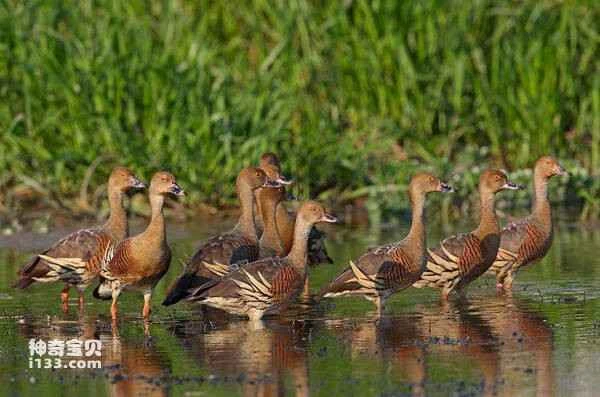
The Sharp-feathered Tree Duck is monogamous and may remain so for life. The breeding season in northern Australia is February and March, while the southern species breed in September and October. The breeding season varies greatly depending on rainfall. In dry years, it may be delayed or only a portion of the population may lay eggs. Nests are built on the ground covered with shrubs or grass near water. Courtship and mating take place in the water; before mating, the male and female swim together, with the male repeatedly dipping his beak at the female while she remains upright. The male then suddenly mounts the female's back to mate. Each clutch contains 8-14 eggs, usually around 10, which are white. Both parents incubate the eggs for 27-30 days.
Listed as Least Concern (LC) on the IUCN Red List of Threatened Species 2012 ver 3.1.
Protect wild animals and ban the consumption of wild game.
Maintaining ecological balance is everyone's responsibility!