Basic Information
Scientific classification
- Chinese name: Fine-spotted Tree Duck
- Scientific name: Dendrocygna guttata, Spotted Whistling-duck, Spotted Whistling Duck
- Classification: Waterfowl
- Family and genus: Anseriformes, Anatidae, Anatolia
Vital signs data
- Body length: 43-50 cm
- Weight: About 800g
- Lifespan: No verification data available.
Significant features
The sexes are similar; adult ducks have rye straw-colored combs, napes, collars, and around-the-eyes, while their heads, eyebrows, and throats are grayish-white.
Distribution and Habitat
Distributed in Australia, Indonesia, Papua New Guinea, and the Philippines, it typically inhabits lakes and marshy grasslands, and also appears in forest edge swamps and ponds and streams surrounded by vegetation. It gathers in small groups until evening when large flocks of hundreds roost together on dead branches at the top of large trees.
Appearance
The Fine-spotted Tree Duck measures 43-50 cm in length, has a wingspan of 80-90 cm, and weighs 800 grams. Sexes are similar. Adults have a rye straw-colored comb, nape, collar, and area around the eyes; the head, eyebrows, and throat are greyish-white. The breast and sides are reddish-brown, speckled with white spots edged in black. These fine spots gradually increase in size, becoming larger and more prominent on the hindquarters. The central abdomen and vent are white. The wingtips and tail are dark brown. The wattles and back are light brown, with black centers and red edges on the feathers. The beak is a mixture of black and red.
The tarsal scales are shield-like; the male's trachea has an asymmetrical enlargement; the calls of the two are different, and their plumage and behavior are usually different as well; the mating relationship and family life are short-lived; they molt twice a year; the male often molts once for "erosion feathers" and once for bright nuptial feathers; the chicks' down feathers have obvious patterns; the female has a "teasing" performance.
Detailed introduction
The Spotted Whistling-duck (scientific name: Dendrocygna guttata), also known as the Spotted Whistling Duck, has no subspecies.
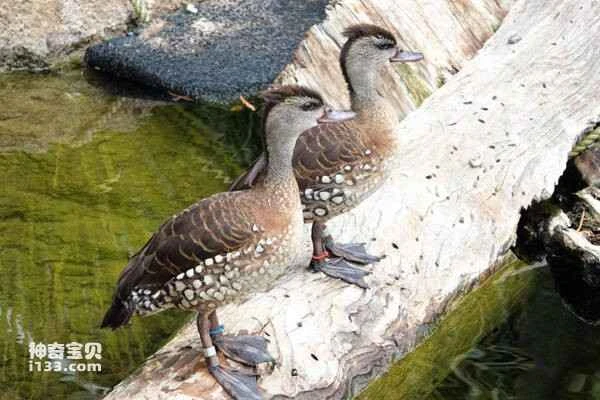
The Scaly Tree Duck can forage on the water's surface and underwater, and sometimes also forages on grass near the water's edge. Its diet consists mainly of plant-based foods such as rice, crop seedlings, grass, and aquatic plants, but it also eats animal-based foods such as insects, snails, molluscs, frogs, and small fish. Typically, at dusk, groups of several to dozens of tree ducks fly to nearby rice paddies to forage, returning to their daytime roosting areas before dawn.
When resting, the Fine-spotted Tree Duck stands upright, and several of them often crane their necks to look around. Upon encountering humans or predators, they are the first to take flight, followed by the others, demonstrating their extremely alert nature. They typically forage in groups of several to dozens, and sometimes in large flocks of hundreds. Their flight is weak, and their speed is slower than other ducks. They are also adept swimmers and divers, with particularly strong diving abilities, capable of diving for over ten minutes at a time. During the hot daytime, they often sleep and rest in reed beds or other tall aquatic plants. If food is plentiful and undisturbed, they tend to remain in one fixed location, generally not changing habitats or even undertaking long-distance migrations.
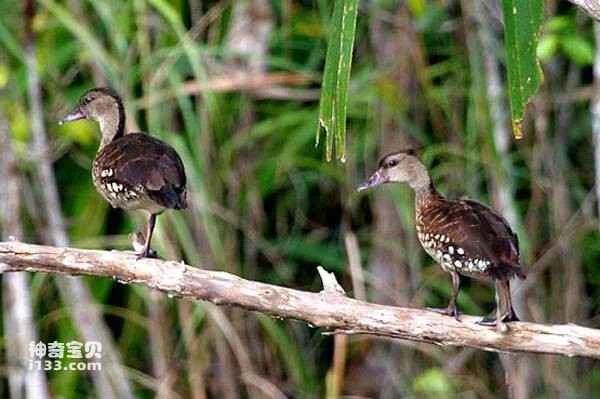
The breeding season for the Fine-spotted Tree Duck extends from September to March of the following year, peaking in September during the rainy season. They nest in tree cavities. Courtship and mating take place in the water; before mating, the male and female swim together, with the male repeatedly dipping his beak into the water towards the female, who remains upright. Then, the male suddenly mounts the female's back to mate. The nest is constructed of grass leaves and stems, with each clutch containing 8-14 eggs, up to a maximum of 16. The eggs are white. Both parents incubate the eggs for 28-31 days.
Listed as Least Concern (LC) on the IUCN Red List of Threatened Species 2012 ver 3.1.
Protect wild animals and ban the consumption of wild game.
Maintaining ecological balance is everyone's responsibility!