Basic Information
Scientific classification
- Chinese name: Sugarcane Toad
- Scientific name: Rhinella marina (Cane Toad)
- Order: Anura
- Family: Bufonidae Rhinella marina
Vital signs data
- Body length: Adults are generally about 10–15 cm in length, while large females can exceed 20 cm.
- Weight: Most weigh several hundred grams, with larger individuals approaching 1 kilogram, making them among the larger terrestrial toads.
- Lifespan: In the wild, they can typically live for 5–10 years, and under artificial breeding conditions, individuals can live even longer (recorded to be over ten years).
Significant features
This large toad, with its robust body and highly developed venom glands behind its ears, has venom that is potentially lethal to many predators and pets. It has an extremely high reproductive rate and has become a serious invasive species in places like Australia.
Distribution and Habitat
Native to tropical and subtropical regions of Central and South America, it was later introduced to the Caribbean, Pacific islands, and northern and eastern Australia; it is often found in farmland, sugarcane fields, pastures, urban lawns, and near various still or slow-moving water bodies.
Appearance
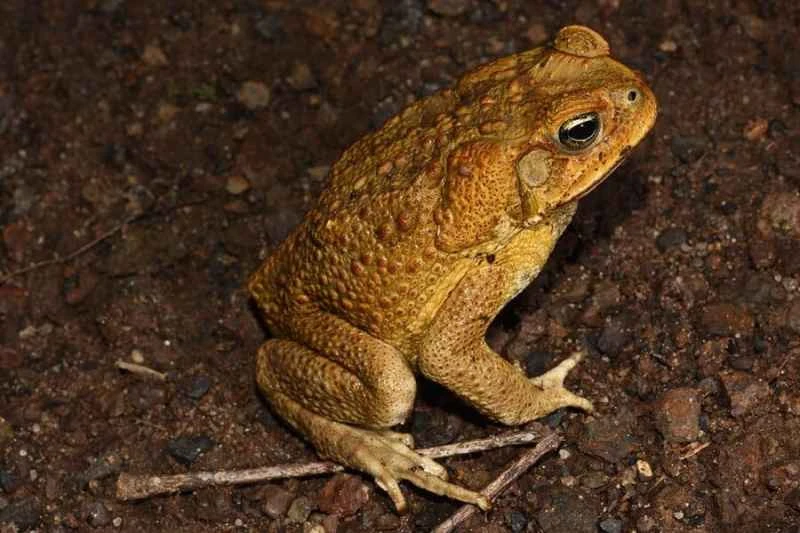
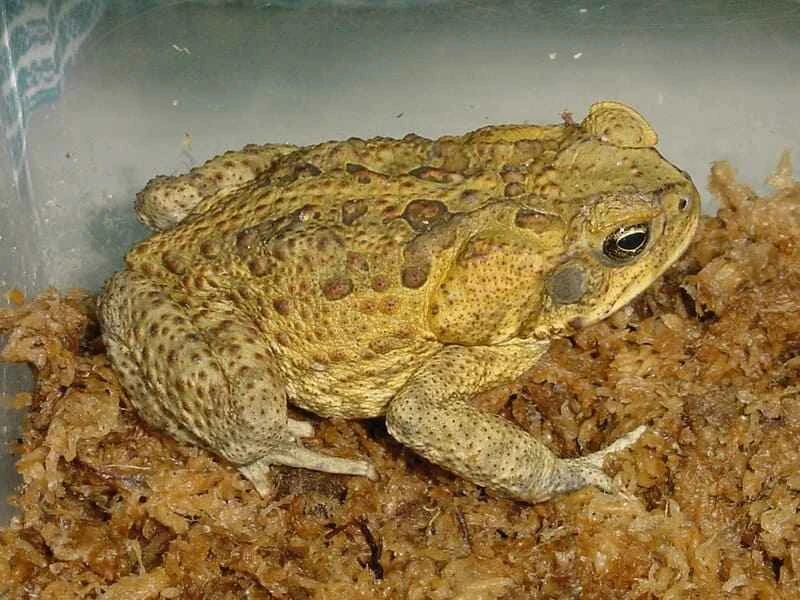
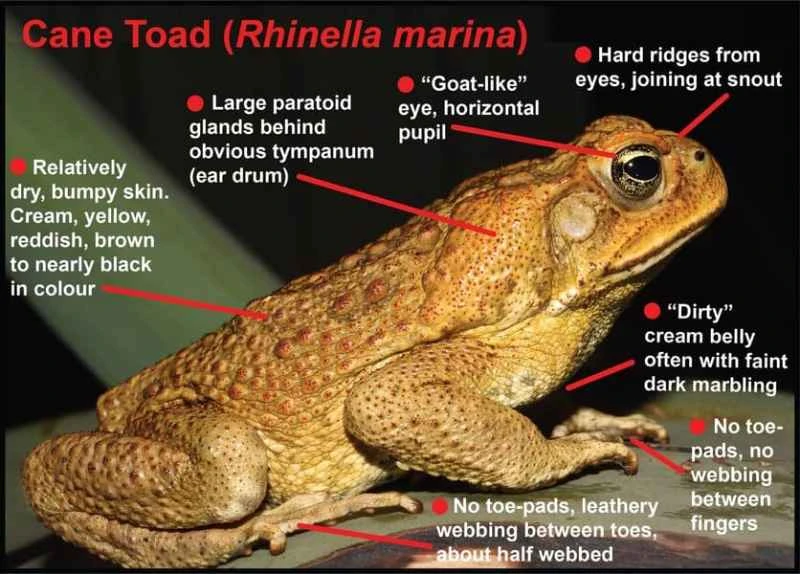
The back is rough and warty, brown or yellowish-brown with dark markings, while the ventral side is lighter; raised, elongated venom glands are visible behind the eyes; the overall body shape is bulky, with a broad and flat head and short, thick limbs.
Detailed introduction
The cane toad ( Rhinella marina , formerly Bufo marinus ) is a large, robust toad belonging to the family Bufonidae . Native to the tropical and subtropical regions of Central and South America, it was introduced to Australia, the Caribbean, and many Pacific islands for biological control of agricultural pests, but unexpectedly became a highly destructive invasive species .
Classification and nomenclature
Chinese name: Cane toad, Sea toad (one of the old translations)
English name: Cane Toad, Giant Toad, Marine Toad
Scientific name: Rhinella marina (former name Bufo marinus )
Family and Genus: Bufonidae → Rhinella
Appearance and Identification Features
The cane toad is one of the most famous and relatively large toads in the world.
Size: Adults are generally about 10-15 cm long, with large females exceeding 20 cm; their weight is mostly several hundred grams, with large individuals approaching 1 kilogram;
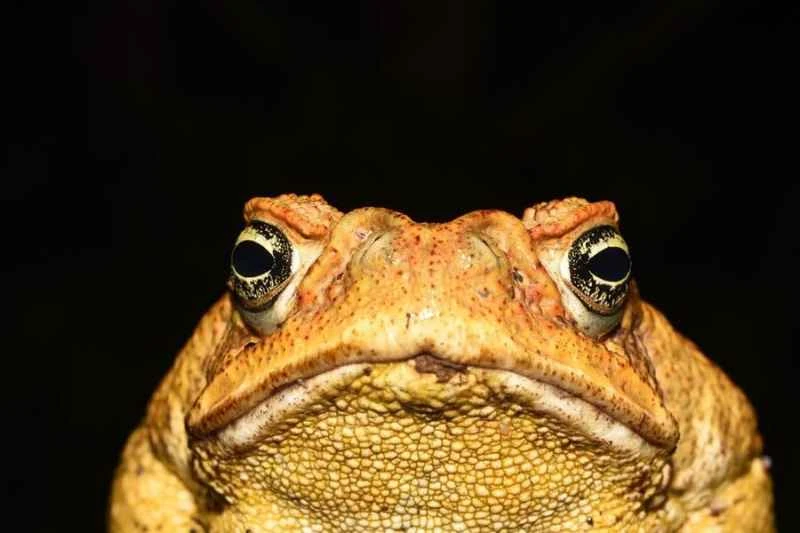
Body shape: The body is stout, the head is wide and flat, and the limbs are strong but relatively short, giving an overall impression of being "sturdy and clumsy".
Skin: The skin on the back is rough, with many warts and bumps, exhibiting a typical "toad bump" texture;
Body color: The back is mostly brown, yellowish-brown, olive or grayish-brown, often with irregular dark spots or cloud patterns, while the belly is lighter, which is cream, grayish-white or with a few spots;
Parotid glands: There is a pair of very well-developed parotid glands (parotid glands, venom glands) behind the eyes, which are shaped like raised strips and can secrete milky white venom when threatened;
Sexual differences: Female toads are usually larger, while male toads have stronger forelimbs and well-developed mating pads during the breeding season.
A robust body, large venom glands behind the ears, and rough, warty skin are key features for identifying the sugarcane toad in the wild.
Distribution range and habitat
The cane toad is native to tropical and subtropical regions of the Americas .
From southern Mexico, Central America, all the way to the Amazon basin and parts of Brazil;
Natural habitats include lowland rainforests, savannas, wetland edges, and river valleys.
Due to its artificial introduction, it is now widely found in:
Caribbean islands and parts of the Pacific Islands;
It is found in large areas of northern and eastern Australia, both along the coast and inland.
Some sugarcane growing areas and surrounding tropical farmlands.
The sugarcane toad is highly adaptable and can utilize a variety of habitats:
Farmland, sugarcane fields, and pastures;
Urban lawns, parks, gardens, and artificial waterways;
The edges of ponds, ditches, drainage ditches, and the perimeter of wetlands.
Given a relatively warm climate, ample insect resources, and nearby water bodies for reproduction, they can quickly establish populations.
Lifestyle and Diet
Sugarcane toads are primarily nocturnal and terrestrial .
During the day, they mostly hide under rocks, among tree roots, in caves, or in shady places under man-made structures;
They come out at dusk and night, walking slowly on the ground or jumping short distances.
They often freeze temporarily when exposed to strong light, and are easily "frozen" by car headlights or human flashlights.
It has a very wide range of diets and is a typical opportunistic omnivorous predator .
Various ground insects (beetles, crickets, cockroaches, ants, moths, etc.);
Spiders, centipedes, and other arthropods;
Earthworms, mollusks, and even small amphibians and reptiles;
In artificial environments, they may also consume pet food, garbage scraps, etc.
This habit of "eating a little bit of everything" is one of the important reasons for its successful spread in the invaded areas.
Toxicity and Defense
The most striking feature of the sugarcane toad is its potent venom :
The milky white, viscous venom secreted by the parotid glands and skin glands contains various bufotoxins and cardiac glycosides .
It is highly toxic, even deadly, to many predators, such as dogs, cats, small carnivorous mammals, reptiles, and fish.
Tadpoles and eggs are also poisonous, and fish or amphibians that prey on tadpoles may also be poisoned.
Contact with its venom can cause irritation to the eyes, mouth, and skin in humans; ingestion or large amounts of the venom poses a potential serious risk of cardiotoxicity. In areas where it has been introduced, cases of pet dogs dying from poisoning after accidentally biting cane toads are not uncommon.
Reproductive capacity
The sugarcane toad's extremely high reproductive rate is key to its successful invasion.
Breeding usually occurs during the rainy season or after continuous rainfall;
A female toad can lay thousands or even tens of thousands of eggs at a time, which are arranged in long, gelatinous strings and attached to aquatic plants or objects in the water.
Tadpoles live in groups in the water. They are small in size and dark in color. Their development speed is greatly affected by water temperature and food.
Once the larvae mature into baby toads, they can begin to live independently on land.
High spawning capacity, extensive water utilization capabilities, and strong environmental tolerance enable their populations to expand rapidly in suitable areas.
Invasion of ecosystems
In its native habitat, the cane toad is part of the local ecosystem; however, in introduced regions such as Australia, it has caused serious impacts on native species.
Its potent toxicity has caused local predators (such as monitor lizards, snakes, and wild dogs) to die from poisoning after consuming it;
They compete with native frogs and toads for habitat and food resources;
It alters the local food web structure and energy flow patterns.
Therefore, the sugarcane toad is considered a harmful invasive species in many areas, and related management includes controlling its spread, removing egg masses and larvae, and promoting pet protection.
Preserve the status quo
On a global scale, the sugarcane toad is classified as Least Concern (LC) on the International Union for Conservation of Nature (IUCN) Red List, indicating that its population is very large, stable, and even expanding.
However, this "Least Concern" status is based on its excessive success and widespread distribution , and does not mean that it is "worthy of protection" in all regions. In countries and regions where it is an invasive species, the management goal is instead to limit and control its numbers in order to protect native ecosystems.
Frequently Asked Questions
Q1: Are sugar toads dangerous to humans and pets?
Yes, the venom of the cane toad is potentially fatal to many vertebrates, including dogs and cats.
If a human accidentally comes into contact with the venom, they should immediately rinse their eyes and skin with plenty of water.
If a pet exhibits symptoms such as drooling, convulsions, or vomiting after being bitten, it should be taken to a veterinarian as soon as possible.
Q2: Why is it called "Cane Toad"?
Its name comes from the fact that it was once introduced to sugarcane-growing areas to prey on beetles and insects that harm sugarcane.
Therefore, the English word "cane" is included.
Q3: How did the sugar toad become an invasive species?
Due to human intervention and introduction, it has left its native habitat and arrived in regions lacking natural predators, such as Australia and Pacific islands.
In addition, its strong reproductive capacity, broad-spectrum diet, and toxicity defense enabled it to spread rapidly in new environments and suppress native species.
Q4: How to identify cane toads in the wild and distinguish them from local frog species?
The cane toad has a robust body, skin covered with warts, and highly developed, elongated, postauricular venom glands behind its eyes. Its head is broad and flat.
They are often found at night on lawns, roadsides, and near bodies of water. Many native frogs are more slender in shape.
The skin is relatively smooth, and the parotid glands are not as well-developed.