Basic Information
Scientific classification
- Chinese name: Anselm's beaked whale
- Scientific name: Mesoplodon bowdoini
- Order: Cetacea
- Family and genus: Beaked whale (family Beaked whales)
Vital signs data
- Body length: Adults are generally about 4–5 meters long, females are usually slightly larger than males, and newborn calves are about 2–2.2 meters long.
- Weight: The estimated weight of adult individuals is approximately 0.9–1.4 tons, with some data suggesting that the largest individuals could reach close to 2.6 tons.
- Lifespan: The exact lifespan is unknown, but it is generally speculated that, similar to other medium-sized beaked whales, it can live for several decades.
Significant features
One of the world's most mysterious beaked whales, known only through a few stranded individuals in the Southern Hemisphere, it is medium-sized and robust, with males possessing outward-protruding flat teeth, and is believed to inhabit the deep, cold waters near the Southern Ocean.
Distribution and Habitat
It is speculated that they mainly live in the mid-to-high latitude seas of the Southern Hemisphere, possibly distributed in a circumpolar pattern along the Antarctic Convergence Zone. They are often active in the deep waters near New Zealand, southern Australia (including Tasmania), Marquari Island, the Falkland Islands, Tristan da Cunha, and Argentina, mostly in the open ocean and at the edge of the ocean at depths of over 200 meters.
Appearance
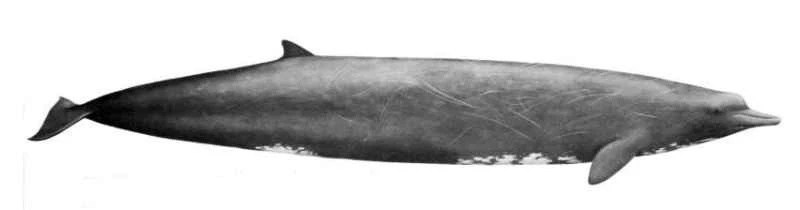
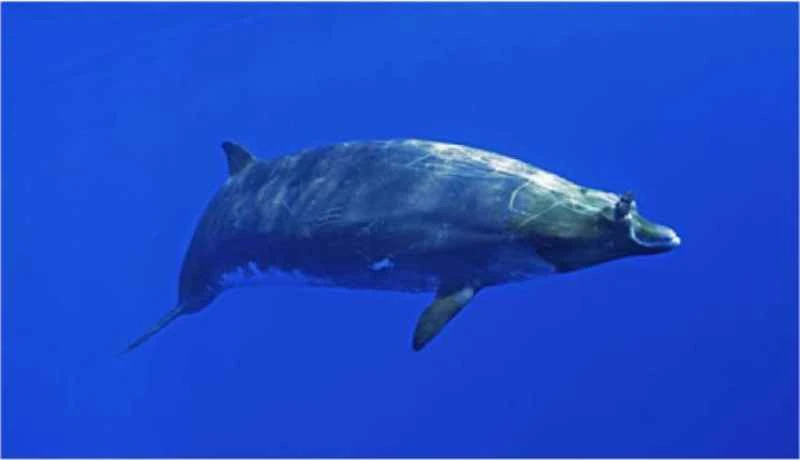
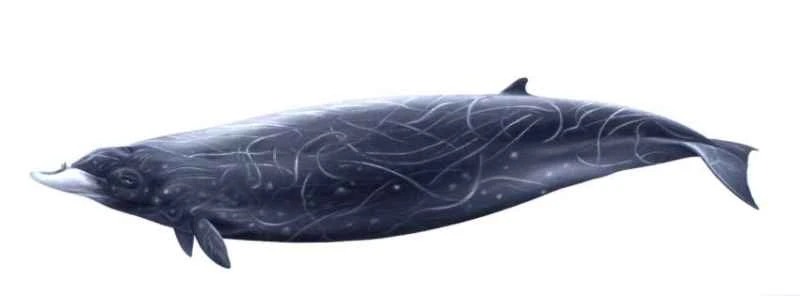
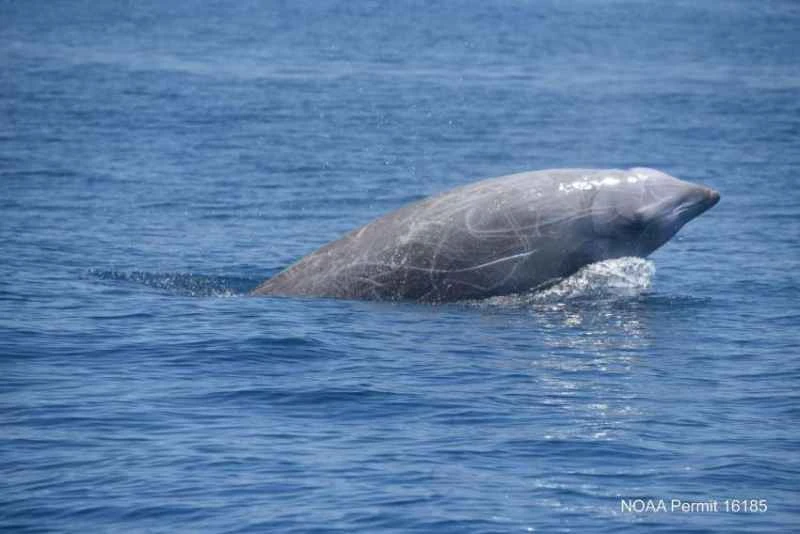
The body is spindle-shaped and more robust than many species of the genus *Mesobeaked*. Males are generally dark gray to nearly black, often with a lighter "saddle-shaped" patch on the mid-back, while females are more slate gray, with slightly lighter sides and belly. The head is low-set, with a short, thick snout and a prominent mid-section of the lower jaw. Two large, flat teeth protrude from the lower jaw in adult males, one of their most striking features. The dorsal fin is relatively small, located about two-thirds of the way down the body, and the tail fin is broad. Biscuit shark bite marks and linear scars are commonly seen on the bodies of both sexes.
Detailed introduction
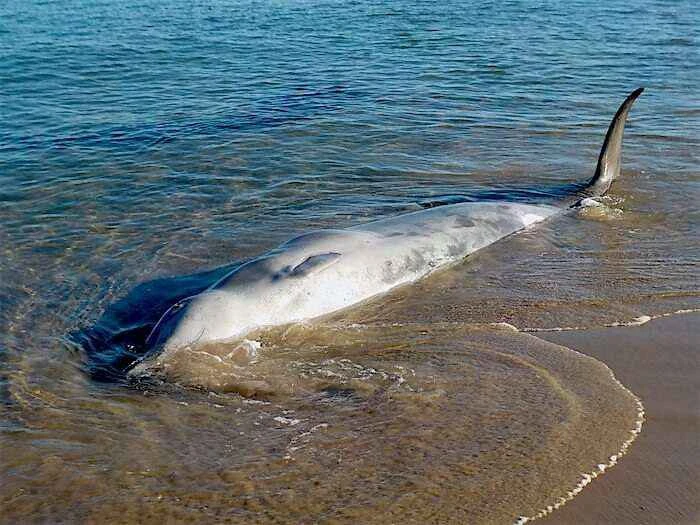
The Andrews' Beaked Whale ( Mesoplodon bowdoini ) is a medium-sized, extremely difficult-to-observe beaked whale belonging to the genus Mesoplodon in the family Beaked Whaleidae. It is considered one of the most mysterious whales in the world, with almost all reliable information about this species coming from anatomical records of stranded individuals in the Southern Hemisphere, rather than direct observations at sea.
Classification and nomenclature
Mesoplodon Andrews' beaked whale belongs to the class Mammalia, order Cetacea, suborder Odontoceti, family Ziphiidae, and genus Mesoplodon . This genus contains over 15 species of medium-sized, deep-diving beaked whales, most of which are shrouded in mystery and have limited records. Mesoplodon Andrews was first described in 1908 by American scientist Roy Chapman Andrews based on specimens stranded on a beach in Canterbury, New Zealand. Its specific epithet, bowdoini, is named in honor of George S. Bowdoin, a patron and trustee of the American Museum of Natural History. The commonly used Chinese name "安氏中嘴鲸" (Anshi Zhongzuijing) is derived from the surname of its author, Andrews.
Appearance features
Compared to many members of the beaked whale genus, the Ange's beaked whale is relatively robust, with a spindle-shaped body, the thickest part being the midsection of its torso. Adults are generally about 4–5 meters long, with females usually slightly larger than males. Newborn calves are about 2–2.2 meters long. The overall body color is dark; males are mostly dark gray to nearly black, often with a lighter "saddle-shaped" patch on the mid-back from the blowhole to the dorsal fin; females are usually slate gray, slightly lighter on the sides and belly. Males are often covered with long, thin white scratches, "battle scars" left by adult males in fights.
The head is relatively low-set, with a gentle melon and a short, thick snout. The anterior half of the lower jaw is distinctly raised in the middle. In adult males, two flat, broad teeth are located in the middle of the lower jaw, protruding outwards and may even be visible from outside the mouth when closed. This "protruding teeth" feature is one of the most distinctive identifying characteristics of this species. The dorsal fin is relatively small, located about two-thirds of the way down the body; the caudal peduncle is laterally compressed, and the caudal fin is relatively wide, adapted for deep diving and long-distance swimming. Bites from the "biscuit shark" (a type of carnivore) and various small abrasions are frequently visible on the body surface.
Distribution range and habitat
Anselm's beaked whale is believed to inhabit the cooler mid-to-high latitude waters of the Southern Hemisphere, possibly exhibiting a circumpolar distribution near the Antarctic Convergence. Almost all known records to date come from stranded individuals, with approximately half found off the coast of New Zealand, and the remainder distributed along the coasts of southern Australia (including Tasmania), Marquari Island, the Falkland Islands, Tristan da Cunha, and Argentina. Based on typical beaked whale ecology and the depth of their stranding sites, it is inferred that they typically inhabit deep-sea and marginal ocean waters at depths exceeding 200 meters, often diving deep to forage in remote, untouched waters far from the coast.
Lifestyle Habits and Behaviors
To date, there are no reliable and sustained observation records of wild populations of the Anglo-beaked whale, and even sightings of live individuals in the wild are extremely rare. Therefore, its social structure, migration routes, and daily behaviors remain largely speculative. Based on other members of the Anglo-beaked whale genus, this species likely lives in small groups, possesses the ability to dive for extended periods at great depths, and spends most of its time foraging in the mid- or deep waters, surfacing only briefly to breathe. The numerous linear scars on the bodies of adult males indicate intense male-male competition and tooth-fighting among them.
feeding habits
Analysis of the stomach contents of stranded individuals suggests that the Ange's beaked whale primarily feeds on deep-sea cephalopods, especially various mid-to-deep-water squid and cuttlefish, and may also consume a certain number of mid-to-deep-water fish. They likely use echolocation to locate prey in the dark, deep-water environment, utilizing their agile maneuvers to capture fast-moving small to medium-sized cephalopods, making them one of the important mid-water predators in the cold-water deep-sea ecosystems of the Southern Hemisphere.
Reproduction and life cycle
Almost nothing is known about the reproductive biology of the Anglo-Saxon beaked whale. Based on records of stranded mothers and calves in New Zealand waters, some scholars speculate that the peak birthing season likely occurs in late summer and autumn. Similar to other beaked whales, this species is likely to give birth to one calf at a time, with a gestation period of about one year. The mother gives birth and nurses the calf in open water. The calf is about 2 meters long at birth and then learns to dive and hunt with its mother. There is no definitive data on its natural lifespan, but it is generally estimated to be similar to other medium-sized beaked whales, reaching several decades.
Relationship with humans
The Anselzan's beaked whale has never been a primary target of traditional whaling, and there are almost no records of it being caught as a large-scale bycatch by fisheries. Direct human contact with it is extremely limited. Currently, the main way people "see" Anselzan's beaked whales is through stranding incidents: researchers learn about their basic characteristics by dissecting stranded individuals and measuring their bones and stomach contents. Therefore, this species is very unfamiliar to the public and is almost never seen in whale watching tourism. For ordinary people, it is more like "an unsolved mystery of the deep sea."
Protecting the status quo and threats
In the IUCN Red List, the Ange's beaked whale is currently rated "Data Deficient (DD)," meaning that the scientific community lacks sufficient data on its population size, trends, and threats. Although there is no direct evidence of severe hunting or bycatch pressure, like other beaked whales, it is likely sensitive to marine noise pollution (such as military sonar and large ship noise), marine environmental changes due to climate change, and plastic debris. With future advancements in deep-sea acoustic monitoring and marine survey technologies, it is hoped that a better understanding of the true situation of this mysterious beaked whale will be achieved, leading to the development of more targeted conservation measures.
Frequently Asked Questions
Q1: Why is it called "Angey's beaked whale"?
This species was first named by American scientist Roy Chapman Andrews in 1908 based on a stranded specimen in New Zealand. The Chinese name "安氏中嘴鲸" (Andrews's beaked whale) is taken from his surname, while the scientific name "Mesoplodon bowdoini" is named after the donor George S. Bowdoin.
Q2: Has the Anselm beaked whale really never been observed in the wild?
For a long time, this species was known almost entirely through stranded individuals, with reliable live observations at sea being extremely rare. Only after the 21st century were there a few suspected or brief observation records, thus it remains considered an "extremely mysterious" species in terms of behavior and ecology.
Q3: What do Anselm's beaked whales mainly eat?
Based on the analysis of the stomach contents of the stranded individuals, the Anselm beaked whale mainly feeds on deep-sea cephalopods (various mid-to-deep-sea squid and cuttlefish), and may also consume some mid-to-deep-sea fish, making it one of the important mid-water predators in the cold-water deep-sea ecosystem.
Q4: Are Anselm's beaked whales threatened by human activities?
Currently, there is a lack of direct evidence that it is being heavily hunted or bycatch, but similar to other beaked whales, it may be sensitive to underwater noise (military sonar, seismic exploration, etc.), marine pollution, and changes in food distribution caused by climate change. Due to insufficient data, the true extent of the threat it poses requires further research.