Basic Information
Scientific classification
- Chinese name: Giant Whale
- Scientific name: Globicephala (genus)
- Classification: Giant fish
- Family and Genus: Dolphinidae, Giant Whale
Vital signs data
- Body length: 3.5–7.5 meters (varies by species and sex)
- Weight: Approximately 1–3.5 tons
- Lifespan: Approximately 45–60 years (estimated, subject to population variation).
Significant features
Highly social; deep-diving squid hunting; matrilineal groups; strong community cohesion and collaborative foraging; occasional mass strandings.
Distribution and Habitat
Global temperate to tropical offshore waters and continental shelf margins, seamounts and frontal waters; the two species show significant latitudinal differences.
Appearance
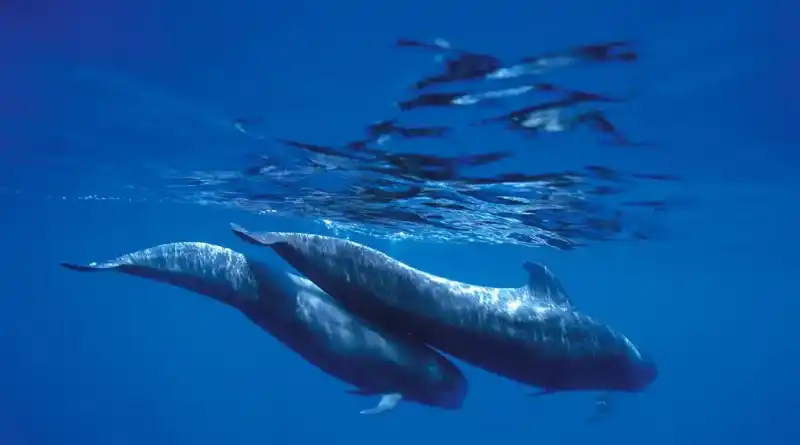
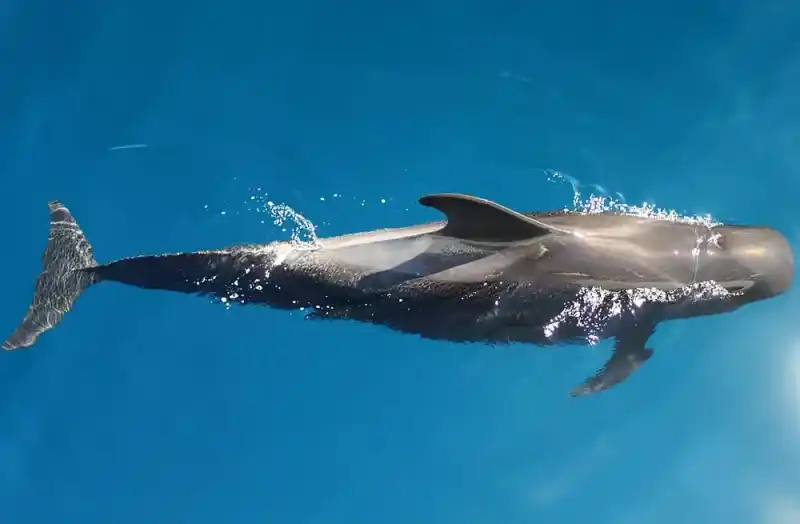
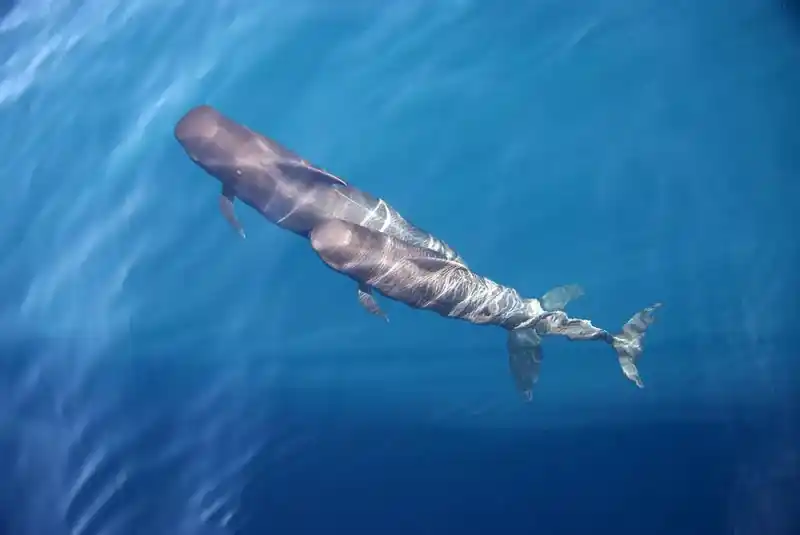
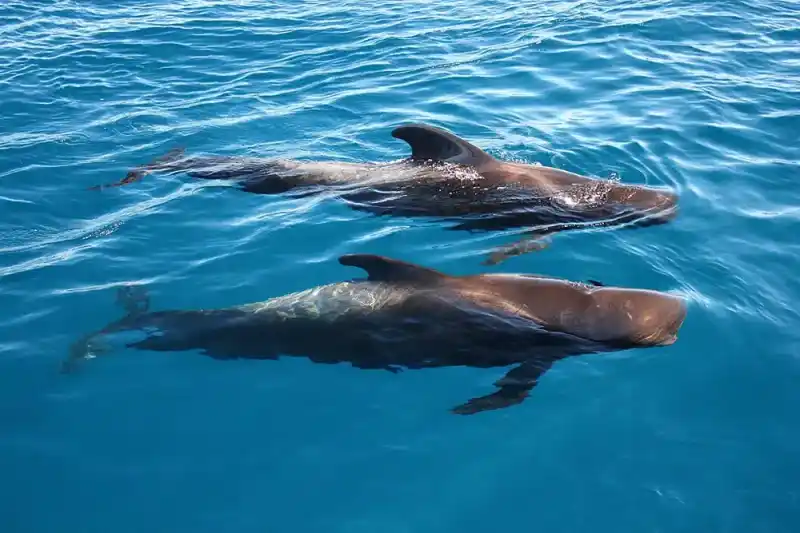
Head round and snout short; dorsal fin sickle-shaped and positioned forward; body dark gray to black, with saddle-shaped light spots commonly seen on the front of the chest/behind the dorsal fin; long-finned species have even longer pectoral fins.
Detailed introduction
The genus * Globicephala * belongs to the family Delphinidae and comprises two extant species: the long-finned pilot whale ( *G. melas* , commonly known as the long-finned pilot whale) and the short-finned pilot whale ( *G. macrorhynchus *). Both are highly social, deep-diving, medium to large toothed whales that hunt squid . They have rounded, swollen heads ("melon"), sickle-shaped dorsal fins located in the anterior third of their bodies, and typically live in matrilineal family groups , occasionally sharing hunting grounds with sperm whales and other whales.
Ecology and Behavior
Primarily preying on squid and mid-to-upper-level fish , they can dive to depths of hundreds of meters (see the species page for deeper records). They exhibit close social cooperation, sophisticated acoustic communication, and nurturing behaviors (e.g., "nanny whales"). They forage near the outer edge of the continental shelf, seamounts, and current fronts. Their social cohesion is extremely strong, and mass strandings are occasionally observed.
Morphology and Recognition
It measures approximately 3.5–7.5 meters in length and weighs approximately 1–3.5 tons; it has a round head and a very short snout; its dorsal fin is sickle-shaped (more pointed and high in short-finned species), and its pectoral fins are long (even longer in long-finned species with white markings commonly on the leading edge). Its body color ranges from dark gray to black, with light-colored "saddle-shaped" spots often present on the chest and above the back of the dorsal fin.
Distribution and species differences
G. melas (long-finned) : Mainly found in the North Atlantic and temperate-subpolar waters of the Southern Hemisphere; it has longer pectoral fins and is more cold-resistant.
G. macrorhynchus (short fin) : Widely distributed in tropical and subtropical regions worldwide; pectoral fins are relatively short, and the dorsal fin is more triangular/pointed.
Threats and Protection
Secondary catches and entanglement (longline fishing, drift gillnetting).
Ship noise and sonar can affect communication and navigation; there is also a risk of ship collisions in certain sea areas.
Nearshore hunting/hunting still occurs in a few areas (with a focus on local regulations and international concerns).
Pollution and prey shifts (persistent organic pollutants, biotoxins, climate variability).
Recommendations: Improvement of high-risk fishing gear and observer system, spatial and temporal management of key seamount/frontal feeding grounds, quiet vessel and speed control, grounding emergency network and rescue training.
Frequently Asked Questions
Q1: How to quickly distinguish between long-finned and short-finned pilot whales?
The long-finned species ( G. melas ) has longer pectoral fins and is adapted to temperate and cold seas; the short-finned species ( G. macrorhynchus ) has shorter pectoral fins and is distributed more in tropical and subtropical regions, and its dorsal fin is usually more pointed and higher.
Q2: Why did the mass stranding occur?
It is related to factors such as strong community, shallow bay topography, navigation inaccuracy, or acoustic interference; the specific causes are often a combination of multiple factors.
Q3: Will it be close to the coast?
They mostly operate in the open sea and along the edge of the continental shelf, but may also approach the coastline near seamounts, fjord mouths, or upwelling areas.
Q4: What is the protection level?
This page provides a general overview of the genus ( Globicephala ), which is "unassessed" overall; the IUCN classifications for each species differ (most are LC/NT), please refer to the species page for the most accurate classification.