Basic Information
Scientific classification
- Chinese name: Sperm whale
- Scientific name: Physeter macrocephalus
- Classification: Giant fish
- Family and genus: Sperm whale family, Sperm whale genus
Vital signs data
- Body length: females 8.5–12 meters; males 13–18 meters (large individuals can reach 20 meters).
- Weight: Female ~15 tons; Male ~30–50 tons (regional variations)
- Lifespan: Approximately 60–70 years
Significant features
Largest toothed whale; deep-diving squid hunting; matrilineal groups and male migrations; unique oblique jets; complex acoustic "dialects".
Distribution and Habitat
It is more common in the deep sea, near continental slopes and trenches; upwelling and seamount areas are also more productive.
Appearance
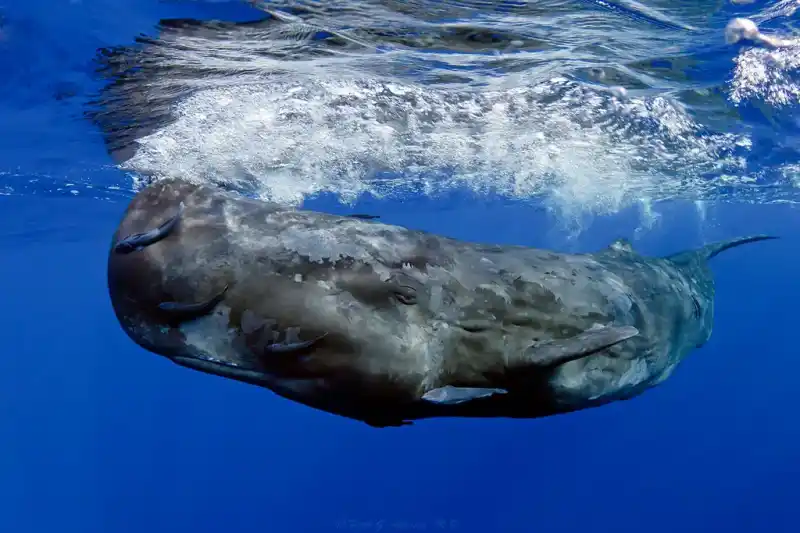
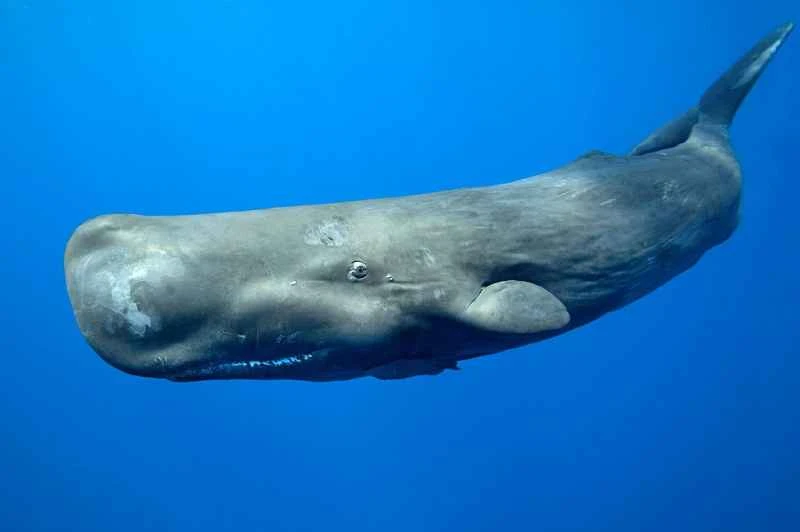
A large, square head; the dorsal fin is reduced to a small protrusion and the dorsal spine is wavy; the body is dark gray to blackish brown, often with sucker scars; the jet is ejected obliquely to the left front.
Detailed introduction
The sperm whale ( Physeter macrocephalus ) is the largest living toothed whale and one of the largest predators in the ocean, belonging to the family Physeteridae . Its massive, square head accounts for more than one-third of its body length and contains a highly developed spermaceti organ , used for sonar production and buoyancy regulation. Sperm whales are renowned deep-diving squid hunters , often diving to depths of 800–1200 meters (with extreme depths exceeding 2000 meters), and single dives can last 45–60 minutes or even longer. The IUCN classifies it as Vulnerable (VU) .
Ecology and Behavior
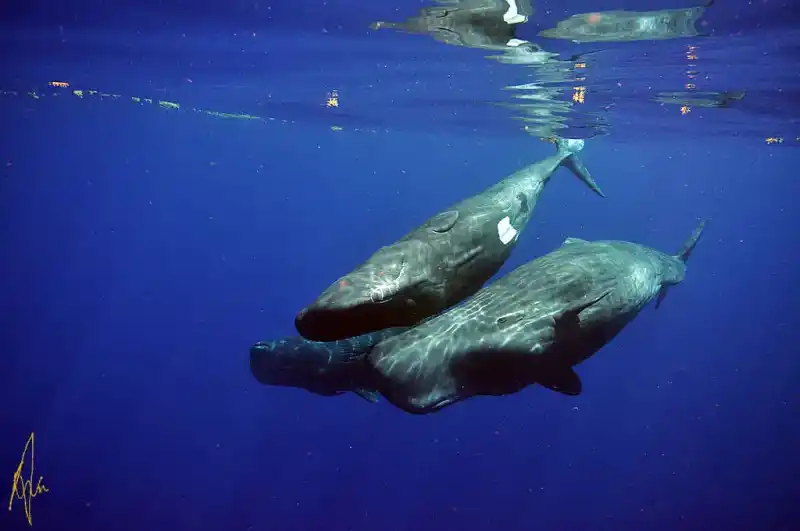
They primarily feed on medium to large cephalopods (squid, octopus), but also prey on fish. Females and calves form matrilineal family groups , with adult females cooperating in raising the young. Adult males are mostly solitary or live in small groups, migrating to higher latitudes as they age. Acoustically, they emit a series of "clicks" for echolocation and communication; different groups have unique " dialectal " rhythms.
Morphology and Recognition
The body is robust, with a large, square head; the dorsal fin is reduced to a small protrusion, and the posterior part of the back has a wavy ridge; the body color is dark gray to blackish-brown, often with abrasions and circular sucker scars. The lower jaw is slender and has rows of conical teeth (the upper jaw usually has no teeth exposed). The blowhole is located on the left front of the head, and the water jet is a characteristic oblique jet that is low and tilted forward at 15–20° .
Distribution and Habitat
Globally distributed in deep ocean and continental slope/trench waters, commonly found in high-productivity waters near upwelling currents, canyons, and seamounts; adult males are more common in high-latitude waters, while females and calves are more prevalent in tropical to subtropical regions.
Threats and Protection
Historical whaling impact : Large-scale commercial whaling in the past has led to a significant decline in whaling numbers.
Fishing gear entanglement and vessel collisions : Longline fishing, drift nets and busy waterways pose risks.
Underwater noise and blasting/seismic exploration : can interfere with sonar and foraging, and may alter habitat distribution.
Pollution and ingested debris : persistent organic pollutants, heavy metals, marine debris; ambergris is occasionally found to form in the gut.
Climate variability and prey variation : Influencing the abundance and distribution of deep-sea cephalopods.
Key measures include: improvement and detour pilot of high-risk fishing gear, speed and route management, marine noise assessment and mitigation, spatiotemporal dynamic protection of important habitats, and transnational collaborative stranding rescue networks and long-term population acoustic monitoring.
Frequently Asked Questions
Q1: What is the purpose of an air freshener?
It is mainly related to echolocation and sound-generating structures, and may also be involved in thermal/buoyancy regulation ; its waxy substance is "scented oil".
Q2: How deep and how long can it dive?
Common depths are 800–1200 meters, with extreme depths exceeding 2000 meters; single dives typically last 45–60 minutes, with records showing even longer durations.
Q3: What is ambergris?
The waxy masses ( ambergris ) that form in the intestines of some individuals have been used in human history for flavoring spices. The causes of their formation and the mechanisms by which they are excreted are still under investigation.
Q4: What is the group structure like?
Female calves live in maternal family groups, while adult males are mostly solitary or live in small groups and migrate to higher latitudes.