Basic Information
Scientific classification
- Chinese name: Red-eared Duck
- Scientific name: Pink-eared Duck, Malacorhynchus membranaceus
- Classification: Waterfowl
- Family and genus: Anseriformes, Anatidae, Red-eared Duck
Vital signs data
- Body length: 36-45 cm
- Weight: Approximately 375g
- Lifespan: No verification data available.
Significant features
It has a superb large beak and an extremely short tail, with a small patch of pink feathers behind its eyes.
Distribution and Habitat
It is distributed in Australia, mainly in the central, southwestern and southeastern regions.
Red-eared Shelducks are frequently found in woodlands near water sources in humid areas, particularly favoring shallow ponds. They typically make temporary stays in open freshwater or brackish water areas. Primarily inland birds, they are capable of long journeys to the coastal coast in search of water during years of severe drought.
Appearance
The Red-eared Shrike measures 36-45 cm in length and weighs 375 grams. This brown duck possesses a remarkably large beak and an exceptionally short tail, seemingly disproportionate to its small size. This is also the main distinguishing feature that makes it difficult to confuse with other ducks. Adults have several arched patches of color on their heads; the crown and neck are greyish-brown; the area around the eyes is dark brown extending to the back of the neck; the lores are white, and there is a narrow, circular white ring around the iris. Behind the eyes is a small patch of pinkish-red feathers, resembling ears, hence the name; the cheeks, sides of the neck, and breast are delicately grey; the belly is white, and the wings have many long, dark brown and white stripes; the tail is pale yellow with a brown tip, and the tail coverts are blackish-brown.
Detailed introduction
The Pink-eared Duck (scientific name: Malacorhynchus membranaceus) has no subspecies.
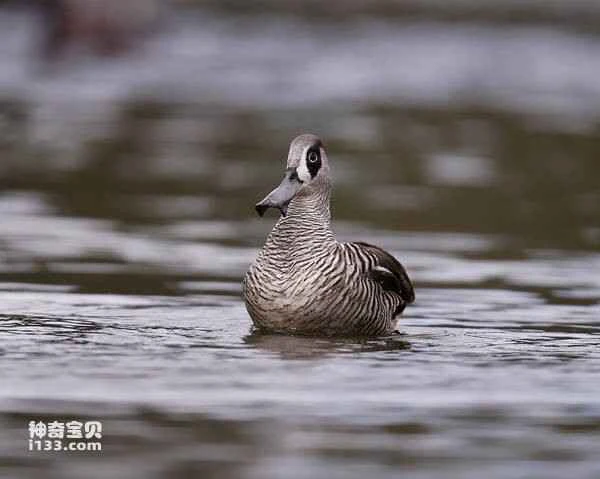
Red-eared Shelducks typically live in small flocks. However, in some important bird habitats, they also congregate in large groups, often mixed with other species, particularly grey herlders. When foraging, red-eared shelducks use their small, paddle-like bills—highly specialized leaf-like bills—to swish back and forth in shallow water, filtering plants and small animals; they even extend their entire heads and necks into the water. They spend very little time on land, perching on tree stumps along the shore.

Red-eared Ducks can breed year-round, provided there is sufficient rainfall. They are monogamous, and their pair bonds can last the entire breeding season. They build a large, covered, round nest in waterside grasses or tree cavities, and also utilize the old nests of other aquatic species, such as coots and moorhens. Sometimes they will even seize another species' nest, driving away the inhabitant and laying their own eggs there. Several species sometimes lay eggs in the same nest; 60 eggs have been found in a single tree cavity. Under suitable conditions, the female duck will typically lay 5 to 8 eggs very quickly. The female incubates the eggs for only 26 days.
Listed as Least Concern (LC) on the IUCN Red List of Threatened Species 2012 ver3.1.
Protect wild animals and ban the consumption of wild game.
Maintaining ecological balance is everyone's responsibility!