
Basic Information
Scientific classification
- Chinese name: Spotted Muscovy Duck
- Scientific name: Melanitta perspicillata, Surf Scoter
- Classification: Waterfowl
- Family: Anseriformes, Anatidae, Muscovy
Vital signs data
- Body length: 78-92 cm
- Weight: 907-992g
- Lifespan: No verification data available.
Significant features
The base of the beak has a large fleshy growth resembling a pom-pom; the male duck has large white patches of feathers on its forehead and back.
Distribution and Habitat
Country of origin: Canada, Mexico, Saint Pierre and Miquelon, USA.
Migratory birds: Belgium, Bermuda, Czech Republic, Denmark, Faroe Islands, Finland, France, Germany, Greenland, Guam, Iceland, Ireland, Japan, Netherlands, Norway, Poland, Portugal, Russian Federation (East Asia), Spain, Sweden, United Kingdom.
They typically choose habitats near lakes and ponds, and in northern forests, they appear in open areas such as coniferous forests and tundra. Except during winter or the breeding season, they linger in coastal waters and estuaries. During migration, they stop to rest at inland lakes.
Appearance
The Bar-headed Muscovy Duck measures 78-92 cm in length and has a wingspan of 78-92 cm. Females weigh 907 grams, and males weigh 992 grams. It is similar in size to the Black Muscovy Duck, but has a stronger head and a much larger bill with a large fleshy tuft at the base resembling a pom-pom. The male has large white patches of feathers on its forehead and back, visible from a distance. In summer and autumn, the white patches on the neck fade to disappear completely, reappearing in the depths of winter. The bill is composed of white and orange feathers, with a large black patch at the base. The female is slightly smaller, with dark brown plumage, a black upper head, grayish-white lower head, and brownish-black cheeks with two white patches.
Detailed introduction
The Surf Scoter (scientific name: Melanitta perspicillata) has no subspecies.
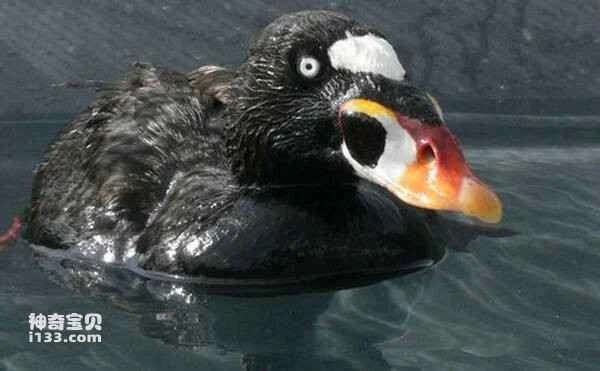
Every winter, the Bar-headed Muscovy Duck migrates to shallow waters along the Pacific coast, from the Aleutian Islands of Alaska to the Baja California Peninsula. From October to March, it is frequently seen in the bays of the Farallon Bay National Marine Reserve. It breeds in the northern forests of Canada and Alaska; winters along the eastern coast from Nova Scotia to Florida, and in the western coast from the Aleutian Islands to the southern coast of California.
The Bar-headed Muscovy Duck is a gregarious bird, active in flocks almost year-round. Sometimes, males and females flock separately. Females typically winter further north. They are commonly found swimming near coastlines and islands, and sometimes in inland freshwater lakes. They usually huddle together, swimming freely in flocks, though occasionally seen alone or in pairs. They swim quickly and gracefully, often with their tails held high. They are also excellent divers, able to remain submerged for over 30 seconds at a time. However, they have difficulty walking on land, appearing clumsy and unsteady. They are also very agile when taking off from the water, requiring minimal surface flapping for a run-up. Their flight is fast and powerful, usually low, flying close to the water's surface.
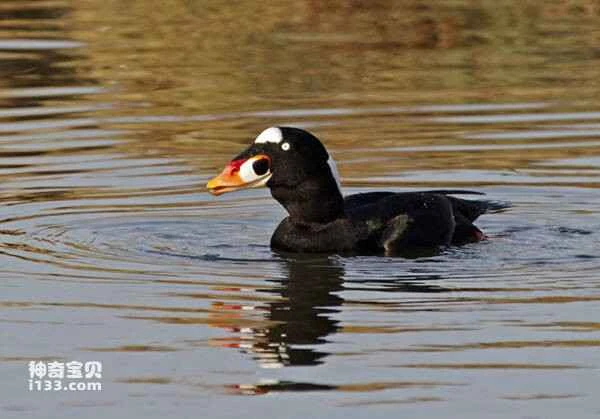
The Bar-headed Muscovy duck belongs to the diving duck family. It is an excellent swimmer and diver. Except during the breeding season, it is mostly found in the ocean. Its diet consists primarily of carnivores, with aquatic plants and seeds making up a smaller proportion of its diet. Like most seabirds, it dives to catch fish by hopping forward with its wings partially open, keeping its neck straight, and splashing water with its wings. It feeds on invertebrates and crustaceans, as well as insects such as beetles, flies, roundworms, spiders, and leeches. In winter, it returns to marine waters to prey on mussels, clams, herring, and crabs.
There is limited research on the Muscovy duck in North America. They nest in remote areas of Alaska and Canada, building sturdy, concealed nests in northern forests and tundra, typically within vegetation near shallow lakes, inaccessible to other organisms. Lined with grass and feathers, the female usually lays 5-7 white eggs, with an incubation period of 27-29 days. The ducklings can forage in the water immediately after hatching, but it takes them 55 days to become capable of flight. At this point, the female often abandons her young, returning to the nearshore waters to molt before she can fly again.
Listed as Least Concern (LC) in the IUCN Red List of Threatened Species 2016 ver 3.1.
Protect wild animals and ban the consumption of wild game.
Maintaining ecological balance is everyone's responsibility!


