Basic Information
Scientific classification
- Chinese name: Turbulent Duck
- Scientific name: Merganetta armata, Torrent Duck
- Classification: Waterfowl
- Family and genus: Anseriformes, Anatidae, Duck (Amur spp.)
Vital signs data
- Body length: 43-45 cm
- Weight: 330-440g
- Lifespan: No verification data available.
Significant features
Male ducks often have complex black and white stripes on their heads.
Distribution and Habitat
It is distributed along the Andes Mountains in South America, including Colombia, Venezuela, Ecuador, Peru, Bolivia, Argentina, and Chile.
They frequently appear in the rapids of the Andes Mountains, moving on exposed rocks and in the water amidst the swift currents and waterfalls. Their altitude is typically between 1500 and 3500 meters, but in Chile and Bolivia, they can reach as high as 4500 meters.
Appearance
The turkey is 43-45 cm long and weighs 330-440 grams. Its plumage varies not only between sexes but also according to the geographical distribution of its six subspecies. Males commonly have complex black and white stripes on their heads. They have contrasting black lores and white eyebrows, with a V-shaped black stripe down the forehead to the neck, flanked by two black eye stripes. The rest of the head and neck are white. The breast and wings have varying shades of blackish-brown and greyish-brown stripes, while the belly is blackish-grey. The wattles and scapulars are distinctive: sharp, long, and decorated with brown accents in black and white. The back, rump, and upper tail have fine grey and black spots. The tail feathers are long and greyish-brown. They have a green speculum. The primary flight feathers are blackish-brown-grey.
The most significant difference in female ducks is in their head, comb, cheeks, and neck; the area above the neck is almost entirely grey with very fine reticulate markings. The shoulder feathers are long and sharp with a black central section. The throat, foreneck, and underparts are brightly colored, a beautiful reddish-brown. The wings and tail are similar to those of the male duck.
The turkey duck is an excellent swimmer because of its powerful legs, streamlined body, and sturdy long tail.
Detailed introduction
The Torrent Duck (scientific name: Merganetta armata) has 6 subspecies.
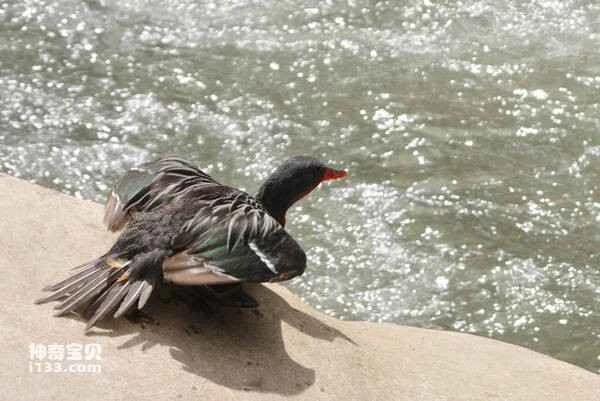
Both male and female ducks emit a piercing whistle. When flying over the water, the male duck's call is similar to 'Witi,' sometimes repeated and sometimes paused, loud enough to drown out the sound of the rushing water. The female duck's call is like a cry—'quiick,' more like a guttural sound, and its range is smaller.
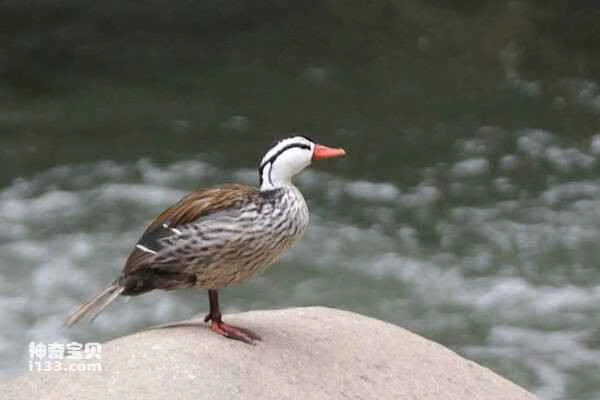
Torrent ducks have relatively stable and enduring mates. The breeding season varies considerably among subspecies. In equatorial regions, the breeding season is long, from July to November; in Peru, breeding occurs during the dry season, generally July and August; in Chile in the Southern Hemisphere, torrent ducks nest at low elevations and breed in the spring, around November. The female builds her nest on the riverbank, concealed among rocks and tree roots in dense vegetation, or in tree cavities or even old kingfisher burrows. Each nest typically contains 3 or 4 eggs. Incubation takes 43 or 44 days. Once hatched, these black and white ducklings follow their mother back to the turbulent river for a perilous journey. The ducklings possess remarkable stamina but are somewhat inexperienced and capable of climbing rocks.
Listed as Least Concern (LC) on the IUCN Red List of Threatened Species 2012 ver3.1.
Protect wild animals and ban the consumption of wild game.
Maintaining ecological balance is everyone's responsibility!