Basic Information
Scientific classification
- Chinese name: Brown Merganser
- Scientific name: Brazilian Merganser (Mergus octosetaceus)
- Classification: Waterfowl
- Family: Anseriformes, Anatidae, Mergansers
Vital signs data
- Body length: 49-56 cm
- Weight: No verification information available.
- Lifespan: No verification data available.
Significant features
It is one of the world's six most threatened waterfowl, with a total wild and captive population estimated at less than 250.
Distribution and Habitat
It is distributed in Argentina, Brazil and Paraguay.
They inhabit shallow streams, fast-flowing rivers, and surrounding clear seawater in dense tropical forests.
Appearance
The Brown Merganser measures 49-56 cm in length. It is a dark-colored merganser with a long, glossy, dark green comb; the female's comb is typically shorter. The upperparts are dark grey, the breast is light grey, and the belly is white, especially notable for the white speculum on the wings, which is very prominent in flight. It has long, serrated, reddish feet, and a black bill and legs. The female's bill is shorter and has a smaller cusp. Brown Mergansers are relatively slender, and the coloration is similar for both sexes. Juveniles are distinguished from adults primarily by their black and white throat and breast.
Detailed introduction
The Brown Merganser (scientific name: Mergus octosetaceus) has no subspecies.
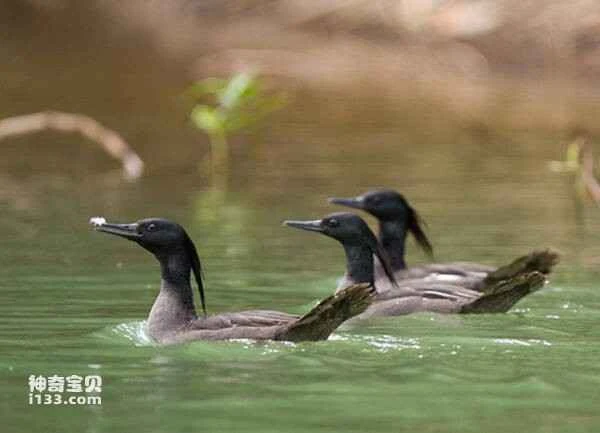
Brown Mergansers typically live in small groups. During migration and winter, they are occasionally seen alone. When swimming, they stretch their necks very straight, sometimes immersing their heads in the water and frequently diving. When resting, they mostly wander along the shore or roost on the sandy beach near the water. They fly fast and straight, with rapid wingbeats that often produce a clear flapping sound. Their takeoff is clumsy, requiring rapid wingbeats on the water's surface and a short run-up before they can take off. They are also excellent divers, able to swim underwater for 25-35 seconds at a time. They can also walk on land, often floating on the surface when resting. They hold their heads high and stretch their necks very straight. Sometimes they rest on the shore. They are also good at walking on land. When diving, like other mergansers, they first leap upwards before flipping and diving into the water. Their flight is fast and straight. Their takeoff requires a rapid wingbeat on the water's surface, appearing somewhat strenuous and clumsy. They are timid and alert.
The Brown Merganser primarily forages by diving, but sometimes it also dips its head directly into the shallow water near the shore to feed. They usually forage in small groups, swimming and diving simultaneously, but sometimes they disperse into groups of 2-3 or forage alone. Their diet consists mainly of small fish, but they also eat aquatic insects, insect larvae, crustaceans, mollusks, and other aquatic animals. Occasionally, they also consume small amounts of plant matter.
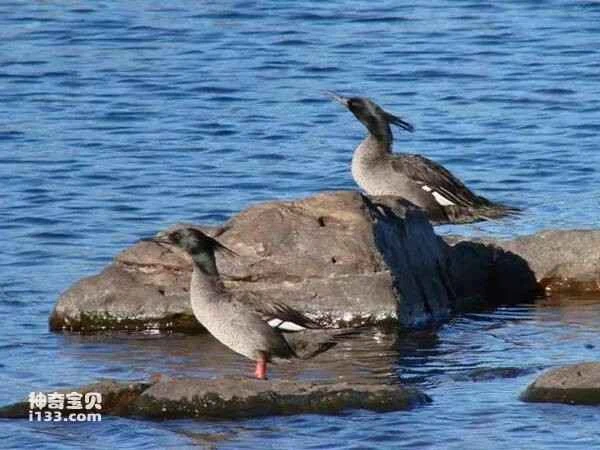
Listed as Critically Endangered (CR) on the IUCN Red List of Threatened Species 2012 ver3.1.
Protect wild animals and ban the consumption of wild game.
Maintaining ecological balance is everyone's responsibility!