Basic Information
Scientific classification
- Chinese name: Brown-billed Shepherd
- Scientific name: Puffinus gavia, Fluttering Shearwater
- Classification: Waterfowl
- Family and genus: Procellariiformes, Procellariiidae, Procellarii
Vital signs data
- Body length: 37 cm
- Weight: 230-415g
- Lifespan: No verification data available.
Significant features
The upper body is dark brown with a white spot on the back of the wing.
Distribution and Habitat
Breeding grounds: New Zealand.
Non-breeding: Australia.
Wandering: Antarctica and the Solomon Islands.
Seasonal uncertainty: New Caledonia and Norfolk Island.
This species is common and widespread, endemic to New Zealand. The largest colonies are found in the Three Kings Islands, Moturoya Islands, Motuharak Islands (Kavali Islands), northwest Cheeks Islands, Bloom Islands, Mokoshinau Islands, Channel Islands, Mercury Islands, Ruamavanui Islands (Aldeman Islands), and the Terio Islands, as well as several other islands in the Cook Strait. Some adults may still be present in February, migrating east and south to Australia, but most remain near their breeding grounds throughout the year.
They are often encountered near the coast, and sometimes even enter harbors. When breeding, they settle on well-vegetated islets with cliffs or rocky slopes, and nest in burrows under grasslands, bushes, or coastal forests.
Appearance
The Brown-billed Shearling measures 37 cm in length, has a wingspan of 76 cm, and weighs 230-415 grams. It is a medium-sized seabird, somewhat reminiscent of the Mediterranean Shearling or the Black Shearling. Its upperparts are uniformly dark brown, except for a white spot on the back (actually the side) of its wing. The underparts are white, except for a broad dark area at the wingtips. The species appears paler in worn feathers; during molting, a white band appears on the secondary coverts. It has a thin beak and a short tail. Its legs and feet are pink with darker banding. It can be confused with the Australian Shearling and sometimes forms mixed flocks. The Australian Shearling is slightly larger, and most importantly, has a significantly darker underside of its wings.
They all have tubular nostrils at the base of their beaks. Their wings are typically long and narrow, with a streamlined design, enabling them to travel long distances on the high seas, utilizing the wind and air movement generated by the waves to minimize effort and thus reduce energy consumption.
Detailed introduction
The brown-billed shearwater (scientific name: Puffinus gavia) has no subspecies.
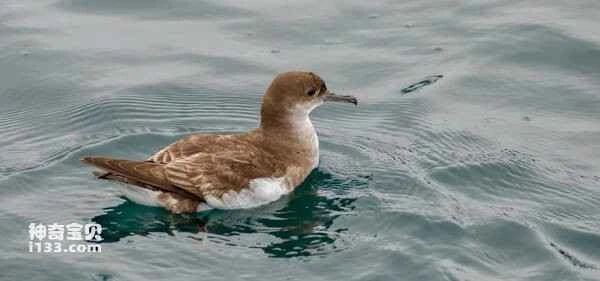
Brown-billed shelducks are very gregarious, often living in flocks with other gulls and seabirds. They fly fast, low, and directly, with rapid wingbeats and short glides. They effortlessly tumble and acrobatic in strong winds. Their flight is powerful, easy, and often spectacular. Their webbed feet allow them to swim and dive on the water's surface.
The most common sound heard at campsites from the brown-billed shearling is a rapid "ka-how ka-how ka-how ka-how kihik kihik kihik kihik irrrr". It primarily feeds on small fish, crustaceans, and some coastal krill, sometimes at the surface, sometimes with its head submerged, and even underwater, chasing prey.
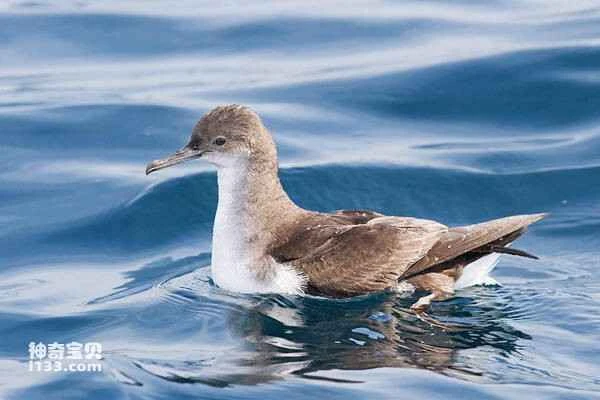
Brown-billed petrels breed on lush islets and rocky outcrops, nesting in burrows in grasslands, bushes, or coastal forests, but occasionally in rocky caves. The breeding season typically begins in September, with one egg per clutch, and the chicks emerge and leave the nest in late January or February.
In 2004, the global population of Brown-billed Shearlings was estimated at at least 100,000. The rationale for this trend is that the population is likely declining due to predation by invasive species. Brown-billed Shearlings have suffered significant losses due to the introduction of predatory mammals to their breeding islands. Thanks to the efforts of New Zealand authorities and conservation societies, at least 15 islands have been freed from these invasive mammals (primarily rats and cats). Attempts to establish a new breeding camp on a predator-free island (through transporting chicks) began in 1991; pairs successfully nested there as early as 1995.
Listed as Least Concern (LC) in the IUCN Red List of Threatened Species 2018 ver3.1.
Protect wild animals and ban the consumption of wild game.
Maintaining ecological balance is everyone's responsibility!