Basic Information
Scientific classification
- Chinese name: Australian sea lion
- Scientific name: Neophoca cinerea
- Order: Carnivora
- Family and Genus: Sealidae, genus *Lion*
Vital signs data
- Body length: Adult males are generally about 2.0–2.5 meters long, while females are about 1.3–1.8 meters long, with males being significantly larger than females.
- Weight: Adult males weigh approximately 200–300 kg or more, while females weigh approximately 60–110 kg.
- Lifespan: In the wild, lifespan can generally reach 15–20 years, and some individuals may live even longer.
Significant features
The only sea lion species in the world that breeds entirely within Australia, with a narrow distribution range, an exceptionally long breeding cycle (approximately 17–18 months), and a weak population recovery capacity, is therefore considered a threatened pinniped requiring close attention globally.
Distribution and Habitat
Highly localized, it is found only along the southern coast of Australia and nearby islands, extending from the south-central coast of Western Australia to South Australia and into Victoria. It primarily breeds and rests on relatively quiet rocky islands, beaches, and gravel beaches far from the mainland. At sea, it is mostly active on the continental shelf and its marginal waters, in depths ranging from a few dozen to a couple hundred meters.
Appearance
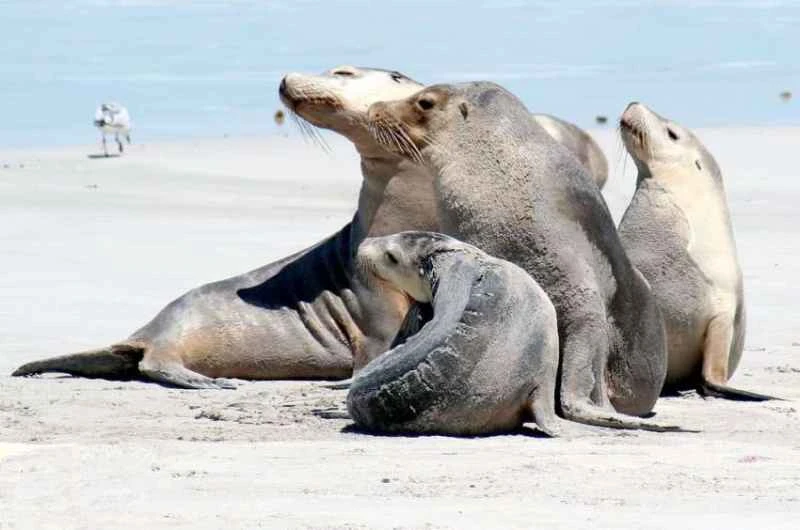
Medium to large in size, with a robust and sturdy body, prominent external ear flaps, and powerful forelimb flippers; males are darker in color, mostly chocolate brown or grayish-brown, with light-colored patches on their head and neck, and are large in stature with large heads and thick necks; females and juveniles are silvery-gray or light brown, with lighter abdomens, and are more slender in shape. Newborn calves are covered in dark downy fur, which gradually changes to light-colored downy fur.
Detailed introduction
The Australian sea lion (scientific name *Neophoca cinerea* ) is one of the world's most geographically limited pinnipeds and the only sea lion species that breeds entirely within Australia. Belonging to the family Ottogiidae, it is a medium to large marine mammal known for its unique breeding cycle, relatively small population size, and high endemicity. It is currently considered a threatened species globally.
Classification and nomenclature
The Australian sea lion belongs to the class Mammalia, order Carnivora, superfamily Pinnipedia, family Otariidae, and genus Neophoca . Currently, only one species is recognized as the Australian sea lion. It is closely related to sea lions such as the New Zealand sea lion, but differs significantly in morphology and ecological characteristics. Its scientific name, *Neophoca cinerea *, means "grey new seal," referring to the grayish-brown coat color of adults.
Appearance features
Australian sea lions are robust and sturdy, possessing typical sea lion characteristics: prominent external ears, strong and powerful forelimb flippers, and hindlimb flippers that can flip forward to support the body. Adult males are significantly larger than females, exhibiting distinct sexual dimorphism. Males typically reach 2.0–2.5 meters in length and weigh approximately 200–300 kilograms or even more, with large heads, thick necks, and well-developed shoulder muscles; females are approximately 1.3–1.8 meters in length and weigh approximately 60–110 kilograms, with a more slender body.
Body coloration varies with sex and age. Adult males are mostly dark chocolate brown or grayish-brown, with lighter yellowish-brown to cream-colored patches on the top of the head and back of the neck, forming a distinct "light-colored hood." Females and juveniles are generally lighter in color, with silvery-gray or light brown backs and sides, and a lighter, almost white belly. Newborn calves are covered in dark downy hair, which changes to light gray or light brown down after a few months. They have well-developed long whiskers, which are advantageous for sensing prey and their surroundings in murky waters.
Distribution range and habitat
Australian sea lions are a highly endemic species, with their natural distribution limited to the southern coast of Australia and adjacent islands, extending eastward from the south-central coast of Western Australia through South Australia to the waters near the border between South Australia and Victoria. Known breeding populations are primarily distributed on approximately 70 islands and reefs along the coasts of South and Western Australia, with notable breeding grounds including Seal Bay near Kangaroo Island and Dangerous Reef.
They typically choose rocky islands, beaches, and pebble beaches far from the mainland, in relatively quiet environments with minimal human interference, as breeding and resting sites. Their maritime range is mostly within the continental shelf and its marginal waters, with depths ranging from a dozen to a couple of hundred meters. Individuals can venture out to sea to forage tens or even hundreds of kilometers away from their breeding grounds, traveling between coastal and nearshore waters.
Lifestyle Habits and Behaviors
Australian sea lions spend most of their time foraging and swimming at sea, only coming ashore in large groups during the breeding season and molting period. Unlike most sea lions, Australian sea lions have a very unique breeding cycle—breeding only once every 17–18 months, and the breeding times of different populations are not synchronized, resulting in breeding activity being observed on some islands almost year-round. This "extended and staggered" breeding strategy makes their population recovery slower.
In breeding grounds, adult males establish territories and compete for mates through vocalizations, displays of physique, and intense physical confrontations. Females frequently dive into the sea to forage between giving birth and nursing their pups, then return to the beach to nurse them. Australian sea lions are adept divers and hunters, typically diving for several minutes at a time to depths of tens of meters or even exceeding 70 meters. When resting ashore, individuals often lie in groups on the sand or rocks, engaging in significant social interaction and vocal communication.
feeding habits
Australian sea lions are mesotrophic to hypertrophic predators with a diverse diet. Studies have found that they feed on a variety of nearshore and shelf fish, such as those from the orders Clupeiformes, Perciformes, and Gadiformes, as well as large numbers of cephalopods (squid, cuttlefish, and octopus), some crustaceans, and benthic invertebrates. They both chase schools of fish in the upper and middle layers of the ocean and ambush or search for prey on the seabed or near reefs.
Reproduction and life cycle
The most unique characteristic of Australian sea lions is their long and irregular breeding cycle. Unlike most sea lions that give birth once a year, they breed approximately every 17–18 months, and the breeding seasons between different populations can differ by several months or even nearly a year. Females typically give birth to one pup, which weighs about 6–8 kg at birth and can crawl on land and call out within hours. For a period after giving birth, females frequently travel between land and sea to nurse their pups and forage for food to replenish their energy; the weaning period can last for more than a year.
This slow-paced breeding strategy means that the Australian sea lion population has very limited growth potential, and recovery from high mortality rates or prolonged environmental stress will be extremely slow. Wild individuals typically live to be around 15–20 years old, with some females potentially living even longer.
Relationship with humans
Historically, Australian sea lions were heavily hunted for their fur and grease, leading to a sharp decline in their population in the 19th century and the destruction of many breeding grounds. While commercial hunting is now completely prohibited, human activities continue to have multifaceted impacts, including bycatch in fisheries, marine debris entanglement, disturbance from vessels, and habitat degradation due to nearshore development. On the other hand, Australian sea lions are also a significant ecotourism attraction in South and Western Australia, with sea lion viewing programs in places like Seal Bay attracting large numbers of tourists and generating economic benefits for the local communities.
Protecting the status quo and threats
According to the IUCN Red List, Australian sea lions are currently listed as "Endangered (EN)," with a total population estimated at only tens of thousands and showing an overall declining trend. Major threats include: bycatch and drowning from fishing activities such as bottom trawls and longline fishing; entanglement and injuries caused by discarded fishing gear and plastic waste; disturbance to breeding and resting grounds by tourism and boat activities; and fluctuations in sea temperature and food resources due to climate change. Conservation measures include establishing marine protected areas, modifying and restricting the use of certain fishing gear, regulating whale and sea lion watching tourism, and strengthening long-term monitoring of breeding populations.
Frequently Asked Questions
Q1: How are Australian sea lions different from other sea lions?
Australian sea lions are the only sea lion species that breeds entirely within Australia, with a very limited range. They also have an exceptionally long breeding cycle of about 17–18 months, which is extremely rare among sea lions and seals, making their population recovery capacity relatively weak.
Q2: Why are Australian sea lions listed as an endangered species?
Its total population size is small and its distribution range is narrow. Combined with historical hunting, extensive bycatch by fisheries and modern environmental pressures, the population has been in a vulnerable state for a long time. Scientific assessments indicate that the overall trend is declining, so it is listed as endangered (EN).
Q3: Where in Australia can you see wild Australian sea lions?
Seal Bay on Kangaroo Island in South Australia is one of the most famous viewing spots. In addition, there are ecotourism programs for sea lion watching on some islands and reserves off the coast of South and Western Australia, but these usually limit the distance and number of visitors to reduce disturbance to the breeding grounds.
Q4: What are the key measures to protect Australian sea lions?
This includes improving or restricting high-risk fishing gear to reduce bycatch and entanglement, establishing and managing marine protected areas, regulating tourism and vessel activities, reducing marine plastic and waste fishing gear pollution, and continuously monitoring population changes in various breeding populations to provide data support for developing more precise conservation strategies.