Basic Information
Scientific classification
- Chinese name: Australian fur seal
- Scientific name: Arctocephalus pusillus doriferus
- Order: Carnivora
- Family and genus: Sealidae, Genus: Seal
Vital signs data
- Body length: Adult males are typically about 2.0–2.3 meters long, while females are about 1.2–1.8 meters long, with distinct sexual dimorphism.
- Weight: Males weigh approximately 180–220 kg or more, and females weigh approximately 35–80 kg.
- Lifespan: In the wild, lifespan can generally reach 15–20 years, and a few individuals may live longer.
Significant features
One of the larger fur seals in the Southern Hemisphere, it mainly breeds on islands near the Bass Strait. Males have large heads, thick necks, and prominent manes. They are adept at deep diving and climbing reefs and are a signature marine mammal of the southern coast of Australia.
Distribution and Habitat
They are mainly distributed in the rocky islands, reef platforms and gravel beaches of the Bass Strait and its surrounding waters in southern Australia. Their breeding grounds are concentrated on several offshore islands in Victoria and Tasmania. During the non-breeding season, they can roam widely along the coasts of South Australia, New South Wales and Tasmania, mostly in waters tens to hundreds of meters deep near the nearshore shelf and continental slope.
Appearance
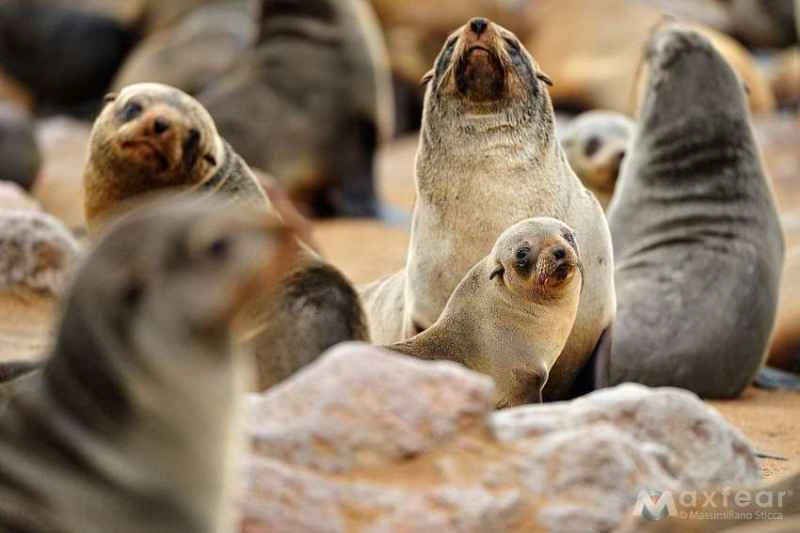
The body is robust and spindle-shaped, with a large head and thick neck, prominent external ear flaps, and robust forelimb flippers; the males have coarser, stiffer hair on their backs and shoulders, resembling a mane. The body color ranges from dark brown to grayish-brown, with a slightly lighter abdomen. The young are born with fur that is close to blackish-brown, which changes to light brown or silvery-gray down after a few months.
Detailed introduction
The Australian fur seal (scientific name *Arctocephalus pusillus doriferus* ) is one of the larger antherid marine mammals of the Southern Hemisphere, belonging to the genus *Arctocephalus* in the family Sealidae. It is a subspecies of the brown fur seal found in Australian waters, belonging to the same species as the South African fur seal found near the coast of Africa, but differing slightly in distribution, physical characteristics, and ecological habits. Today, the Australian fur seal is one of the most common large seals in the waters off southern Australia.
Classification and nomenclature
The Australian fur seal belongs to the class Mammalia, order Carnivora, superfamily Pinnipedia, family Otariidae, and genus Arctocephalus . Its scientific name is often written as *Arctocephalus pusillus doriferus* , and it is the Australian subspecies of the brown fur seal *Arctocephalus pusillus *, therefore it is sometimes collectively referred to as the "brown fur seal" or "African-Australian fur seal." The subspecies name "doriferus" is often used to distinguish it from the South African *A. p. pusillus* and the Australian *A. p. doriferus *.
Appearance features
Australian fur seals are robust and powerfully built, among the largest fur seals in the Southern Hemisphere. Adult males typically measure 2.0–2.3 meters in length and weigh over 180–220 kilograms; females measure 1.2–1.8 meters in length and weigh approximately 35–80 kilograms. Sexual dimorphism is very pronounced. Males have large heads, thick necks, and prominent shoulders and backs, with distinctive, coarse mane-like fur, giving them the appearance of a "sea lion." Females are relatively slender with more delicate necks.
The fur color is primarily dark brown to grayish-brown, with a darker back and sides, and a slightly lighter chest and abdomen; the overall color may appear slightly duller after the winter molt. Newborn pups have darker fur, close to blackish-brown, which changes to light brown or silvery-gray down after a few months. Unlike true seals, fur seals have prominent external ears, robust, fur-covered forelimb flippers, and hind limb flippers that can fold forward to support their bodies, allowing them to walk nimbly on land and climb rocks.
Distribution range and habitat
Australian fur seals are relatively concentrated, primarily found in the Bass Strait and surrounding waters of southern Australia. Breeding colonies are almost entirely located on nine islands in Victoria and Tasmania, with Seal Rocks in Victoria being one of the largest breeding grounds. Outside the breeding season, individuals roam a wider area, ranging from Kangaroo Island in South Australia to the surrounding areas of Tasmania and the southern coast of New South Wales. They prefer steep reefs, offshore rocky islands, reef platforms, and gravel beaches, but sometimes also gather to rest or breed on more open beaches.
Lifestyle Habits and Behaviors
Australian fur seals spend most of their time foraging and migrating at sea, only coming ashore in large groups during the breeding season and molting period. They are skilled swimmers and divers, easily climbing steep rocks and diving to depths typically ranging from tens to over a hundred meters, with some records exceeding 130 meters. Adult males establish territories at breeding grounds, using vocalizations, displays of strength, and physical contact to drive away competitors. The social structure of the group is relatively loose, but there is a strong bond between females and pups, who gather on land in kindergarten-like play groups.
feeding habits
Australian fur seals are mesophobic to trophic level predators, primarily feeding on fish and cephalopods. Studies show that their diet typically consists mainly of small, mid-to-upper-level fish, such as those in the orders Clupeiformes and Perciformes, followed by cephalopods like squid and cuttlefish. They also consume crustaceans and some large invertebrates. Individuals actively pursue prey on the seabed or in the upper and middle layers of the water, using their flexible forelimbs and powerful tails to maneuver quickly through complex reefs and seabed terrain.
Reproduction and life cycle
The breeding season for Australian fur seals primarily occurs between November and December. Males arrive at the breeding grounds early and establish small territories, followed by females giving birth. Each female typically gives birth to one pup per year, with newborns weighing approximately 4–7 kg and covered in dark downy fur. Shortly after giving birth, the female can mate again, but implantation is delayed, resulting in an actual gestation period of about one year. The pups nurse on land for several months before gradually learning to forage in the sea with their mothers. In the wild, individuals typically live to be 15–20 years old, with a few exceeding this age.
Relationship with humans
During the 18th and 19th centuries, Australian fur seals were overhunted for their fur and grease, nearly driving them to extinction. Since the 20th century, with the ban on commercial hunting, their population has gradually recovered, now reaching tens of thousands, though still below historical levels. In recent years, regular seal-watching tours have emerged in several coastal areas of southern Australia, allowing tourists to observe seals in groups near their breeding grounds from boats or viewing platforms. However, conflicts also exist between them and coastal trawlers, such as bycatch due to accidental entry into nets and the perception of seals as "pests" when competing for fish.
Protecting the status quo and threats
Globally, the Australian fur seal (including the Australian subspecies) is generally classified as "Least Concern (LC)" on the IUCN Red List, indicating that its overall population is currently relatively stable. However, in some Australian waters, the Australian fur seal still faces potential impacts from bycatch, marine debris entanglement, coastal habitat disturbance, and climate change on marine productivity and prey distribution. In some regions (such as New South Wales), it is also listed as a regionally vulnerable or concerned species. Continuous monitoring of breeding ground populations, improving fishing gear design to reduce bycatch, controlling nearshore pollution, and maintaining appropriate distances and regulated viewing practices during tourism activities are important directions for the future conservation of the Australian fur seal.
Frequently Asked Questions
Q1: Are Australian fur seals and South African fur seals the same species?
Both belong to different subspecies of the brown fur seal Arctocephalus pusillus : the South African fur seal is A. p. pusillus , and the Australian fur seal is A. p. doriferus . They differ slightly in size, distribution, and detailed characteristics, but belong to the same species.
Q2: Why were Australian fur seals once on the verge of extinction?
During the 18th and 19th centuries, the species suffered from prolonged and large-scale commercial hunting due to the high value of its fur and oil, resulting in severe damage to many breeding grounds. The population only began to slowly recover after hunting was gradually banned in the early 20th century.
Q3: Where can you see wild fur seals in Australia now?
Relatively stable breeding populations exist in the waters surrounding Victoria and Tasmania, such as near Phillip Island, Seal Rocks, and some islands in the Bass Strait. Many coastal towns offer ecotourism programs involving boat trips to observe seals and seabirds.
Q4: What are the main threats currently facing Australian fur seals?
These threats primarily include bycatch and injuries resulting from trawling and other fishing activities; entanglement caused by plastic ropes and fishing gear; disturbance of breeding and resting grounds by nearshore tourism and engineering projects; and changes in seawater temperature and prey distribution that may be caused by climate change. Strengthening the construction of marine protected areas and fisheries management will help reduce these threats.