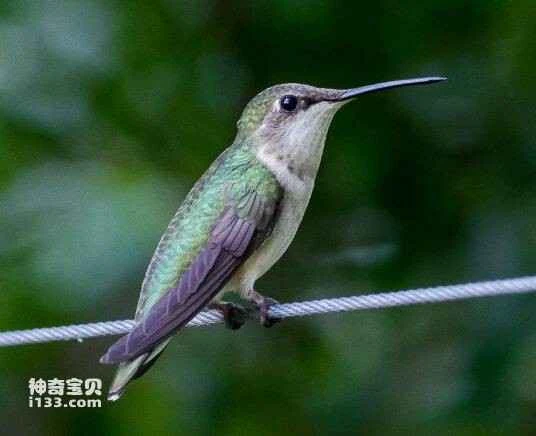
Basic Information
Scientific classification
- Chinese name: Madagascar woodpecker
- Scientific name: Picumnus innominatus, Speckled piculet
- Classification: Climbing birds
- Family and genus: Order Vulpecula, Family Woodpeckers, Genus *Pterygodon*
Vital signs data
- Body length: 9.6-11 cm
- Weight: 10-16g
- Lifespan: No verification data available.
Significant features
Distribution and Habitat
Global distribution: Found from Himalayan countries to Assam, India, Myanmar, Thailand, the Indochina Peninsula, and Indonesia.
Distribution in China: It is distributed in provinces south of the Yangtze River, extending north to southern Gansu, southern Shaanxi and southern Henan, and south to Sichuan, Guizhou, Yunnan and southeastern Tibet.
The Spotted Woodpecker inhabits evergreen or deciduous broad-leaved forests in low mountains, hills, and plains below 2000 meters in altitude, and also appears in mixed forests and coniferous forests in mid-mountain areas. It particularly prefers to be active in open sparse forests, bamboo groves, and forest edge thickets.
Appearance
The male has a chestnut or smoky brown forehead and nape, with orange-red markings on the front of the crown and black feather bases. The back and uppertail coverts are olive-green; the wings are dark brown with yellowish-green edges and nearly white wing edges; the uppertail coverts and inner flight feathers are the same color as the back. The tail feathers are black, with the inner side of the central pair white or yellowish-white, and the outer three pairs having broad, oblique white or pale yellowish-white subterminal bands. A white stripe begins from the lores and extends above and below the eye to the side of the neck. The ear coverts are chestnut brown. The chin and throat are nearly white, speckled with round, dark brown spots; the rest of the underparts are pale greenish-yellow or buff-white. The breast, upper abdomen, and flanks are covered with large, round black spots, which become horizontally banded on the hind flanks and undertail coverts. The black spots on the middle of the abdomen are indistinct or absent.
The female and male are similar, but the front of the head is not adorned with orange-red, but is a single chestnut or smoky brown.
The iris is brown or reddish-brown, and the mouth and feet are lead-brown or grayish-black.
Size measurements: Weight: males 10-16 grams, females 12-16 grams; Body length: males 96-110 mm, females 97-107 mm; Bill length: males 10-12 mm, females 10-12 mm; Wing length: males 55-61 mm, females 55-59 mm; Tail length: males 30-36 mm, females 30-34 mm; Tarsus length: males 11-14 mm, females 13-14 mm.
Detailed introduction
The scientific name of the spotted woodpecker is Picumnus innominatus, and its foreign name is Speckled piculet. Its specific habits are unknown.
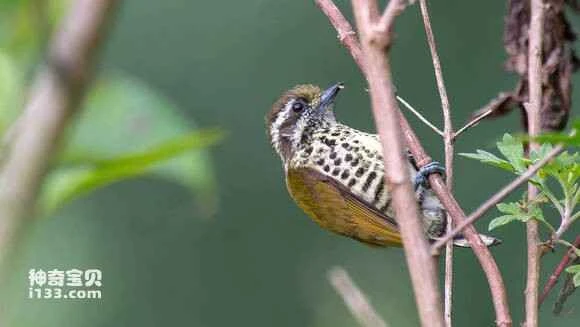
The spotted woodpecker is usually solitary, foraging mostly on the ground or branches, and rarely climbs tree trunks like other woodpeckers. It primarily feeds on ants, beetles, and other insects.
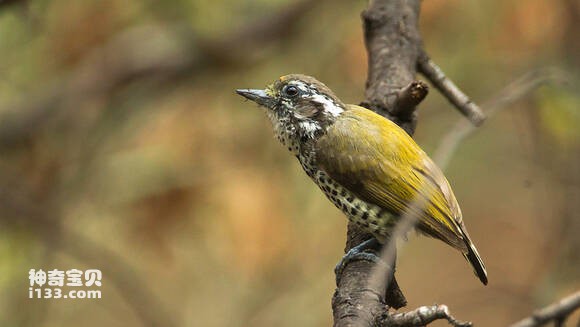
The breeding season for the Spotted Woodpecker is from April to July. They nest in tree cavities, laying 3-4 eggs per clutch. The eggs are white, oval or nearly round in shape, measuring 13-16 × 11-13 mm, with an average size of 15 × 12 mm. Both parents take turns incubating the eggs.
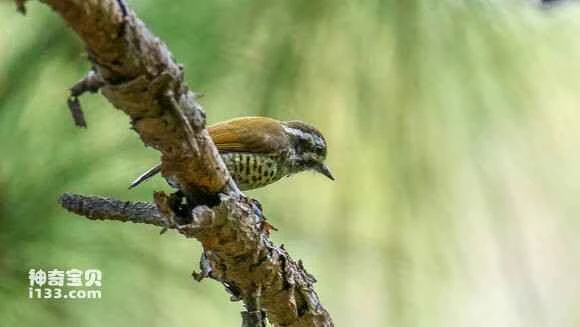
The Madagascar woodpecker is a resident bird. Its population is small and should be strictly protected.
It is listed in the "List of Terrestrial Wild Animals of Beneficial or Important Economic and Scientific Research Value under State Protection" issued by the State Forestry Administration of China on August 1, 2000.
Listed as Least Concern (LC) on the IUCN Red List of Threatened Species 2012 ver 3.1.
Protect wild animals and ban the consumption of wild game.
Maintaining ecological balance is everyone's responsibility!