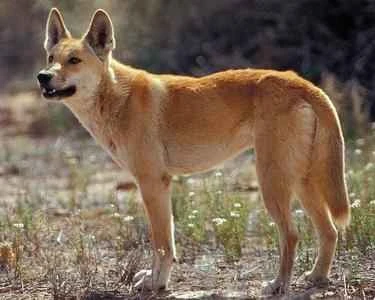
Basic Information
Scientific classification
- Chinese name: Albatross
- Scientific name: Royal Albatross, also known as the Royal Albatross, is a species of sea swallow.
- Classification: Waterfowl
- Family and genus: Proteromorpha, Albatrossidae, *Albatross*
Vital signs data
- Body length: 110-135 cm
- Weight: 7-8kg
- Lifespan: 20-30 years
Significant features
Capable of flying thousands of miles in a single day, it can be considered the champion of flight among birds, and has a record of circumnavigating the globe.
Distribution and Habitat
They are distributed in South America (including Colombia, Venezuela, Guyana, Suriname, Ecuador, Peru, Bolivia, Paraguay, Brazil, Chile, Argentina, Uruguay, and the Falkland Islands), Australia and New Zealand (including Australia, New Zealand, Tasmania and their surrounding islands), and Antarctica (including the Antarctic continent, the Antarctic Peninsula, and several islands such as the South Shetland Islands and South Georgia Island).
Appearance
Body length 110–135 cm; wingspan 250–350 cm. Feathers white with dark wingtips; females are white with dark eyebrows, back, wing fronts, and tail, and are one of the largest birds.
Detailed introduction
The Royal Albatross, scientifically known as *Diomedea epomophora*, is a large seabird.
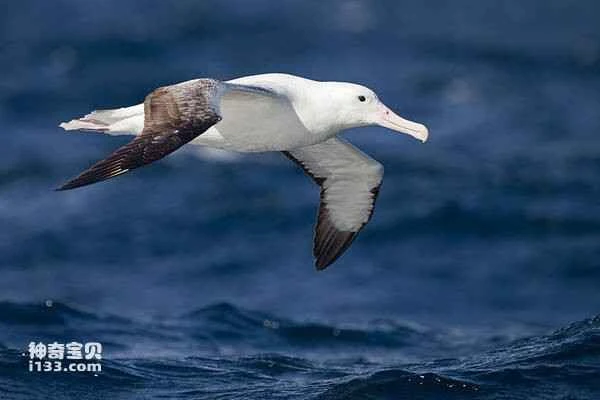
Cuttlefish, fish, shrimp, and crabs are the albatrosses' primary food source, and they also have a strong appetite for leftovers discarded by ships (such as dead fish and animal entrails). Therefore, they often follow ships in circles, sometimes soaring into the sky to catch aerial prey, and sometimes diving close to the towering waves to hunt for food.
In early October, albatrosses build nests and lay eggs on the riverbanks of islands. At this time, they do not shy away from people. From late October to early November, each female lays only one egg, which averages 11.6 cm in diameter and weighs about 370-390 grams. Both parents take turns incubating the eggs for more than 60 days. The chicks hatch with a coat of light downy feathers. After the downy feathers fall off, they grow a thick coat of curly feathers.The chicks receive digested fat and semi-digested food from their parents. After five months of careful nurturing, they grow strong feathers and are able to leave the nest to live independently in the wind and waves. The young birds begin to reproduce when they are 5-8 years old and can generally live for 20-30 years.
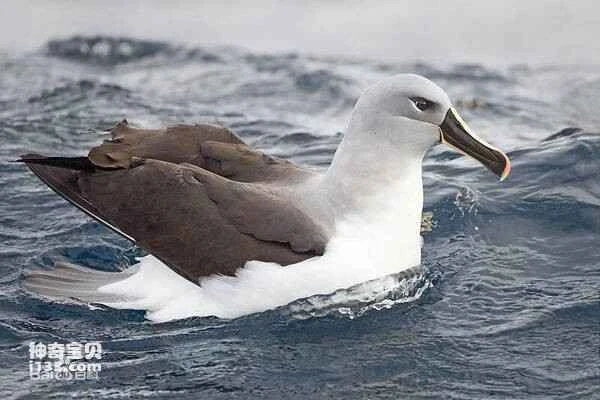
Ornithologists estimate that at least 10 million albatrosses have been killed in just 50 years, becoming extinct in many seas. In 1960, at the International Bird Conservation Conference held in Tokyo, Japan, the albatross was listed as an internationally protected bird.
Protect wild animals and ban the consumption of wild game.
Maintaining ecological balance is everyone's responsibility!