Basic Information
Scientific classification
- Chinese name: Darwin's frog
- Scientific name: Rhinoderma darwinii
- Order: Anura
- Family and genus: Rhinostomidae (beaked snout frog family), Rhinostomus (beaked sn
Vital signs data
- Body length: 2.2–3.5 cm
- Weight: Approximately 2–4 grams
- Lifespan: Estimated 5–10 years in the wild
Significant features
The male frog uses its sac to nurture larvae; it has a nasal protuberance at the tip of its snout; it inhabits near streams in temperate forests; and it exhibits camouflage and feigning death behaviors.
Distribution and Habitat
Temperate broadleaf forests in southern Chile and southwestern Argentina are surrounded by leaf litter, moss, and decaying wood, near clean streams and seepage zones.
Appearance
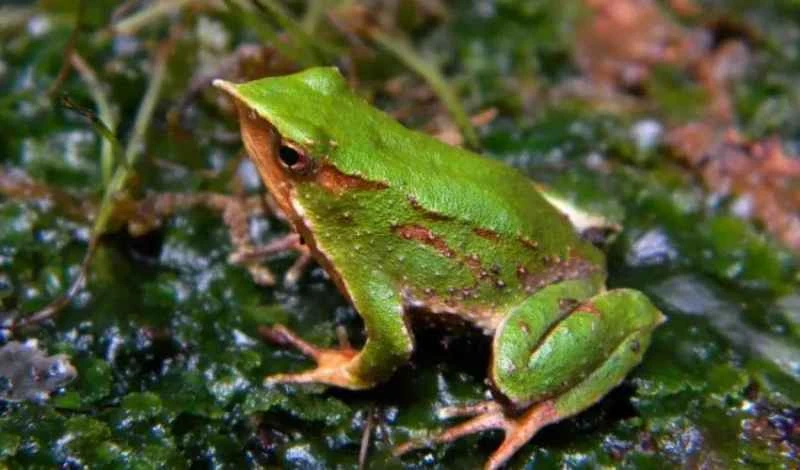
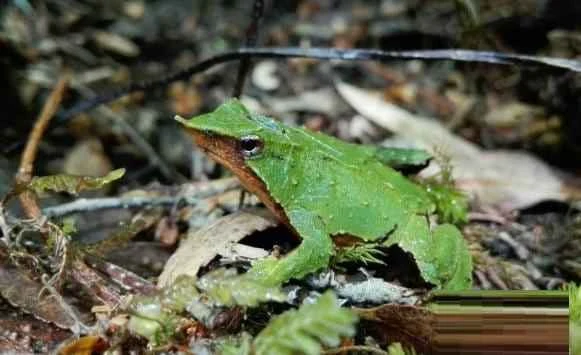
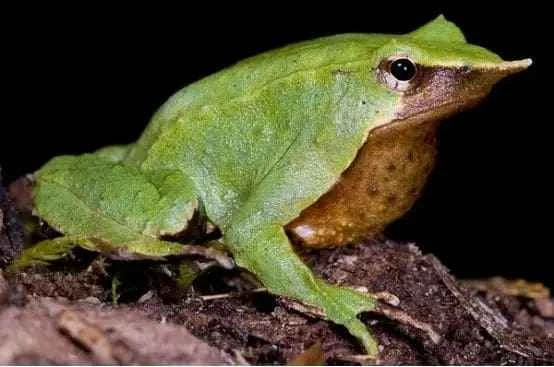
Its back is greenish-brown/dried leaf-colored with mottled markings; its abdomen has black and white markings; its snout is small and protruding, and its eyes are large; its body is small.
Detailed introduction
Darwin's frog ( Rhinoderma darwinii ) is a small, terrestrial frog found in the temperate forests of southern Chile and southwestern Argentina. It is known for the male's unique method of raising its young—"sound sac nurture" : after fertilization, the male sucks the hatched tadpole into its mouth and places it inside the sound sac to continue developing until metamorphosis, at which point it "regurgitates" the tadpole from its mouth. This species is declining due to habitat degradation, disease, and human disturbance, and is assessed as Endangered (EN) by the IUCN.
Basic Information
Scientific name: Rhinoderma darwinii
Body length: 2.2–3.5 cm for adults (females are slightly larger)
Weight: Approximately 2–4 grams (individual variations)
Identification: The snout has a small nasal protrusion , the back is mostly greenish-brown or withered leaf color, and the belly has black and white patterns resembling a checkerboard.
Ecology and Behavior
They are mostly found in broad-leaved forests, around leaf litter, moss, and decaying wood, near clean streams and seepage zones; they feed on small invertebrates. Their calls are weak, and they often feign death when startled. During the breeding season, the male frog guards the eggs and sucks the hatched tadpoles into its vocal sac to complete their development (about 6–8 weeks).
Threats and Protection
Habitat loss and fragmentation: forest clearing, introduction of pine and eucalyptus afforestation and road development leading to decreased understory humidity and stream pollution.
Disease: Chytrium dendrobatidis may cause localized disappearance.
Invasive species and disturbances: Historical impacts of tourist trampling, harvesting, and the pet trade.
Conservation recommendations: Establish buffer zones for key habitats, restore native forests and understory wetlands, monitor chytrid fungus, strictly control collection and trade, and strengthen community education and ecotourism regulations.
Frequently Asked Questions
Q1: Where does the name Darwin's frog come from?
It is named after Darwin's description of the frog's unique morphology during his South American expedition.
Q2: How do male frogs "orally breed" their offspring?
After fertilization, the male frog sucks the egg into its mouth when it hatches into a tadpole and moves it into its vocal sac to continue developing until the tadpole is fully metamorphosed and then released.
Q3: What is the relationship with the "rough-skinned Darwin's frog" ( R. rufum )?
R. rufum is another species in the same genus that has not been seen for many years and is classified as critically endangered/possibly extinct; this entry focuses on R. darwinii .