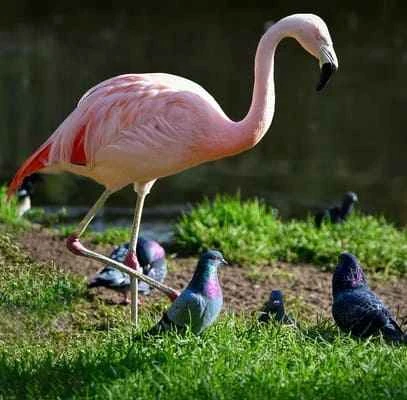
Basic Information
Scientific classification
- Chinese name: Chilean Flamingo
- Scientific name: Phoenicopterus chilensis
- Classification: Wading birds
- Family and genus: Flamingo family, Flamingo genus
Vital signs data
- Body length: approximately 100–145 cm; wingspan ~140–165 cm
- Weight: Approximately 2.5–3.5 kg (regional variation)
- Lifespan: 20–30 years in the wild; even longer in captivity.
Significant features
Inverted filter feeding; breeding in colonies in salt lakes/lagoons; mud-platform nests and chick nurseries; seasonal migration across wetlands.
Distribution and Habitat
High-altitude salt lakes and coastal lagoons/estuaries in Chile, Argentina, Bolivia, Peru, Paraguay, Uruguay, Brazil, and other countries.
Appearance
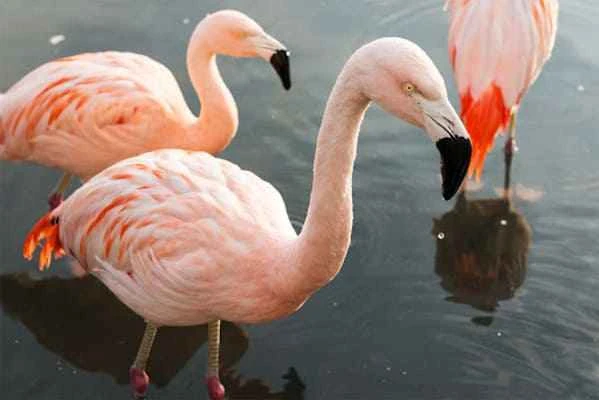
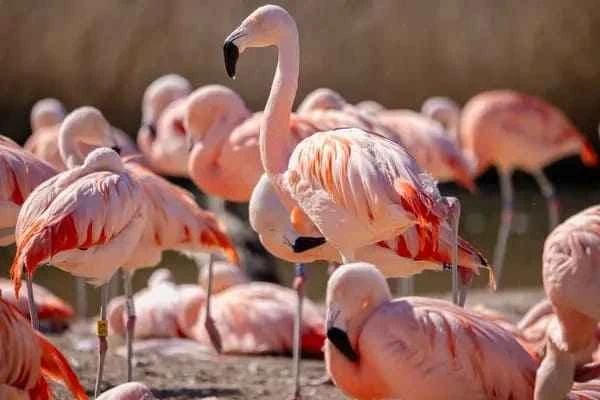
Light pink body feathers, black primary flight feathers; downward-curved beak with pink base and black tip; legs gray to pink, iris pale yellow.
Detailed introduction
The Chilean flamingo ( Phoenicopterus chilensis ) is a large wading bird of South America, known for its pale pink to rose-colored plumage and long neck and legs. It is mainly distributed in Chile, Argentina, Bolivia, Peru, Paraguay, Uruguay, and Brazil, forming breeding and foraging flocks in high-altitude salt lakes and coastal lagoons/estuaries. It is assessed as Near Threatened (NT) by the IUCN.
Ecology and Behavior
Primarily a filter feeder , they use the lamellae on the edge of their beak to filter water upside down, feeding on algae, diatoms, zooplankton, and small crustaceans; they often share the same habitat as Andean flamingos and little flamingos. They breed by nesting in colonies in exposed areas of salt lakes, building mud nests that are small, round platforms. They typically lay one egg, and the chicks are collectively cared for in a "nursery."
Morphology and Recognition
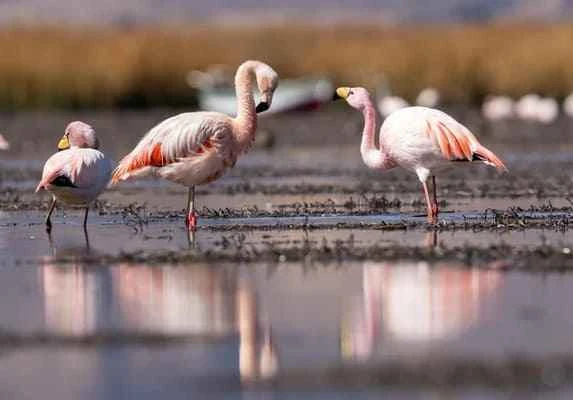
The body is pale pink, with even pinker wing coverts and black primary flight feathers; the legs are grey-pink (unlike the brighter red lesser flamingo), the beak is pink with a black tip and a distinct downward curve; the iris is pale yellow. Compared to the lesser flamingo, it is larger and lighter in color; compared to the Andean flamingo, its legs are greyer and the black tip of its beak is more pronounced.
Threats and Protection
Wetland loss and drying: Mining and water resource development (including lithium brine extraction), damming and water extraction lead to changes in salt lake water level and salinity.
Human interference and infrastructure: tourist disturbances, off-road vehicles, aerial photography; collisions caused by power lines and fences.
Pollution and climate variability: Heavy metals, pesticides and extreme drought/floods affect reproductive success and food supply.
Key actions include: ecological management of water levels/volumes in salt lakes and lagoons, environmental review and mitigation of mining projects, power line identification, breeding ground buffer zones and seasonal visit restrictions, and cross-border monitoring (Chile-Argentina-Bolivia, etc.).
Frequently Asked Questions
Q1: How to distinguish it from the Lesser Flamingo/Andean Flamingo?
Chilean flamingos are larger and lighter in color overall; their feet are grayish-pink, and their beaks have a pink base with a black tip. Little flamingos are smaller, darker in color, and have redder feet; Andean flamingos have yellowish legs and different beak color distribution.
Q2: Why is it rated as Near Threat (NT)?
Highland salt lakes are significantly affected by mining and water resource development, and coupled with climate variability and disturbance, many breeding grounds have been unstable for a long time.
Q3: How do they eat?
The beak is placed upside down in the water, and algae and small zooplankton are filtered out using the teeth and tongue pump.