Basic Information
Scientific classification
- Chinese name: Australian Wild Dog
- Scientific name: Dingo, Australian Wild Dog, Australian Wild Dog
- Order: Carnivora
- Classification: Australian dingo, genus Canis, family Canidae, order Carnivora
Vital signs data
- Body length: 81-111 cm
- Weight: 11-22 kg
- Lifespan: 10-15 years
Significant features
A dog breed that was never fully domesticated [citation needed]. One reason is that they lived in remote, isolated areas, and another is due to less human intervention. They lack equidistant teeth and a shortened muzzle, features that distinguish them from other dogs and their ancestor, the Iranian wolf. Like wolves, female Dingo dogs have only one breeding season per year.
Distribution and Habitat
The dingo population is not limited to Australia; it is also found in China, Myanmar, Vietnam, Thailand, the Philippines, Cambodia, India, Laos, Indonesia, Malaysia, and Papua New Guinea. Wild populations primarily inhabit various parts of Australia, with some scattered communities in other parts of Southeast Asia and New Guinea.
Inhabiting a variety of environments, including tropical alpine swamps above 3,800 meters, as well as tropical forests, grasslands, meadows, deserts, plateaus, and wetlands, they are highly adaptable, with some even venturing near villages. They are found throughout the snow-capped peaks covered in temperate forests of eastern Australia and the arid deserts of central Australia.
Appearance
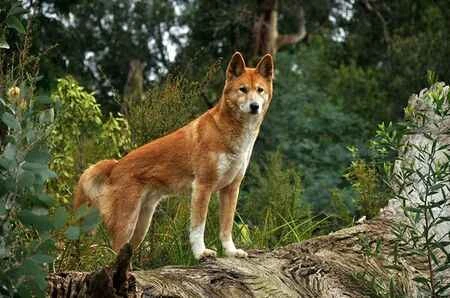
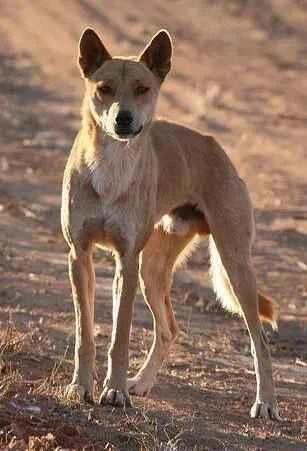
A medium-sized canine species, males are significantly larger than females, weighing 9.6-19.4 kg, with a body length of 885-920 mm and a shoulder height of 470-670 mm. The dingo has elegant long legs and is extremely agile, possessing excellent movement, speed, and endurance. Its coat has a rich variety of colors, generally a typical sandy hue, including ginger, gold, red, brown, and cream; even pure black and pure white individuals have been found. Its appearance is indistinguishable from that of a common domestic dog. The white down on the chest, feet, and tail tip are lighter in color. Some dingoes have black, brown, and white markings.
Detailed introduction
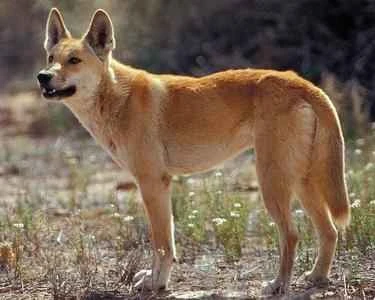
The Australian dingo ( scientific name : *Canis lupus dingo* , *Canis dingo *) is a mammal belonging to the family Canidae. Also known as the Dingo , Australian wild dog, or Australian kennel, it is a group of prehistoric, feral dogs, a subspecies of wolf, and a species within the genus *Canis*. Males are significantly larger than females, with a body length of 81-111 cm, a tail length of 31 cm, and a shoulder height of 40-65 cm. Males weigh 12-22 kg, while females weigh 11-17 kg. They possess elegant long legs and are extremely agile, exhibiting excellent movement, speed, and endurance. Their coat colors are diverse, generally a sandy hue, including ginger, gold, red, brown, and cream; pure black and pure white individuals have even been found. Their appearance is indistinguishable from that of a common domestic dog.
The earliest dingo skull was discovered in Vietnam , dating back approximately 5,500 years. Fossils of dingoes have been found in other parts of Southeast Asia , dating from 5,000 to 2,500 years ago. The earliest record in Australia dates back 3,500 years , while similar dingo skeletons have been discovered in Israel dating back 14,000 years .
Morphological characteristics
The dingo is a medium-sized canine species, with males significantly larger than females. They weigh 9.6-19.4 kg, are 885-920 mm long, and stand 470-670 mm tall at the shoulder. Dingos have elegant long legs and are extremely agile, possessing excellent movement, speed, and endurance. Their coat comes in a variety of colors, generally a sandy hue, including ginger, gold, red, brown, and cream; pure black and pure white individuals have even been found. Their appearance is indistinguishable from that of a common domestic dog. The white fur on the chest, feet, and tail tip are lighter in color. Some dingos have black, brown, and white markings. Their thick tails are more wolf-like than those of other wild dogs, and the species possesses large canines typically found in carnivores.
Australian dingoes are often larger than Asian jackals , and Southeast Asian dingoes usually have ginger-colored fur, but there are more pure black individuals found in Southeast Asia than in Australia.
Distribution range
The dingo population is not limited to Australia; it is also found in China, Myanmar, Vietnam, Thailand, the Philippines, Cambodia, India, Laos, Indonesia, Malaysia, and Papua New Guinea. Wild populations primarily inhabit various parts of Australia, with some scattered communities in other parts of Southeast Asia and Papua New Guinea.
This species is not limited to Australia; wild populations mainly live in Australia, with some communities scattered in other parts of Southeast Asia and New Guinea.
Habitat
Dingoes inhabit a variety of environments, including tropical alpine swamps above 3,800 meters , tropical forests, grasslands, meadows, deserts, plateaus , and wetlands . They are highly adaptable, and some even dare to roam near villages. They are found throughout the snow-capped peaks of temperate forests in eastern Australia, the arid deserts of central Australia where ranchers dig deep wells for cattle, and the tropical wetlands and forests of northern Australia. Puppies are born in burrows, rabbit holes, and rock caves, with their habitats near water sources. In Asia, dingoes live near villages, where people provide food and shelter in exchange for protecting their homes.
Lifestyle
Like most primitive wild dogs, dingoes typically live solitary lives outside the mating season and often organize themselves into close-knit family groups to hunt large prey. Each group usually consists of 3-12 individuals, with a strict hierarchy and varying degrees of social interaction. Typically, a pair of dingoes leads, with the male ranking higher than the female. Lower-ranking dingoes may exhibit aggression towards each other when vying for position. There is little interaction between rival dingoes. A group occupies a territory of 10-20 square kilometers and exhibits a strong sense of territory.
Living in packs, these are typical carnivores, active at dawn and dusk, resting in the shade during the midday heat. Dingoes generally hunt small prey, but when chasing larger prey such as kangaroos, sheep, and calves, they hunt in pairs or packs, attacking from multiple directions until the prey is off-balance before striking. In Australia, 60% of the diet consists of high-protein meat, with a diverse diet including rabbits, rats, opossums, wallabies, kangaroos, sheep, calves, birds, reptiles, carrion, and human waste. Packs often cooperate to hunt large prey such as kangaroos, wombats, sheep, calves, and monitor lizards. The remainder consists of birds and reptiles. They may also eat kangaroos, wallabies, sheep, and calves, but their diet is primarily small animals, especially the introduced European hare. Asian populations, on the other hand, are closely intertwined with human life, and their diet consists mostly of household waste, including cooked rice, fruit, and small amounts of chicken, fish, or crab meat. They also forage for other food sources, such as carrion, making them well-suited for survival in various ecosystems. This species has also been observed hunting lizards and mice in Thailand.
Their main predators are humans and crocodiles, as well as domestic dogs and jackals. Sometimes, dingoes from different packs will kill each other. Eagles will also snatch pups.
Group Composition and Social Hierarchy : Dingoes typically form family groups with complex social structures. A typical dingo pack is often led by an adult male and female kennel, along with their offspring. This family structure ensures the stability and order of the pack.
Dingoes prefer to live near water, and over the years they have learned to store water. In many cases, if water is available...
Only the stronger dingoes have access to water, while older and weaker dingoes remain thirsty.
Reproduction methods
Australian dingoes live in small packs with a strict hierarchy. Only one dominant pair of dingoes can reproduce, while the other dingoes help raise the pups. The female dingo may sometimes kill pups that are not her own. Their behavior is similar to that of primitive dogs. They reproduce once a year. The breeding season varies depending on latitude and season. Australian dingoes mate between March and April, while Asian populations mate between August and September . The average gestation period for a female is 63 days, with litters of 1-10 pups, usually 4-5 . The puppies are carefully cared for by all members and first leave the burrow at three weeks old. After eight weeks, the puppies are weaned and completely leave the burrow. They roam within a 3-kilometer radius of the burrow, primarily accompanied by adult dogs. When the newborn puppies are 9-12 weeks old, the adult dogs in the pack bring them large pieces of solid food, which they usually swallow whole and then regurgitate to feed the puppies. The breastfeeding period is about 2 months. They can move independently when they are 3-4 months old. They reach sexual maturity at around 2 years old. Their average lifespan is 10 years, and the longest recorded lifespan in captivity is 15 years.
This is not the first time dingo attacks have occurred. On April 17 , 1980 , a 10- year-old boy was killed by a dingo; in March 1998 , two British tourists were attacked by dingos on Fraser Island; in April 1998 , a 13- month-old baby and a 3- year-old Norwegian boy were bitten by dingos on the island; and on February 17 , 1999 , a German tourist was also bitten on the island. According to island management, they have received nearly 300 reports of dingo attacks. It is estimated that approximately 200 dingos live on the island, while the total number of dingos in Australia is between 200,000 and 350,000 . Carry hoods and leashes to prevent attacks.
Australia has announced new pet welfare regulations that stipulate hefty fines for owners who fail to provide their dogs with shelter, clean food, and water. The regulations also stipulate that owners cannot confine their dogs for more than 24 hours a day and must walk them for at least two hours within that 24- hour period . Confinement exceeding 24 hours will result in a fine of up to AU $ 4,000 (approximately RMB 20,000 ).
This regulation shows that Australia is no longer satisfied with simply feeding and watering dogs; the new regulations are protecting " dog rights , " which is the same principle as " human rights . "
In addition, other regulations introduced along with this law are even more stringent. Pet shop owners and pet breeders who beat or otherwise abuse dogs will be fined AU$48,000 (approximately RMB 240,000 ) and imprisoned for up to 3 years!