Basic Information
Scientific classification
- Chinese name: kangaroo
- scientific name:
- Order: Hedgehogaeformes
- Genus and species: Kangaroo, family Coccinellidae, order Diprotodontia
Vital signs data
- Body length: 1300~1500 mm
- Weight: 2.5 to 100 kg
- Lifespan: 20 to 22 years
Significant features
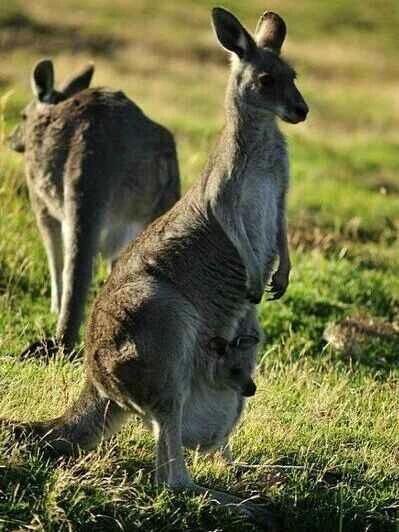
Pouch: Kangaroos are known for the pouch possessed by females, a distinctive feature of the kangaroo family. Located on the female's abdomen, the pouch is used to carry and raise the young.
Jumping ability: Kangaroos are the highest and farthest jumping mammals. Their powerful hind legs enable them to jump with astonishing speed and height.
Physical characteristics: Kangaroos have slender bodies, small heads, large eyes, long ears, and black whisker marks on either side of their nostrils. Their tails are thick and provide support when perched and balance when jumping.
Habitat and Habits: Kangaroos are herbivores, primarily feeding on grass and other plants. They prefer to congregate in small groups, typically consisting of one male and several females and their young. Kangaroos have highly sensitive vision, hearing, and smell, which allows them to effectively evade predators and find food in the wild.
Distribution and Habitat
Mainly distributed across the Australian continent and parts of Papua New Guinea, kangaroos have adapted to a wide variety of natural environments in Australia, ranging from cool-climate rainforests, deserts, and plains to tropical regions. Their habitats typically include dry, sunny locations that help them retain body temperature and moisture. There are many different species of kangaroos, each living in a diverse range of natural environments across Australia.
Appearance
Strong hind legs and tail: Kangaroos possess strong hind legs adapted for hopping. Their tails are not only thick but also provide balance during jumps and support when perched.
Pouch: Female kangaroos possess a front-opening pouch used to carry and nurse their young. After birth, the joey climbs into the mother's pouch to continue developing and growing.
Head features: Kangaroos have relatively small but very flexible heads. They have large ears, black whisker marks on either side of their nostrils, and highly sensitive vision, hearing, and smell.
Herbivorous: Kangaroos are herbivores, feeding mainly on herbs, leaves, and bark. They possess a specialized digestive system to process plant fibers.
Social behavior: Kangaroos typically live in groups and have a certain degree of territoriality. They express their intentions and emotions through special calls and gestures, forming a certain hierarchical structure.
Adaptable to a variety of environments: Kangaroos can adapt to a variety of natural environments, from cool rainforests to dry desert plains, and can even be found in tropical regions.
Jumping ability: Kangaroos are among the highest and farthest jumping mammals, with a maximum jump of 4 meters and a maximum jump distance of 13 meters.
Reproduction method: Kangaroos are viviparous animals, without a placenta. The babies are born very small and need to continue to develop and grow in the pouch.
Detailed introduction
Kangaroos (English: kangaroo , ganguro ) are mammals belonging to the genus *Macropoda* in the family Macropodidae , order Diprotodontia. The term " kangaroo " usually refers to the four largest species in the family Macropodidae: the red kangaroo, the eastern grey kangaroo, the western grey kangaroo, and the antelope kangaroo. Kangaroos are native to Australia and New Guinea. They are known for their high and long jumps. Female kangaroos have a pouch that opens at the front, hence their name. According to Australian government statistics, in 2019, there were 42.8 million kangaroos living in the four main economic regions of New South Wales, Queensland, South Australia, and Western Australia , down from 53.2 million in 2013 .
The kangaroo is a symbol of Australia, appearing on Australian currency. The green triangular kangaroo represents "Made in Australia," and the Qantas Airways logo features a flying kangaroo. The kangaroo is also one of the animals on the Australian coat of arms .
Morphological characteristics
Kangaroos are a typical example of marsupials. Marsupials are underdeveloped animals, essentially premature infants, so they need to develop in a pouch. The female kangaroo has four nipples: two high-fat and two low-fat. A female kangaroo typically gives birth to 3 to 4 pups per litter. The newborn kangaroo immediately enters the pouch and feeds on the low-fat milk. This means that only two kangaroo pups survive per litter . Newborn kangaroos are very small, about the size of a peanut. Adult kangaroos can reach 1.3 to 1.5 meters in height and weigh up to 50 kilograms.
Kangaroos have small heads, large eyes, long ears, and relatively long faces, with black whisker marks on either side of their nostrils. They are timid yet alert, with highly sensitive vision, hearing, and smell. Kangaroos live by hopping; their forelimbs are short and slender, used for grasping food, while their hind limbs are strong and their toes are fused. Their thick tail provides support when resting and balance when hopping. They can hop on their hind legs and run at very high speeds, exceeding 50 kilometers per hour. The kangaroo's " multi-functional " tail plays a crucial role; when resting, it supports the body along with its hind legs for balance; during running, the tail is an important balancing tool; and it is also a significant weapon for both offense and defense.
Kangaroos like to gather in groups of twenty or thirty . Regardless of their size, they all have one thing in common: strong and powerful hind legs with long legs; the creural index of kangaroos (i.e., ( lower leg length / thigh length ) × 100 index, or ( tibia length / femur length ) × 100 index) reaches 172 , with red kangaroos reaching 202 , far exceeding other animals, while the average human is only over 80 [2] . Kangaroos jump instead of running, and can jump up to 4 meters and up to 13 meters, making them the highest and farthest jumping mammals. Most kangaroos live on the ground, and their strong hind legs make them easy to distinguish from other animals. Kangaroos use their tails to balance during jumps, and when they walk slowly, their tails can act as a fifth leg. The kangaroo's tail is thick and long, full of muscles. It can support the kangaroo's body when it is resting, and it can also help the kangaroo jump faster and farther when it jumps.
All female kangaroos have a pouch that opens at the front, but males do not. The pouch contains four nipples. The " babies, " or joeys, are raised in the pouch until they are able to survive in the outside world.
Kangaroos and wallabies have large, flexible tendons in their hind feet. These tendons store strain energy and, using a spring-like mechanism, provide most of the energy needed for jumping, without excessive strain on the muscles. This is true for all animals whose muscles are connected to bones by elastic structures like tendons, but kangaroos are even more efficient.
Jumping is closely related to respiration: when the hind feet leave the ground, air is expelled from the lungs; just before landing, the hind feet move forward, and the lungs re-inflate, improving energy efficiency for long-distance movement. Studies show that kangaroos and wallabies, compared to animals like horses, dogs, or humans, accelerate effortlessly beyond the minimum energy required for jumping. Kangaroos' jumping is not advantageous for escaping predators; their upper limit of jumping speed is no higher than other quadrupeds of similar size, and native Australian predators are significantly less powerful than those in other regions. Conversely, the advantage of jumping lies in its locomotion efficiency; in barren and extremely variable environments, the ability to forage long distances at relatively high speeds is crucial for them.
Habitat
They are mainly distributed in the grasslands and forests of Oceania. Most kangaroos are endemic to Australia, but some tree kangaroos live on the island of New Guinea. They are widely distributed throughout Oceania, from cold Tasmania to the arid and hot Northern Territory, from national parks to the outskirts of cities.
Different species of kangaroos live in a variety of natural environments. For example, the Portolon kangaroo builds its own nest, while the tree kangaroo lives in the woods. Large kangaroos prefer to use trees, burrows, and rock crevices as cover.
" Kangaroo ," like " large kangaroo " and " small kangaroo ," refers to a paraphyletic group of species. These three terms all refer to members of the same taxonomic family, Cricetidae, and are distinguished by size. The largest in this family is called a " kangaroo ," while the smallest is usually called a " small kangaroo , " and " large kangaroo " refers to medium-sized species. There are also tree kangaroos, another type of kangaroo, inhabiting the rainforests of New Guinea, northeastern Queensland, and some islands in the region. These kangaroos live in the upper branches of trees. The general idea behind these informal terms regarding size is:
Small kangaroo: Body length excluding tail is approximately 45-105 cm, tail length is approximately 33-75 cm. The small forest kangaroo (the smallest of all known megalopods) is 46 cm long and weighs only 1.6 kg;
Tree kangaroos: From the Lumholtz tree kangaroo ( males weigh 7.2 kg, females weigh 5.9 kg, body length excluding tail is about 48-65 cm, tail length is about 60-74 cm) to the gray tree kangaroo (weighing about 8-15 kg, body length 70-95 cm).
Large kangaroo: The black kangaroo (the smaller of the two varieties) has a tail length of 60-70 cm, and 80 cm when standing . Males weigh 19-22 kg, and females weigh 13 kg.
Kangaroo: Large male kangaroos can stand up to 2 meters tall and weigh 90 kilograms.
To graze, kangaroos possess unique teeth rarely seen in mammals. Their incisors cut through grass, while their molars are responsible for chopping and grinding. Because the sides of their lower jaw are not connected, their lower incisors are spaced further apart, giving kangaroos a wider bite range. The kangaroo's molars are ground down by the silica in the grass, but before they eventually fall out, they move forward in the mouth and are replaced by new teeth growing from the back of the mouth. This process is called polyphyodontia , and it is found only in elephants and manatees, in addition to kangaroos.
The origin of the English name "Kangaroo" is said to be that botanist Joseph Banks discovered a strange animal (the eastern grey kangaroo). He showed it to the indigenous people and asked them about it. The indigenous people did not understand English and replied, " I don't know. " ( gangurru ). Banks then mistakenly thought that "gangurru" was the name of " kangaroo " .
In 1819-1820 , explorer Phillip Parker King studied the Nurul River region and believed that the local word for kangaroo was " menah " rather than " kangaroo ," and that " menah " might also refer to another species of kangaroo. In 1898 , anthropologist Walter Roth attempted to correct this misconception, but with little success. In 1972, linguist John B. Haviland , in his research on the Guguymish tribe, suggested that the local language word "ganguruu" referred to a rare, large, dark-colored kangaroo.
The Kongouro from New Holland , painted by George Sterbs in 1772, is the first Western painting of a kangaroo.
There are four extant species called kangaroos:
The red kangaroo ( Osphranter rufus ) is the largest living marsupial in the world and the largest native mammal of Australia. They typically inhabit arid and semi-arid regions, found almost throughout the Australian continent, except for the more fertile rainforests of the southern, eastern, and southeastern coasts of Western Australia, as well as the northern coast. The highest density is found in pastures in western New South Wales. While the red kangaroo is often mistakenly considered the most numerous kangaroo species, the eastern grey kangaroo is actually more abundant. Large male red kangaroos can stand up to 2 meters tall and weigh 90 kilograms.
The Eastern Grey Wallabies ( Macropus giganteus ) is less well-known outside of Australia than the Red Wallabies, but it is the most common species, found throughout the most fertile eastern regions. Its habitat extends from the top of the Cape York Peninsula in northern Queensland to Victoria, southeastern Australia, and Tasmania. In sparse woodlands, their density is around 100 individuals per square kilometer. In developed areas, such as farmland, where resources are scarcer, population sizes are smaller.
The western grey kangaroo ( Macropus fuliginosus ) is slightly smaller than the eastern grey kangaroo, with large males weighing approximately 54 kg. It is distributed in southern Western Australia, along the coastline of South Australia, and in the Murray - Darling Basin. The highest population density is found in western Raefleurs and western Nullarbor Plains of New South Wales. It is less common in agricultural and other human-inhabited areas. Due to their high tolerance to the plant toxin sodium fluoroacetate, scientists believe this species may have originated in southwestern Australia.
The antelope kangaroo ( Osphranter antilopinus ) can be considered the northern counterpart of the eastern and western grey kangaroos. While sometimes mistaken for a large kangaroo, they are more behaviorally and habitat-wise similar to kangaroos (red kangaroos, eastern grey kangaroos, and western grey kangaroos). Their name comes from their antelope-like fur, which has a color and texture. To adapt to hot and humid regions and release more heat, male antelope kangaroos can widen their nasal passages by adjusting their nostrils.
In addition to the above, there are about 50 smaller species of kangaroos that are closely related to kangaroos. They and the possums all originated from a common ancestor in the middle of the Miocene. This ancestor was likely an arboreal animal that settled in the forest canopy that covered most of Australia at that time, eating leaves and plant stems, when the climate was more humid. From the late Miocene to the Pleistocene, the climate became drier, forest area decreased, and grassland area expanded. During this period, kangaroos evolved larger bodies and adapted to low-nutrient herbivores, while developing the ability to ferment the foregut to break down complex plant fibers and extract more nutrients. The large early kangaroos, the fangtooth kangaroos and the Bulungamayinae, became extinct about 5 to 10 million years ago in the late Miocene . [16] The relationship between these two groups and kangaroos and possums is controversial. Some argue that fangtooth kangaroos are the ancestors of possums and Bulungamayinae are the ancestors of kangaroos, while others hold the opposite view.
The middle and late bulungamayines (subfamily) of Ganguroo and Wanburoo lacked the first toe on their hind feet, and their second and third toes were reduced and partially attached to the larger fourth toe, similar to the foot structure of modern kangaroos, indicating that they were bipedal. Furthermore, their ankle joints were not conducive to lateral movement but were more advantageous for jumping. Species such as the modern grey kangaroo and giant kangaroo appeared in the Pliocene. The red kangaroo is probably the most recently diverged species, with its fossil record dating back only to the Pleistocene, approximately 1 to 2 million years ago.
Kangaroos and wallabies belong to the same taxa ( Macropodidae ) and are usually classified in the same genus. The term " kangaroo " specifically refers to the four largest species in the family, while " wallaby " is an informal name that refers to any kangaroo or wallabies smaller than a kangaroo or wallabies but not specifically classified.
athletic ability
Kangaroos are the only large mammals that primarily locomotion by hopping on two legs. The red kangaroo's comfortable hopping speed is approximately 20-25 km /h, but it can reach speeds of up to 70 km /h over short distances and maintain a speed of 40 km /h for nearly 2 kilometers. During a jump, powerful peroneal muscles lift the body off the ground, while smaller plantar muscles at the big toe provide propulsion; approximately 70% of the energy is stored in elastic tendons. When moving slowly, kangaroos use a five-legged locomotion system, with the tail and forelimbs forming a triangular structure to support the body, and the hind legs providing forward propulsion. Both slow movement and high-speed hopping require significant energy expenditure. Moderate speeds are the most energy-efficient; compared to animals of similar size running at the same speed, kangaroos moving at speeds exceeding 15 km/h maintain greater energy consistency.
diet
Kangaroos have only one stomach, unlike ruminants such as cattle and sheep which have four stomachs. Although they sometimes ruminate the plants in their stomachs and then swallow and digest them again, rumination is more strenuous and infrequent for kangaroos compared to that of other ruminants.
All kangaroo species are herbivores, also consuming fungi , but each has its own distinct diet. They feed on low, green grasses close to the ground, with some species also eating leaves or small buds. The eastern grey kangaroo's main diet consists of grasses, and they eat a variety of types, while other species, such as the red kangaroo, also include a significant amount of shrubs in their diet. Smaller kangaroos consume underground fungi. Many kangaroo species are nocturnal and twilight-loving, resting in the shade during the hot day and moving and feeding in the cool evening, night, and morning.
No methane emissions
Cows and other ruminants produce methane ( CH4 ) through slow digestion. This methane is released when they burp and fart. Although kangaroos have a very similar herbivorous diet to these animals, they release almost no methane. The hydrogen byproduct of fermentation is converted into acetic acid in the body, providing energy. Scientists are interested in how to transfer the bacteria that facilitate this process to cows, because methane is about 23 times more efficient at increasing greenhouse gas emissions than carbon dioxide.
Kangaroos typically live in groups of 10 or more, effectively protecting weaker members. Group size and stability vary across geographical regions; kangaroo groups in eastern Australia are larger and more stable than those in the arid western regions. Larger kangaroo groups exhibit increased group cohesion and more complex social structures, comparable to ungulates. A common behavior is nose-to-nose contact and sniffing, primarily occurring when an individual joins the group. Kangaroos glean a great deal from scent, and this behavior reinforces social cohesion. During mutual sniffing, smaller kangaroos may lower their bodies to the ground and tremble their heads, possibly as a form of submission. Interactions between males and females are common, with larger males exhibiting more frequent interactions. Other friendly interactions occur between mothers and their young, who groom each other to strengthen their bond, and mothers also groom their young during or after nursing. If a young kangaroo wants to enter its mother's pouch, it will gently rub its nose against her.
Fighting can occur in all species of kangaroos, sometimes brief, sometimes prolonged and ritualistic. Fights driven by competition, such as male kangaroos vying for mates during estrus or for water sources, are usually short-lived. Both sexes fight for water, but prolonged, ritualistic "boxing" typically occurs only between males. Smaller males are more likely to fight for mates during estrus, while similar fights are less common among larger males. Ritualistic fights can erupt suddenly when male kangaroos are grazing together. Before most fights, the two males groom each other with their paws or mouths. One or both adopt a high stance, and one initiates the challenge by grabbing the other's neck with its front paws. Sometimes the challenge is rejected; larger males often refuse challenges from smaller males. In this type of fight, the fighters adopt a high stance and grab the opponent's head, shoulders, and chest with their front paws. They also lock their forelimbs together and wrestle, using their tails to maintain balance and kick their opponents in the abdomen.
Aside from not locking their forelimbs, the fights are not significantly different in length or duration. The weaker kangaroo will kick more frequently to block the winning blow. If one side initiates the fight and retreats, the outcome is clear. The winner can push their opponent backward or knock them to the ground. The initiator of the fight is more likely to win, which helps them advance in the male hierarchy. It has been observed that the winner drives the loser out of the habitat, and alpha male kangaroos will even pull up grass to intimidate other males.
Breeding
Kangaroo sexual behavior primarily occurs in pairs. Kangaroos are viviparous, placental, and mate within 1-2 months of birth, with a gestation period of 4-5 weeks. Newborn joeys are only about 2.5 cm long. Females in estrus move around significantly, attracting the attention of males. Males observe and track her movements, sniffing her urine to determine her estrus status—a behavior exhibited by the lip-sniffing reflex. The male then slowly approaches her to avoid startling her. If the female does not flee, the male continues to lick, touch, and scratch her before mating. After mating, the male seeks another female and repeats the process. Because pairing and mating can take several days and is a lengthy process, females may attract competing males during this time. Larger males tend to pair with females closer to estrus, while smaller males usually choose females further away from estrus. Kangaroos that hold a leadership position in the group do not need to seek out females to determine their estrus status; they can mate directly with females paired with the largest males without fighting.
Kangaroos' physiological structure is effectively adapted to dry, barren land and extreme climates. Because female kangaroos have two uteruses, the right uterus contains a newborn joey while the left uterus contains an embryo for another joey. This embryo only begins to develop after the kangaroo has fully grown and left its pouch. After about 40 days, the joey is born in the same manner. This alternating pregnancy in the left and right uteruses allows the mother kangaroo to reproduce continuously if external conditions are suitable.
Kangaroos reproduce one to two times a year. The joeys are born approximately 30 to 40 days after fertilization; they are very tiny, blind, and sparsely furred. Immediately after birth, they are placed in their mother's pouch. They only begin to briefly leave the pouch to learn and live independently at 6 to 7 months of age. They are fully weaned and leave the pouch after one year, but remain near their mother for assistance and protection. A mother kangaroo can have one joey outside the pouch, one joey inside the pouch, and one unborn joey at the same time.
When the baby kangaroo is four months old, its fur is fully grown, with a dark gray back and a light gray belly, making it quite beautiful. At five months, sometimes the baby kangaroo will peek out of the pouch, and the mother kangaroo will press its head down. The baby kangaroo is becoming increasingly playful; when its head is pressed down, it will stick its legs out, sometimes even dragging its little tail outside the pouch opening. Sometimes, this size baby kangaroo will defecate and urinate in the pouch, requiring the mother kangaroo to frequently " clean " it: she uses her forelimbs to open the pouch and carefully licks it clean inside and out with her tongue. After seven months in the pouch, the baby kangaroo begins to jump out and move around. However, if startled, it will quickly burrow back into the pouch. At this time, the pouch becomes like a rubber bag, very elastic, able to open and close, making it easy for the baby kangaroo to go in and out.
Finally, the baby kangaroo grew so big that it could no longer fit inside the pouch, so it had to move outside. But it still needed to drink its mother's milk, so it would put its head inside the pouch to nurse.
It takes three to four years for a kangaroo to mature into a large kangaroo, standing 1.6 meters tall and weighing over 100 kilograms. At this point, its physical strength reaches its peak, allowing it to hop 65 kilometers per hour; a single sweep of its tail can be fatal.
Female kangaroos typically remain pregnant throughout their lives, except for the day of delivery; in other words, they repeat the gestation cycle continuously. Black-tailed kangaroos usually conceive one to two days before giving birth, while marsupials like the red kangaroo can mate and become pregnant a day after giving birth. Furthermore, the mother can control the development of the embryos, ensuring that the previous litter's joeys can leave the pouch independently. This is called embryonic diapause and usually occurs during droughts or in areas with food scarcity. Additionally, the composition of the mother's milk changes as the joey grows.
During droughts, males do not produce sperm, while females only become pregnant when there is sufficient rainfall and vegetation grows abundantly.
Natural enemies
Kangaroos have some natural predators. Paleontologists believe the Tasmanian tiger was one of the kangaroos' main predators, but it is now extinct. Other extinct predators include the marsupial lion, the monitor lizard, and the Wonapi snake. However, with the arrival of humans in Australia at least 50,000 years ago and the introduction of dingoes 5,000 years ago, kangaroos have had to adapt to a gradually changing environment.
With the invasion of dingoes, foxes, feral cats, and dogs, kangaroo populations have also been threatened. Kangaroos and wallabies are adept swimmers; they will escape into the water to avoid pursuers. If a pursuer is chased into the water, the kangaroo will attempt to submerge it with its front paws, drowning it. Another defensive strategy is to grab predators with its front paws and kick them with its hind legs.
disease
Cases of eye disease in kangaroos are quite rare, but the disease is not a recent development. The first report of blindness in kangaroos was made in central New South Wales in 1994. Cases were subsequently discovered in Victoria and South Australia the following year. By 1996, the virus had crossed the desert and spread to Western Australia. Authorities were concerned that the disease could spread to other livestock and even potentially to humans. At the Australian Animal Health Laboratory, researchers detected Wallal virus in two types of midges, and since less than 3% of kangaroos infected with the virus developed blindness, these two midges were likely carriers of the virus.
Kangaroos primarily feed on tender shrub leaves, grass, and soft plants. Oral diseases are common among kangaroos kept in zoos, characterized by high morbidity and recurrence rates, posing a significant threat to zoo-raised kangaroos. In June 2003 , a stomatitis syndrome characterized by jaw swelling, loose and lost teeth, and gingival erosion or ulceration became prevalent among kangaroos at the Chengdu Wildlife Park in Sichuan Province. The disease affected kangaroos of all sexes, breeds, and ages, often presenting as a chronic condition with a morbidity rate of 40% –60 % and a mortality rate of 60% –100 % .
Variety Classification
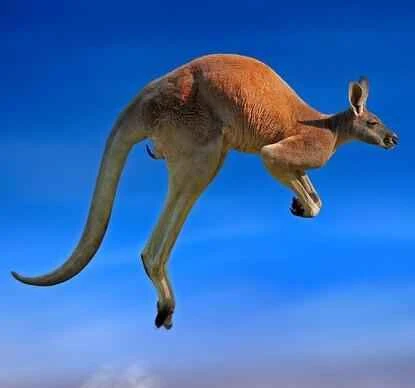
Red Kangaroo
The most famous kangaroo is the red kangaroo, which lives in the arid regions of Australia, where the average annual rainfall is less than 500 millimeters. Because kangaroos eat food with a high water content, they can survive in areas without running water. Actually, only the male red kangaroos are red; the females are grayish-blue, but through crossbreeding in groups, red female kangaroos have also appeared.
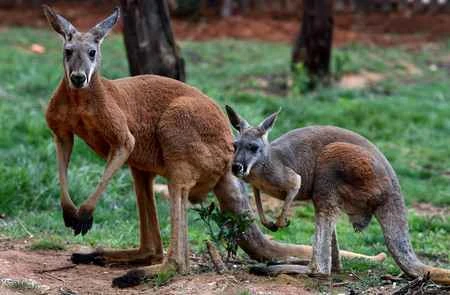
Red Kangaroo
The red kangaroo, which lives in the open grasslands of southeastern Australia, is a marsupial and the representative species of kangaroos, and can be called the king of modern marsupials.
The red kangaroo resembles a mouse, appearing as a giant, oversized rat. However, it is not actually related to mice. Its fur is reddish-brown, its body length is 130-150 cm, its tail length is 120-130 cm, and it weighs 70-90 kg. It has a small head, a relatively long face, and black whisker marks on either side of its nostrils. It has large eyes and long ears. Its unique appearance is endearing. They have small heads, large ears, and large eyes. Adapted to a hopping lifestyle, their forelimbs are short and slender, used for grasping food, while their hind limbs are powerful with fused toes. They can jump up to 5 meters in a single stride, reaching speeds of 40-65 km/h. Their long tail serves as a support organ when resting and a balancer when jumping.
Red kangaroos are most active at dawn and dusk, hiding in grassy nests or shallow burrows during the day. They prefer to live in groups of 20-30 or 50-60 individuals, primarily feeding on grasses and other plant-based foods. They are timid yet alert, with highly sensitive vision, hearing, and smell. Even the slightest noise can be detected by their long, large ears, prompting them to flee.
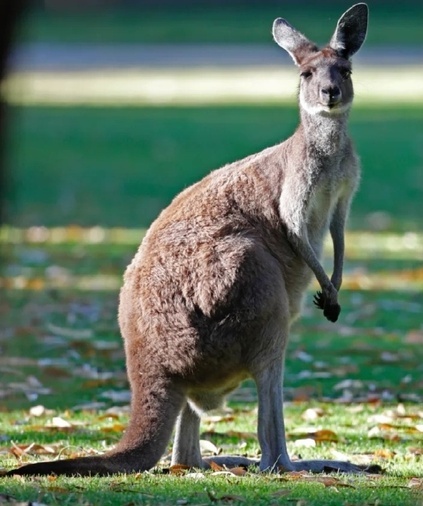
Eastern Grey Kangaroo
Although not as well-known as the red kangaroo, the eastern grey kangaroo (Macropus giganteus) is the most common. It lives in relatively fertile areas.
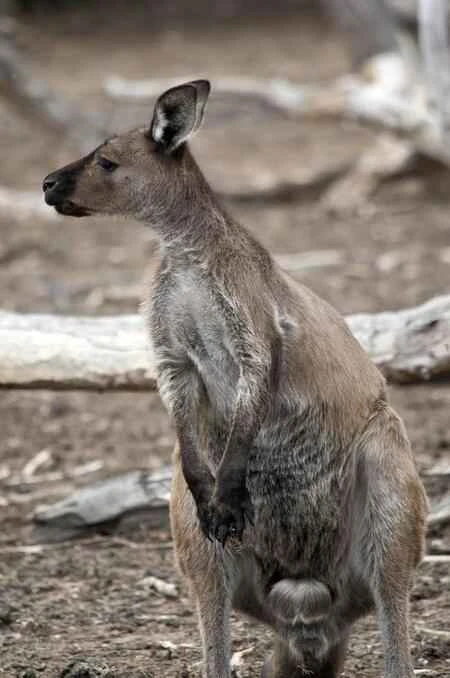
Western Grey Kangaroo
The western grey kangaroo (Macropus fuliginosus) is the smallest of the three kangaroo species: adult males weigh 54 kg (119 lbs ) . It lives on the southwest coast of Australia and in the Darling River Basin.
Musk kangaroo
Measuring only 15 to 20 centimeters in body length and 12.7 to 15 centimeters in tail length , they are the smallest kangaroos in the world. Compared to the common kangaroo that leaps across the grasslands, they are a typical dwarf species. They have lived in tropical rainforests for over 20 million years, and scientists are very concerned about their survival, believing they are highly vulnerable to environmental changes.


