Basic Information
Scientific classification
- Chinese name: Crocodile
- scientific name:
- Classification: Crocodilians
- Family and genus: Suborder Eusuchosaurus, Subclass Dipsida, Class Reptilia, Phylum Chordata
Vital signs data
- Body length: 1.2 to 7 meters
- Weight: Can reach over 1 ton
- Life expectancy: 70 to 80 years
Significant features
Crocodiles, as one of the oldest species on Earth, retain many characteristics of early dinosaur-like reptiles and are known as "living fossils." These characteristics have enabled crocodiles to survive and reproduce in various environments to this day, making them one of the longest-living animals on Earth.
Distribution and Habitat
Crocodiles inhabit environments with abundant water, such as lakes, swamps, shallows, and rivers, or live in damp areas of hilly regions. Except for a few that live in temperate regions, most crocodiles live in rivers, lakes, and watery swamps in tropical and subtropical regions, and some also live in shallow waters near the coast.
Appearance
Body type: Crocodiles have a relatively long torso, well-developed muscles, short and thick limbs, and a thick, slightly flattened tail.
Head: The head is flat, with the skin of the scalp tightly attached to the skull, which is firmly connected and cannot move; the eyes are small and slightly protruding; the external nostrils are located on the back of the snout and have valves on them; the tongue is short and flat and cannot be extended outward.
Teeth: Teeth are cone-shaped and grow in the alveolar bone, with more than 25 teeth on each side.
Scales: It has armor-like scales.
Detailed introduction
Crocodilia (scientific name: Crocodilia) is a typical large carnivore belonging to the class Sauromorpha in the phylum Chordata. They are distributed in tropical to subtropical rivers, lakes, and coastlines, and there are currently 25 extant species.
External features
Crocodiles are reptiles belonging to the families Crocodilians and Gnatsuchidae, comprising 8 genera and 23 species. Crocodiles have relatively long bodies , ranging in length from 1.2 meters to 7 meters. Some prehistoric species exhibited sexual dimorphism, with males generally larger than females. Although the shapes of their snouts and teeth vary, all Crocodilian species share a similar basic body morphology: skin covered with large scales, a long, flat snout, and a powerful, laterally flattened tail ; well-developed muscles; a flat head with skin tightly attached to the skull, which is firmly connected and immobile; conical teeth embedded in alveoli, with more than 25 teeth on each side ; they are animals that almost completely replace their teeth throughout their lives, shedding them 50 times ; a short, flat tongue that cannot protrude; small, slightly protruding eyes; a thick, slightly flattened tail; short, stout limbs; external nostrils located on the back of the snout with valves; and armor-like scales.
Crocodiles have their eyes, ears, and nostrils located on the top of their heads, a structure that allows most of their bodies to be submerged underwater .[3] Crocodiles have a nictitating membrane that enhances their vision in low light conditions, although their vision is quite good in air but significantly reduced underwater. In other vertebrates, the fovea of the eye is usually round; in crocodiles, it is a horizontal strip across the middle of the retina. When the body is fully submerged, the nictitating membrane covers the eye. In addition, glands on the nictitating membrane secrete a lubricating fluid that keeps the eye clean; this fluid is visible as “ tears ” when the eye is removed from the water and dries out .
The ear canals are adapted for use in both air and underwater environments, and the eardrum is protected by skin flaps that can be opened or closed by muscles. Crocodilians have a wide range of hearing, with sensitivity comparable to most birds and some mammals.
Crocodiles have only one olfactory system, and adults lack a vomeronasal organ; this indicates that all olfactory perception is limited to the olfactory system. Behavioral and olfactory experiments suggest that crocodiles can detect airborne and water-soluble chemicals and use their olfactory system for hunting.
A well-developed trigeminal nerve allows them to detect vibrations in the water (such as vibrations caused by potential prey). The tongue cannot move freely, but it can be fixed by folding. Crocodilians have relatively small brains, but their learning capacity is stronger than most reptiles. They lack the vocal cords of mammals and the syrinx of birds, but can produce sound by vibrating three flaps in their throat . Crocodilians appear to have lost their pineal gland, but still secrete melatonin.
Crocodiles breathe with lungs, have a four-chambered heart, and a bony palate that separates their nasal cavity from their oral cavity. Their teeth are located only in the alveoli of their upper and lower jaws—all features similar to mammals, indicating that mammals evolved from reptiles. A crocodile's eyes are located at the top of its head, and in addition to eyelids, it has a transparent nictitating membrane, a structure that allows it to adapt to the aquatic environment. Because the crocodile's nostrils are located on the upper back and contain valves, these valves automatically close when it dives underwater, preventing water from entering the nostrils. In its pharynx, there is a thin, elastic membrane that, when closed, separates its mouth from its respiratory tract, thus preventing water from entering its respiratory tract and lungs even when its mouth is wide open. Its long, thick tail serves as a " rudder " for swimming , a tool for hunting, and a weapon for defense.
Crocodiles, as one of the oldest species on Earth, retain many characteristics of early dinosaur-like reptiles and are often called " living fossils . " Large crocodiles pose a threat to humans, attacking suddenly before humans can react. There's a Western proverb, " crocodile tears , " which refers to the watery liquid that slowly flows from the eyes of crocodiles when they swallow large animals, appearing as if they are shedding tears of sympathy. Of the 23 species of crocodiles, 13 are listed in the IUCN Red List of Threatened Species. The Siamese crocodile is currently on the verge of extinction. The Chinese alligator, endemic to China, is listed as a Class I protected animal in China.
Habitat
Crocodiles inhabit environments with abundant water, such as lakes, swamps, shallows , and rivers , or live in damp areas of hilly regions. Except for a few that live in temperate regions, most crocodiles live in rivers, lakes, and watery swamps in tropical and subtropical regions, and some also live in shallow waters near the coast.
Lifestyle
Crocodiles are cold-blooded animals, apex predators in the food chain, and among the most resilient living animals. They can go up to six months without eating after a large meal . Adult crocodiles spend most of their time underwater, sometimes with their eyes and noses above the surface; they have keen hearing and vision; they surface to bask in the afternoon sun; they are frequently active at night; they have a dual respiratory system; they usually live in groups; and they prefer warm environments. Crocodiles primarily prey on vertebrates, but also eat mollusks and crustaceans.
Crocodiles are often mistakenly perceived as slow-moving. Some even describe them as not crawling on the ground, but rather staggering, with all four limbs outstretched, their bodies floating and tails dragging on the ground. However, this description is a misconception. In reality, crocodiles have extremely sensitive hearing and vision, and their bodies are highly agile. Crocodiles are typical ambush predators. When they spot prey, they bury their bodies below the surface of the water, slowly approach, bite down, drag the prey into the water to drown it, and then feast on it. Crocodiles use a technique called the "death flip" to dismember their prey into smaller pieces for swallowing. This involves using their powerful jaws to firmly bite down on the prey, then twisting their bodies with all their might to tear the flesh from the prey. Anatomical analysis shows that crocodiles prefer to eat animals such as wild ducks, rabbits, frogs, mice, fish, and snails.
Nile crocodiles have a symbiotic relationship with plovers. These small birds often inhabit the sandbars of the Nile River. They are good friends with the crocodiles, frequently feeding on insects on the crocodiles and sometimes even entering the crocodiles' mouths to catch leeches that live inside. Interestingly, sometimes when the crocodile's mouth accidentally closes, trapping the plover inside, the crocodile doesn't swallow it. The plover will gently tap its upper and lower jaws, and the crocodile will immediately open its mouth, letting the bird fly out. Plovers are highly sensitive birds; they will make a commotion at the slightest sound. Therefore, when the crocodile sleeps, the plover sometimes " stands guard . " If there is any " situation , " the plover immediately makes a commotion, waking the sleeping crocodile, allowing it to immediately sink to the bottom and avoid a disaster .
Distribution range
Crocodiles are mostly distributed in tropical regions of Africa, Asia, North and South America, and Australia, with only the Chinese alligator and the American alligator living in temperate regions. They inhabit lakes, swamps, and shallow waters.
Reproduction methods
The sex of crocodiles hatched is related to temperature. If the temperature is below 30 degrees Celsius, all crocodiles will be female; if the temperature is between 30 and 34 degrees Celsius, the sex of the crocodiles will be uncertain; if the temperature is above 34 degrees Celsius, all crocodiles will be male.
Crocodiles reproduce by laying eggs , and mating occurs from December to March of the following year. Female crocodiles reach sexual maturity when they reach an average body length of 232 centimeters. Mating takes place in the water, where the male crocodile approaches the female and then wraps its forelimbs around her to mate. The mating process can last for a considerable time, sometimes even several hours.
After mating, the female crocodile will come ashore and dig a pit to lay her eggs. Before laying eggs, she will build her own " birthing house " on the shore using soft materials such as leaves and dry grass. The nest is about 40-70 centimeters high , and she will use sunlight and the heat from the grass to incubate the eggs. During incubation, the female crocodile will guard the nest, protecting the eggs and the newly hatched crocodiles. After the crocodiles hatch, the female crocodile will help them crawl out of the soil and guide them into the water. They begin to reproduce at the age of 12 and stop reproducing around the age of 40. Each clutch contains 10-90 eggs , and incubation takes 84-90 days. Crocodiles have a lifespan of 65 years.
Generally, the larger the size, the longer the lifespan. The smallest living crocodile is the dwarf crocodile, with an average lifespan of 40-50 years. The Yangtze alligator, which is slightly larger than the dwarf crocodile, has an average lifespan of 50-60 years. The saltwater crocodile is the largest living crocodile and is considered the " longest-lived king " among crocodiles . Adult individuals can exceed 6 meters in length and weigh over 1 ton, with an average lifespan of 70 years.
To date, there have been two crocodiles that have lived to be over 100 years old. The first is " Henry , " a Nile crocodile born in 1900. He was captured at the age of three and lived at the Crocworld Conservation Center in Kwazulu-Natal , South Africa , where he was 123 years old, making him one of the longest-lived captive crocodiles. The second is " Fresh , " a saltwater crocodile born in 1870. He was also captured as a child and sent to a crocodile conservation center in Australia. He died in 2010 , living to be 140 years old, making him the longest-lived crocodile on record.
Classification
There are 23 species of crocodiles belonging to 3 families and 8 genera in the world , mostly distributed in tropical and subtropical regions such as Africa, Central America, and southern Asia. Only the Chinese alligator and the Mississippi alligator of North America are found in temperate zones. The main crocodile species farmed in China include the Chinese alligator, Siamese crocodile ( Thai crocodile ) , Nile crocodile, saltwater crocodile , Mississippi crocodile, and caiman . Among them, the Chinese alligator is endemic to China , while the others are introduced from abroad.
| continent | name | Body length | Living area | scientific name |
| Asia | Fish-eating crocodile | 3.5 meters | India | Gavial |
| Asia | Yangtze alligator | 1.5 to 2 meters | China | Alligator sinensis |
| Asia | Estuarine | 4 to 6 meters | Southeast Asia and northern Australia | Salt-water Crocodile |
| Africa | Nile Crocodile | 5.47 meters | Madagascar, Africa | Nile Crocodile |
| Oceania | Johnston Crocodile | 2.5 to 3 meters | Tropical regions of northern Australia | Johnston's Crocodile |
| America | Petén Crocodile | 3 to 3.4 meters | Mexico, Guatemala and Belize | Crocodylus moreletii |
| America | American alligator | 3 meters | USA | American Crocodile |
| America | American crocodile | 4 meters | North and South America | Alligator |
| America | Black Caiman | 5 meters | South America | Black Caiman |
| America | Cuvier dwarf caiman | 1.5 meters | South America | Cuvier's Dwarf Caiman |
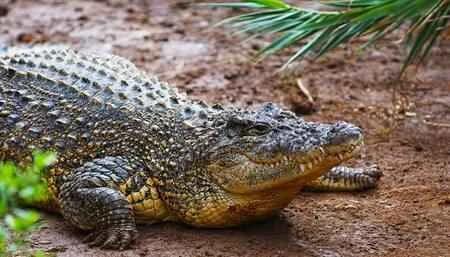
Yangtze alligator
The Chinese alligator (Alligator sinensis) , also known as the crocodile , is a species of crocodile endemic to China and is also the most endangered crocodile species in the world. China has listed it as a national first-class protected animal [26] and strictly prohibits its hunting. The Chinese alligator is relatively small in size. Adult alligators weigh about 36 kg and are generally 1.5 meters long, rarely exceeding 2.1 meters. The Chinese alligator has short and thick limbs. The forelimbs have five fingers without webbing between the fingers; the hind limbs have four toes with webbing between the toes. The tail is about the same length as the body. The head is relatively large, flat, and has a long snout. The eyes are completely black and have eyelids and membranes that can open and close. The back of the body is grayish-brown, the front of the abdomen is gray, and from the anus to the back, it is gray and yellow. The tail is laterally flattened. Newborn alligators are black with yellow stripes.
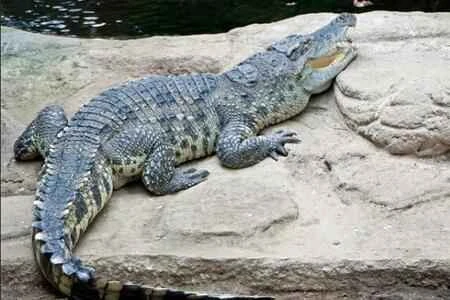
Siamese crocodile
The Siamese crocodile (Crocodylus siamensis) , also known as the Thai crocodile, Siamese freshwater crocodile, or Singapore crocodile, is mainly distributed in Borneo, Indonesia, Malaysia, Thailand, and Vietnam in Southeast Asia. Siamese crocodile leather has a high international reputation. The Siamese crocodile is a medium-sized crocodile; hatchlings are about 25 cm long, while adults can reach up to 4 meters, with a common length of 3 meters. The Siamese crocodile has a medium-length, slightly concave snout. There are two short, sharp ridges in front of its eye sockets, and a prominent orbit on its forehead between the eye sockets, with its squamous bones protruding into a high ridge. It inhabits freshwater areas such as swamps, slow-flowing rivers, and lakes in tropical and subtropical regions, as well as brackish water. It feeds on fish, but also eats amphibians, reptiles, and small mammals. It reaches sexual maturity around 10 years of age. Breeding occurs from April to May each year; females can lay 20 to 50 eggs at a time , with an incubation period of about 80 days.
Nile Crocodile
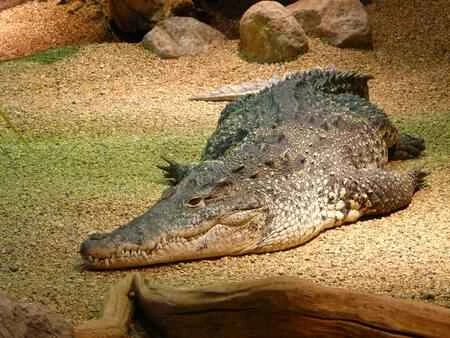
The Nile crocodile (Crocodylus niloticus) is a large crocodile, with adults ranging from 2 to 5.5 meters in length and weighing up to 120 kg . It is the most studied of the 23 crocodile species worldwide . The Nile crocodile's body color ranges from olive green to brown, with black spots and a reticulated pattern. It is very strong, with a powerful tail that aids in swimming. Adults have faint horizontal bands. Juveniles are dark yellowish-brown with distinct horizontal bands on their bodies and tails. Female Nile crocodiles lay approximately 50 eggs at a time , which hatch after about three months. Newborn crocodiles are about 30 cm long and are gently placed into the water by their mother in her mouth. Juveniles can grow to 60 cm in length by one year old and to 1 meter by two years old .
Mississippi alligator
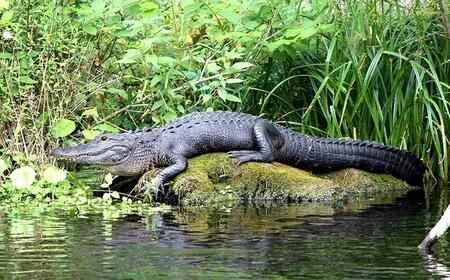
The Mississippi alligator (Alligator mississippiensis) , also known as the Mississippi River alligator or American alligator, is found only in the southeastern United States and the Mississippi River basin, from which it derives its name. It is a large alligator, reaching lengths of 4.9 to 6.1 meters, though few extant individuals reach such sizes. It primarily inhabits swampy areas, but is also found in streams, rivers, and even bodies of water with strong odors. Mississippi alligators can communicate with each other through sound and sight. In the Convention on International Trade in Endangered Species of Wild Fauna and Flora (CITES), the Mississippi alligator is listed in Appendix II .

Caiman
Caimans are a species of crocodile native to South and Central America. They are related to alligators, belonging to the family Alligatoridae. Animals in this genus have a transverse ridge in front of their eyes, resembling the frame of eyeglasses, hence their English name, "spectacled crocodile." Common caimans can reach a maximum length of 250 cm , with adults typically measuring 150-200 cm , and newly hatched juveniles measuring 20-25 cm . Their snouts are slightly elongated, with a slightly raised tip, and the snout length is slightly greater than the width at the base. The back is olive green, with numerous dark spots on the head, body, and tail. Dark brown or black transverse stripes adorn the back and tail, while the belly is pure beige or light yellow. Newly hatched juveniles have light-colored spots on the sides of their jaws, which disappear when they reach about 35 cm in length. Caimans primarily inhabit fast-flowing, rocky rivers.
Saltwater crocodile
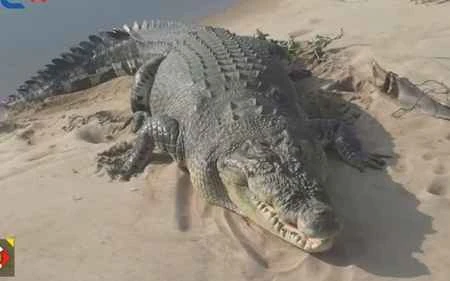
The saltwater crocodile (Crocodylus porosus) , also known as the man-eating crocodile, estuary crocodile, saltwater crocodile, or Malayan crocodile, is the largest of the 23 crocodile species and the largest living reptile. Native to Southeast Asia, including Thailand and Malaysia, it has also been found in India, primarily distributed along the Southeast Asian coast to northern Australia and Papua New Guinea. Because it is a crocodile without large scales on its neck and back, it is also called the " naked-necked crocodile . " Adult saltwater crocodiles typically reach 3-7 meters in length , with some reaching 9 meters, and weigh 600-1400 kg . The mating season is between May and June , lasting for several hours, while fertilization takes only 1-2 minutes . Saltwater crocodiles are territorial and possess physiological structures adapted to high salinity water. They are more tolerant of seawater than most crocodiles and are well-suited to living in various wetlands, such as estuaries, mangrove forests, swamps, and coastal and tidal zones.
Protection level
The Chinese alligator, Central American alligator, South American alligator, narrow-snouted alligator, sharp-snouted alligator, intermediate alligator, Philippine crocodile, Petten crocodile, Nile crocodile, Ganges crocodile, Saltwater crocodile, diamondback crocodile, Siamese crocodile, alligator, Malayan crocodile, and fish-eating crocodile are all endangered wild animal and plant species, and are internationally important protected species. They are listed in Appendix I of CITES (Convention on International Trade in Endangered Species of Wild Fauna and Flora) , prohibiting their international trade. In addition, all species in the order Crocodilia of the class Reptilia, except those listed in Appendix I , are listed in CITES Appendix II , regulating their international trade.
Of the 23 species of crocodiles, 13 are listed in the IUCN Red List of Threatened Species.
The Siamese crocodile is currently on the verge of extinction.
The Chinese alligator is a crocodile species endemic to China and has been listed as a Class I protected animal in China.
Reasons for endangerment
Due to overhunting and killing, the number of crocodiles is declining, and countries that produce crocodiles have enacted laws to protect them. The Chinese alligator, which lives only in China, has become a rare and precious wild animal. In 1973, the International Conference on the Conservation of Wildlife listed it as an endangered and prohibited species, and the Chinese alligator has been listed as a first-class protected animal in China.