Basic Information
Scientific classification
- Chinese name: Wombat
- Scientific name: Phascolomidae
- Classification: Rodentia
- Family and genus: Wombatus (genus Hairy-nosed Wombatus), Phylum Chordata, Order Diprotodontia
Vital signs data
- Body length: 70 to 110 cm
- Weight: 20-35 kg
- Lifespan: 15-20 years
Significant features
All its teeth are rootless and grow throughout its life; its tail is vestigial; its pouch opens backward and contains a pair of nipples; it is the only creature on Earth that poops in a square shape; its buttocks are as hard as stone, forming a defensive barrier.
Distribution and Habitat
Wombats are a species endemic to southeastern Australia. They range from southeastern Queensland and the greater southeastern Australian mainland, as well as Flinders Island and Tasmania. They inhabit the forests, hills, and coastlines of Oceania. They live in forests, mountains, and wilderness areas, and are occasionally seen near farmland.
Appearance
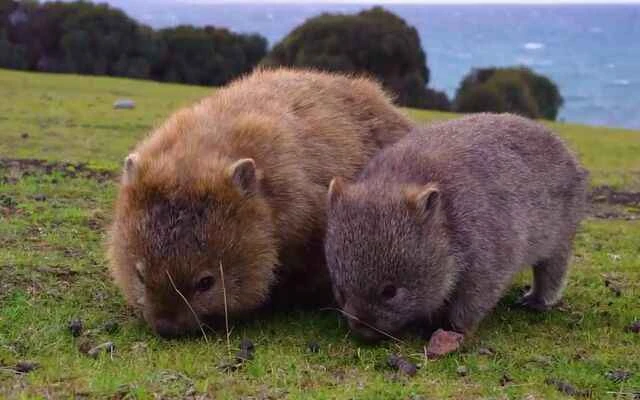
Wombats are mammals belonging to the family Wombatidae in the order Diprotodontia. They are robust in build, with a pouch on their abdomen that opens backward. Their eyes and ears are relatively small, and their bodies are short and stocky. Wombats have strong, powerful claws, a vestigial tail, and coarse, grayish-brown fur. These characteristics make wombats somewhat bear-like in appearance but smaller than bears.
Detailed introduction
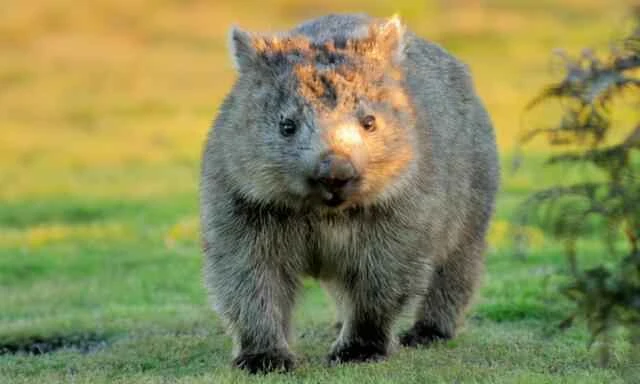
Wombats , belonging to the family Phascolomidae , are marsupials native to Australia. They are diprotodonts with short , muscular legs, reaching about 1 meter in length, and also have short tails. They inhabit the forests, mountains, and heather of southeastern Australia and Tasmania. Their body length ranges from 70 to 110 centimeters ; they weigh 20-35 kilograms , with males typically slightly heavier than females . Wild wombats have a lifespan of 15 years, while those in captivity can live up to 20 years.
Morphological characteristics
Wombats resemble bears somewhat but are smaller. They measure 70-110 cm in length and weigh 20-35 kg. Female wombats have a pouch on their abdomen that opens backwards, containing two nipples for their young to suckle. They have small eyes and ears, and a short, stocky build, earning them the nickname " short and stocky . " The wombat's skull is slightly flattened, with a round nose and a relatively short nasal face. All their teeth are rootless, grow continuously throughout their lives, and are hard enough to crush stones ; their tail is vestigial. The pouch opens backwards and contains a pair of nipples. Their limbs are short and powerful; the forefeet have five toes, broad and with long claws, while the third and fourth toes on the hind feet are fused together. The claws are strong , powerful , and as sharp as knives . The tail is vestigial, leaving only a vestigial mark. Their fur is coarse and grayish-brown.
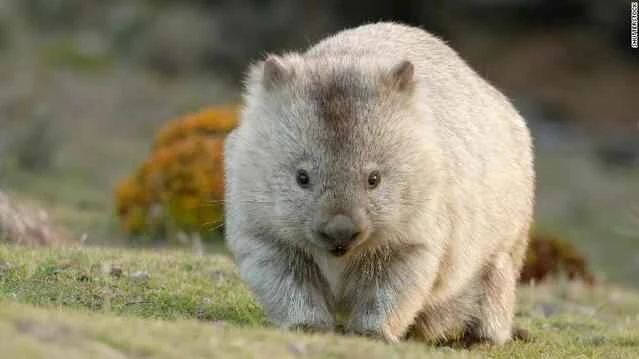
Wombats have a variety of fur colors, generally ranging from sandy to brown, or from gray to black.
Habitat
Wombats are adapted to burrowing in open forests, hills, and near coastlines in temperate regions, at altitudes ranging from approximately 0 to 1800 meters.
Lifestyle
Wombats live in burrows, using their rodent-like teeth and strong claws to dig their nests. They are very good at digging, and their burrows are relatively large. A typical burrow can be up to 10 meters deep and 60 centimeters wide , with its bedroom at the end, lined with grass and bark.
Wombats are solitary animals, sometimes living in groups of 2-3. They are nocturnal, primarily active at dawn, dusk, and night, sleeping in their burrows during the day but still emerging to forage during cooler or darker days. They are not easily spotted, but evidence of their presence can be found wherever they go. They are herbivores, primarily feeding on grasses, sedges, herbs, bark, and roots. Their incisors are somewhat rodent-like, used for gnawing on rough wood or digging burrows. Like other herbivores, they have large longitudinal slits between their incisors and cheek teeth. Wombats have a very slow metabolism, small eyes and ears, and a stocky build; digestion takes them approximately 14 days, which helps them survive in dry environments . Their feces are square. They generally move slowly, but when threatened, they can reach speeds of up to 40 km / h and maintain this speed for up to 90 seconds. Wombats protect their territory centered on their burrows and are aggressive towards intruders. The territory of the Tasmanian wombat extends to 23 hectares, while that of the hairy-nosed wombat genus is no more than 4 hectares.
When attacked, wombats exhibit remarkable resilience. For instance, when attacked by burrowing predators, they can destroy underground tunnels, suffocating the predators. Their primary defense relies on a cartilaginous structure at the rear of their body, along with their relatively short tail, which helps prevent predators from attacking their tails when they escape into tunnels.
Wombats are herbivores. Like most herbivores, their diet includes shrubs, trees, fungi, bark, moss, leaves, and swamp plants, with a particular fondness for perennial grasses. During the dry season, they will also eat withered grass roots. An adult wombat can consume approximately 2-3 kilograms of food per day.
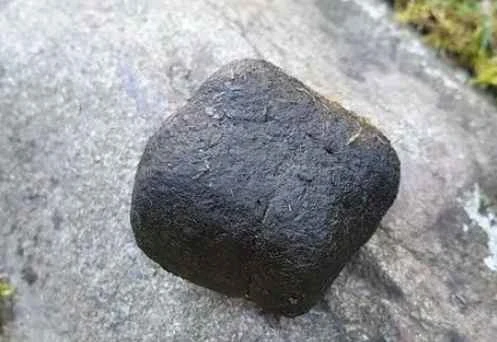
Although they have round anuses like all other mammals, hairy-nosed wombats don't produce round, spiral, or messy droppings; they are the only creatures on Earth that poop square-shaped feces. The wombat's large intestine has special areas where the muscles contract differently than those of other animals. These special areas shape the feces into a square shape. Square feces don't roll easily on irregular terrain, thus they can be used to mark territory.
The wombat's rump is truly a formidable asset . Despite its generally soft and cuddly appearance, the wombat's rump is as hard as a rock. It's said that the wombat's rump has layers upon layers of protective structure, with the outermost layer of skin nearly a centimeter thick! Beneath this thick skin lies a layer of cartilage supporting the entire rump. This structure allows the wombat to withstand the claws and teeth of predators. It's practically the " Iron Fist " of the animal kingdom ! When threatened, they quickly retreat to their burrows and assume a defensive posture. They don't simply hide inside; instead, they leave their rumps outside the burrow entrance as a sturdy barrier.
Distribution range
Wombats are a species endemic to southeastern Australia. They range from southeastern Queensland and the greater southeastern Australian mainland, as well as Flinders Island and Tasmania. They inhabit the forests, hills, and coastlines of Oceania. They live in forests, mountains, and wilderness areas, and are occasionally seen near farmland.
Reproduction methods
Males attract females through scent marking, vocalizations, and body language. Conflicts arise among males over mating rights and territory.
Wombats are adapted to a hopping lifestyle and are herbivorous. Their ruminant-like digestive system allows them to occupy territories unfavorable to other large mammals. They also have unique reproductive adaptations: after a gestation period of 26-28 days, the female gives birth to a cub in the spring. They have a well-developed pouch, in which the female can protect the cub for 6-7 months. Mating and conception are still possible, but the fertilized egg stops developing at the 100-cell stage; if the cub dies in the pouch, the embryo continues to develop; a second cub can be born a few weeks later.
They breed primarily in the summer, with a gestation period of one month and a litter of one cub per birth. Newborn cubs are about 2 cm long and weigh about 2 grams. Wombats are weaned at 15 months and reach sexual maturity at 2-3 years old. Their lifespan is generally around 15 years, although there are records of them living over 20 years. The lifespan of wild wombats is typically 12-15 years.
Wombats are one of the few marsupials whose pouches open backwards, which prevents soil from getting into the pouch and affecting the baby wombats when digging burrows.
Captive wombats can be very docile. However, due to their cute appearance, people may lack sufficient vigilance, and wombats can become aggressive when angry or agitated. A wombat's weight can knock down an average-sized adult, and its sharp teeth and claws can cause injury. A wombat bite can tear trousers, thick wool socks, and rubber boots, and cause a wound up to 2 centimeters deep .
Patrick passed away in 2017 at the age of 31, which is equivalent to 130 years old in human years , accompanied by staff at Ballarat Wildlife Park . On January 31, 2022, Guinness World Records certified the oldest wombat in the world as Wine of Satsukiyama Zoo in Ikeda City, Osaka Prefecture, Japan . [9]
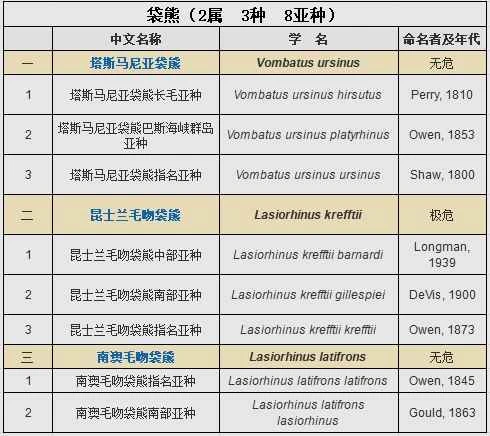
There are currently three types of wombats: the Tasmanian wombat, the Queensland woolly-nosed wombat, and the South Australian woolly-nosed wombat.
The Tasmanian wombat and the South Australian hairy-nosed wombat are listed as " Least Concern " in the IUCN Red List due to their wide distribution and stable populations .
The Queensland woolly wombat has suffered a significant decline in population due to habitat destruction and predation by invasive species, and has been classified as a " critically endangered " species by the International Union for Conservation of Nature (IUCN ) Red List .
Wombats have been found in Australia for 20 million years, but it wasn't until July 1797 , when a European merchant ship wrecked in the Bass Strait and the sailors fled to a nearby island, that they first encountered the animal. It is currently listed in the IUCN Red List of Threatened Species ( ver 3.1 ) , with one species classified as Critically Endangered ( CR ) and one as Near Threatened ( NT ).