Basic Information
Scientific classification
- Chinese name: Five-lined snapper
- Scientific name: Lutjanus quinquelineatus
- Classification: Small fish
- Genus and family: Lutjanidae Lutjanus
Vital signs data
- Body length: Commonly 20–30 cm; Maximum ~38–40 cm
- Weight: Varies by individual (small to medium-sized reef fish)
- Lifespan: Approximately 10–15 years
Significant features
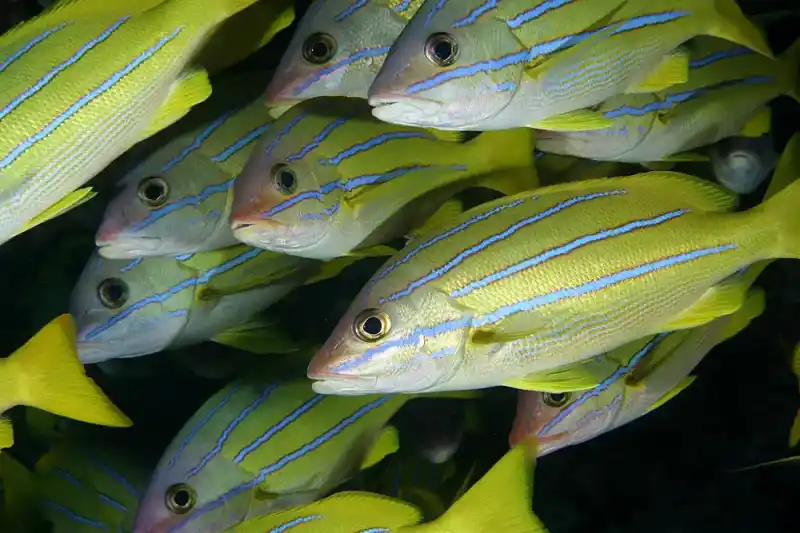
Five longitudinal lines along the sides of the body; gregarious during the day and prey at night; carnivorous; lays eggs in the open ocean; juveniles utilize lagoons/seagrass beds.
Distribution and Habitat
Tropical corals/rocks in the Indo-West Pacific; reef slopes, platforms, lagoons and outer reef walls, 3–60 m.
Appearance
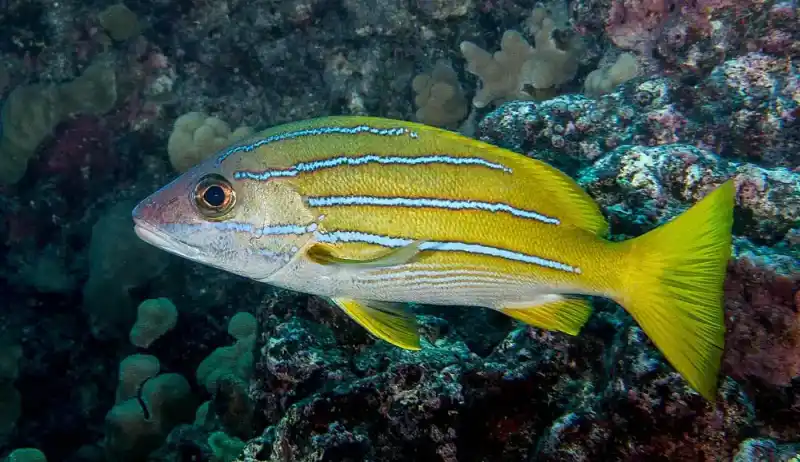
The body is medium-sized and laterally compressed; the dorsal fin is continuous; the caudal fin is forked; fine dots or short oblique stripes can be seen on the back of the head.
Detailed introduction
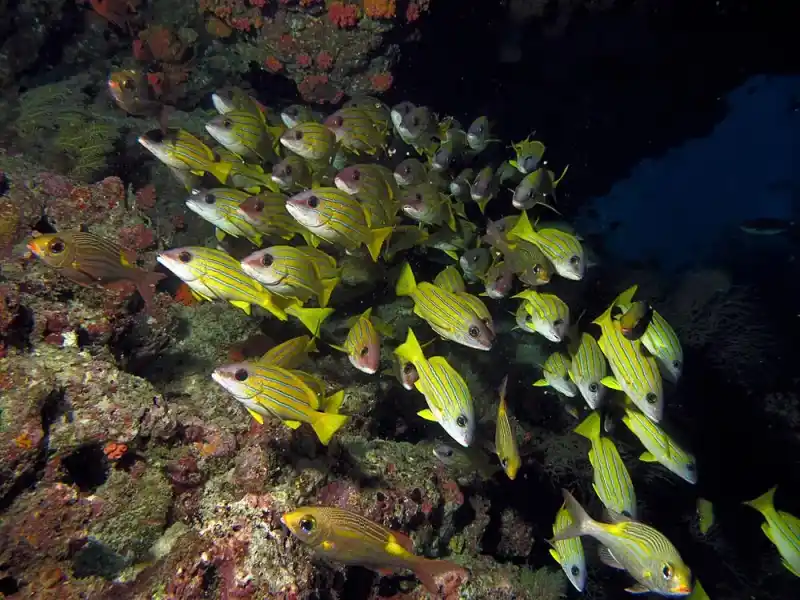
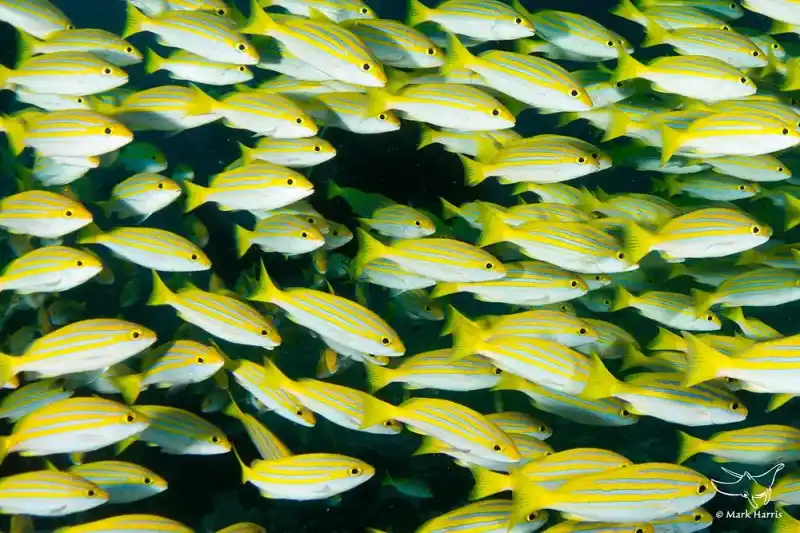
The five-lined snapper ( Lutjanus quinquelineatus ) belongs to the family Lutjanidae and is a common small to medium-sized carnivorous fish found in tropical Indo-Pacific coral reefs. It has five parallel longitudinal stripes on its sides (mostly yellow or blue-yellow). During the day, it often rests or swims in groups at the entrances, tops, or slopes of reefs, and at night it hunts benthic crustaceans and small fish .
Ecology and Biology
Diet: They prey on small fish, shrimp, crabs, amphipods , and polychaetes; adults tend to be carnivorous.
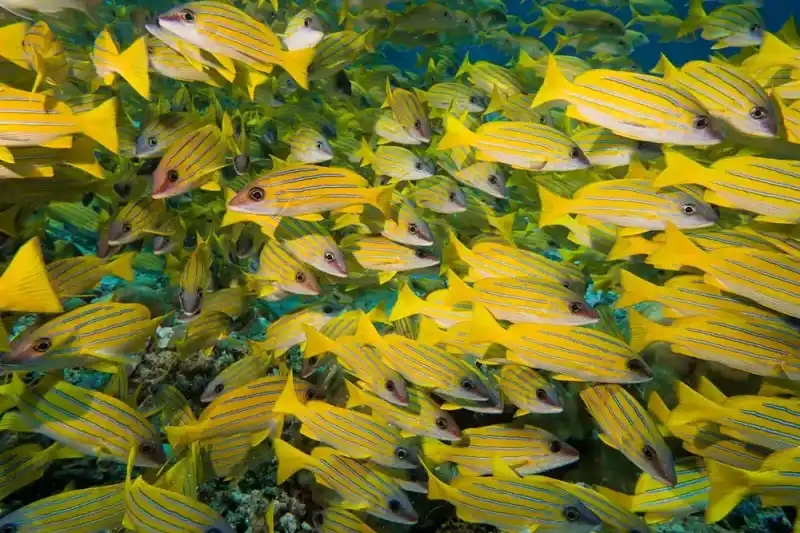
Behavior: During the day, they gather in groups (dozens to hundreds) near the reef caves; at dusk and night, they disperse to forage.
Reproduction: Eggs and fertilization are released in the open ocean; the eggs and fry are buoyant ; juveniles can inhabit shallow areas of lagoons, seagrass beds, or reefs.
Morphology and Recognition
Body color/marking: Five clear longitudinal lines on the sides (a key point to distinguish it from the four-lined L. kasmira ); the back is yellow to yellowish-green, and the abdomen is lighter.
Body shape: elongated, laterally compressed to a medium size; dorsal fin with continuous hard spines in the anterior part and soft rays in the posterior part; caudal fin forked.
Other features: fine dots or short diagonal lines are visible on the back of the head; large eyes and a terminal mouth.
Body size and lifespan
Body length: Commonly 20–30 cm , with a maximum of approximately ~38–40 cm .
Lifespan: Approximately 10–15 years (regional/ethnic differences).
Distribution and Habitat
Widely distributed in the tropical waters of the Indo-western Pacific (Indonesia, Philippines, Papua New Guinea, Solomon Islands, Micronesia, Great Barrier Reef, Australia, etc.), it is often found on reef slopes, reef platforms, outer reef walls, and coral/rocky reef areas of lagoons , at depths of 3–60 m .
Conservation and Human Interaction
Fisheries: It is a regional food and recreational fishing target; there is a risk of ciguatoxin in some waters, please follow local advice.
Conservation: Overall resources are relatively stable, but affected by habitat degradation, overfishing and nocturnal spearfishing; marine protected areas help the population recover.
IUCN: Least Concern (LC) (subject to the latest authoritative assessment).
Frequently Asked Questions
Q1: How to distinguish it from "Blue-banded Snapper" ( L. kasmira )? L. quinquelineatus has five longitudinal lines on its sides; L. kasmira usually has four lines and the bands are bluer.
Q2: Will it attack people? No; it is a small to medium-sized predatory fish and usually keeps its distance from people.
Q3: Why is nocturnal diving common? This species is mostly nocturnal foraging . They gather in groups during the day and are easy to observe, while they disperse at night.
Q4: Is it safe to eat? It depends on the sea area. Some coral reef areas pose a risk of ciguatera toxin poisoning.