Basic Information
Scientific classification
- Chinese name: Rhodesian Ridgeback
- Scientific name: African Lion Dog, African Lion Hound, Rhodesian Hound
- Order: Carnivora
- Classification: Canis lupus, Genus: Canis lupus, Class: Mammalia
Vital signs data
- Body length: 61–68.6 cm
- Weight: 30 kg ~ 39 kg
- Lifespan: 16 years
Significant features
Unique Appearance: The most distinctive feature of the Rhodesian Ridgeback is the hair on its back, which grows in the opposite direction to the hair on the rest of its body. Short, scissor-like hairs grow along the spine, forming the breed's unique trademark. This breed is well-proportioned, muscular, strong, and athletic, possessing a noble temperament.
Temperament and Behavior: Rhodesian Ridgebacks are independent, brave, confident, and intelligent. They are extremely loyal to their owners and deeply love them, but are reserved with strangers. These dogs are intelligent, friendly, and calm, rarely noisy, but can be stubborn when angered, making them beloved family dogs.
Purpose: The Rhodesian Ridgeback was originally used for specialized field hunting, especially for hunting lions, hence its other name, the Lion Dog. Although now primarily used as a police dog and companion dog, it still retains its hunting instincts and unwavering loyalty to its owner.
Adaptability to the environment: Rhodesian Ridgebacks possess a strong physique and a muscular neck and spine, enabling them to run at high speeds across complex terrain without injuring their bones. They have incredible endurance, capable of running over ten kilometers alongside a horse and outrunning antelopes escaping from the jaws of lions, demonstrating their remarkable adaptability to the extreme temperature variations of the African interior.
In conclusion, the Rhodesian Ridgeback is a highly regarded breed due to its unique appearance, brave and intelligent nature, versatility, and strong adaptability to its environment.
Distribution and Habitat
Originally bred and used in South Africa, this breed has been introduced to other parts of the world, including Europe and North America, over time. While their traditional habitat is South Africa, they can now live and breed in suitable environments around the world.
Appearance
The Rhodesian Ridgeback is characterized by its hair growing in the opposite direction to the rest of its body, with a clearly defined ridge that tapers gradually and radiates outwards. The ridge begins behind the shoulders and extends to the two prominent points on the rump, opposite each other, with the lower edge of the points extending beyond one-third of the ridge line. The Rhodesian Ridgeback is well-proportioned, strong, and agile, with a fast running speed and a noble temperament. They are extremely loyal to their owners but maintain a certain distance from strangers. Furthermore, the breed's coat color ranges from light wheat to reddish wheat, with a small amount of white permitted on the chest and toes, but excessive white on the abdomen and toes is considered a disqualifying fault. The head features of the Rhodesian Ridgeback include round eyes, ears close to the head, a powerful and long jaw, and a black or brown nose, corresponding to black or glassy eyes. Their backs are strong and powerful, with well-developed, slightly arched loins. The tail is thick at the base, tapering gradually to the tip, without any coarseness, and may curve slightly upwards but never curled. The Rhodesian Ridgeback's gait is characterized by a level back at long strides, with large, agile, and free strides. The balanced propulsion from the forequarters and hindquarters displays a combination of power and beauty. When running, the back exhibits tremendous speed and endurance.
Detailed introduction

The Rhodesian Ridgeback , also known as the African Lion Dog or Rhodesian Backdog, is a scent hound. With training, it can even become a competent search and rescue dog . Originating in South Africa, its distinctive feature is its spine, along which short, scissor-like hair grows in the opposite direction to the rest of the body, hence its name. This well-proportioned, intelligent, friendly, and calm dog is rarely noisy, but can be very stubborn when angered. It makes a beloved family pet. Skilled at hunting lions, it is also known as the Rhodesian Lion Dog. A versatile dog, it can be used as a hunting dog, guard dog, and companion dog. Lively, large, and powerful, with a tenacious and resilient temperament, it is one of the world's most famous hunting dog breeds. While it may not be the fiercest fighter in a one-on-one fight, it is certainly a survivor. It requires a spacious living environment . Its lifespan is 16 years.
Market reference price: Usually above RMB 10,000
Morphological characteristics
Height: Ideal height for males is 63-67 cm; for females it is 61-66 cm.
Weight: 30 kg ~ 39 kg
Head: Long head with a well-developed jaw. Black or brown nose, matching the eye color, and a long, thick muzzle. Medium-length ears, set high on the head. Amber or dark brown eyes.
Fur: Dense, short, smooth, and glossy; common colors include light wheat, reddish wheat, pale fawn, or red. Body: Robust, with a deep chest and well-developed muscles. Limbs: Strong and powerful, with well-developed muscles. Tail: Long, tapering to a thin tip, with a strong tail set downwards when moving.
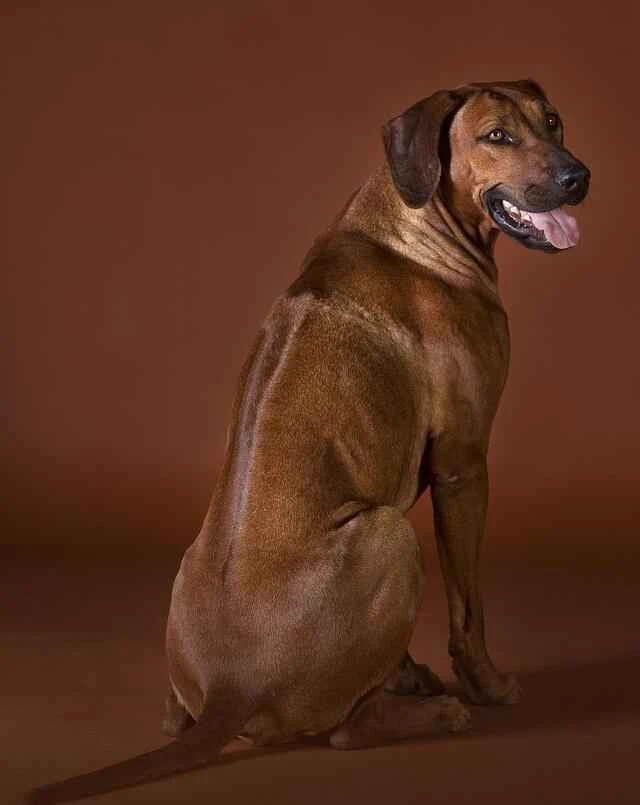
The most distinctive feature of the Rhodesian Ridgeback is the presence of hair growing in the opposite direction to the rest of the body on its back – the reverse hair. This reverse hair is very clearly defined, slightly thinner at both ends, and symmetrical. It begins behind the shoulders and extends to the middle of the rump, consisting of two identical whorls, one on each side. The lower edge of each whorl should not be lower than one-third of the length of the reverse hair on the back .
The coat is short, thick, smooth, and glossy. It is neither woolly nor silky. The short, scissor-like hairs on the back grow in the opposite direction to the hair on other parts of the body, a typical characteristic of this dog. The hairs on the back are very distinct, tapering slightly at both ends, and symmetrical. Starting from behind the shoulders, extending to the middle of the rump, they include two identical whorls, one on each side, with the lower edge of the whorl not falling below one-third of the length of the hairs on the back . A small amount of white on the chest and toes is permissible, but excessive white on the abdomen or above the toes is disqualifying. The absence of hairs on the back is a disqualification, and having only one whorl or more than two whorls is a serious fault. The coat on the back grows forward; in cold climates, the coat is short, dense, smooth, and glossy, with a well-developed, coarse undercoat .
dog breed history
The Rhodesian Ridgeback, also known as the Lion Dog, is a breed of dog specifically designed for hunting in the wild. From around the 16th century onwards, European immigrants brought large hunting dogs to South Africa, such as Great Danes, Mastiffs, Greyhounds, Bloodhounds, and other breeds. These dogs played a crucial role in the development of the Rhodesian Ridgeback.
In 1877 , two Rhodesian Ridgebacks participated in a large hunting expedition in Rhodesia, where their outstanding performance earned them a high reputation. In 1955, the AKC registered the breed as a purebred. The Rhodesian Ridgeback is highly regarded in the United States; its efficient working ability, gentle nature, and fondness for children make it popular with American families.
Around the 16th and 17th centuries , European immigrants brought bloodhounds, mastiffs, and various terrier breeds to South Africa. These dogs interbred and evolved with the local wild hunting dogs — the Hottentot hounds of Africa. In the late 19th century, the Boers successfully bred the Rhodesian Ridgeback. In 1922 , at a breeding conference held in Bulawa Kiln, Zimbabwe, the standard for this robust dog was established, with the prevailing trend being to merge five existing breeds into one. Used in packs for hunting leopards, buffalo, antelope, or lions, the Rhodesian Ridgeback is renowned for its endurance and agility; it is said that a group of three dogs could hunt a lion. It is also a scent hound for large game. These dogs attract the hunter's attention with their barks, and their large size and strength protect them from attack. Due to their loyalty and affection , they were later found to be better suited for long-distance tracking than aggressive behavior. Today, they are no longer used for hunting but are primarily used as police dogs and companion dogs.
Temperament : The Rhodesian Ridgeback is known for its steady and intelligent temperament, its friendly and affectionate nature, and its infrequent barking. It is brave, tenacious, and highly tolerant, able to endure 24 hours without water and withstand the extreme temperature variations of the African interior, making it an excellent hunting dog.

Overall evaluation
The Rhodesian Ridgeback is a sturdy, muscular, and lively dog with a well-proportioned and stable build. A mature Rhodesian Ridgeback appears handsome and robust, is athletic, and possesses great stamina and speed. It has a peaceful yet dignified temperament, deeply loves its owner, but is reserved around strangers.
While adult dogs tend to be calmer, puppies can be just as active as other sporty dogs.
Moreover, they mature relatively slowly, generally only stabilizing after the age of 3.
They are easily driven by curiosity to try and jump over high walls — they are notorious escape artists.
Suitable for hot weather, doesn't require frequent grooming, is not easy to train, doesn't get along well with other dogs, and can be troublesome.
breed defects
Some believe the " spine " on the back of this breed is formed by an abnormal protrusion of the vertebrae. However, it's actually just the result of reversed hair growth along the spine on their back—somewhat resembling a sword-shaped " hair whorl ." A defect called a "dermal sinus " exists , which can indeed affect the nervous system. However, the incidence is extremely low—according to statistics from the Rhodesian Ridgeback Club of America in 1996, the overall prevalence was only 5.3% .
Furthermore, because dogs with dermal sinus defects cannot participate in dog shows, they are generally excluded from breeding by legitimate breeders.
Therefore, the breed's defects have actually decreased over time. Besides Ridgebacks, this problem has also been observed in Shiba Inus, Boxers, Siberian Huskies, Cocker Spaniels, Yorkshire Terriers, and some mixed breeds.
Feeding methods
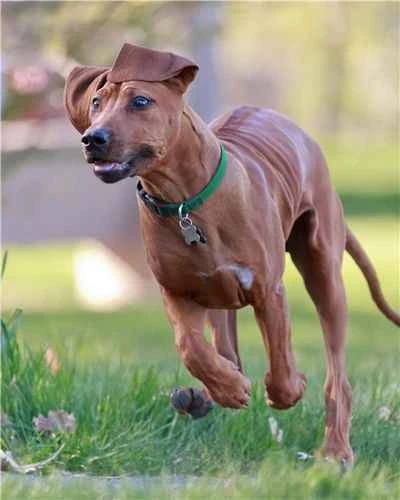
The Rhodesian Ridgeback is renowned for its lion-hunting prowess , possessing formidable speed and stamina. Therefore, its home should be spacious, providing ample room for its basic exercise needs. A large yard would certainly make it happy. Rhodesian Ridgebacks are lively and active; a cramped space will not satisfy their energy requirements and will only give them more opportunities to display their destructive tendencies.
The Rhodesian Ridgeback has a short, dense coat that's very easy to groom and won't take long. Regular brushing is all that's needed; increase brushing frequency during shedding season to remove dead hair and maintain its handsome appearance. Furthermore, Rhodesian Ridgebacks are naturally clean and odorless, making them ideal for people who appreciate cleanliness.
Suitable population
Rhodesian Ridgebacks can adapt to hot weather, do not require special grooming, are difficult to train initially, and do not get along well with other dogs. They are true fierce dogs with very high exercise needs, are not suitable for city life, and are highly adaptable to climate.


