Basic Information
Scientific classification
- Chinese name: Wandering Albatross
- Scientific name: Diomedea exulans
- Classification: Waterfowl
- Family and genus: Proteromorpha, Albatrossidae, *Albatross*
Vital signs data
- Body length: Approximately 1.35 meters
- Weight: 6-12kg
- Lifespan: 20-30 years
Significant features
It is the largest albatross species and also the bird with the longest wingspan among all bird species.
Distribution and Habitat
Wandering albatrosses live near the Southern Ocean and breed on the islands on the back of Antarctica, particularly: South Georgia (United Kingdom), Prince Edward and Marien Islands (South Africa), Crozet and Kerglen Islands (France) and Macquarie Island (Australia).
Appearance
The wandering albatross has the largest wingspan of any living bird, averaging 3.1 meters, with the largest confirmed wandering albatross reaching 3.7 meters. This enormous wingspan grants the wandering albatross excellent gliding ability; they can remain airborne for hours without flapping their wings, and can glide 22 meters for every meter of descent. Its body length is approximately 1.35 meters, with females typically slightly smaller than males. Weight generally ranges from 6 to 12 kilograms, although some chicks have been recorded weighing up to 16.1 kilograms on their first flight. Generally, plumage color is related to age; adult wandering albatrosses are entirely white, with wings typically black and white. Females' wings are whiter than males', with black tips and trailing edges. They also have a faint peach-shaped spot on the side of their head. Although not very obvious, the Wandering Albatross has the whitest plumage when compared with other newly separated species from the Wandering Albatross (such as the Argonaut, Tetsuidae, and Angonaut). Other species of breeding-age albatrosses have more black on their wings and bodies, much like immature Wandering Albatrosses. The Wandering Albatross has a large beak, and both its beak and legs are pink.
Detailed introduction
The wandering albatross, scientifically known as *Diomedea exulans*, is the largest albatross species and also has the longest wingspan among birds, averaging 3.1 meters and reaching up to 3.7 meters.
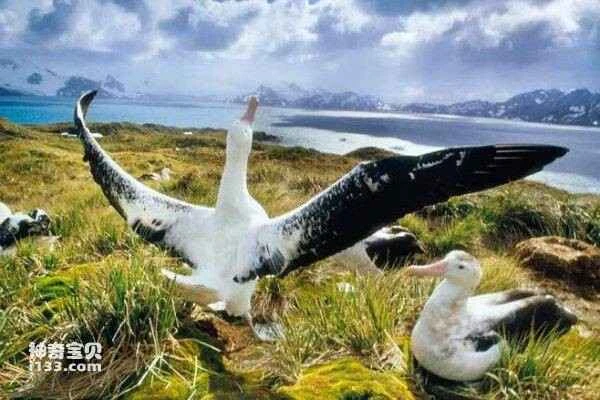
Wandering albatrosses mostly live in the Southern Hemisphere. In the area around 40 degrees south latitude, where strong westerly winds whip up huge waves for 27 days each month, this is the albatross's ideal paradise. It often uses these westerly winds to make long-distance flights from west to east, covering 15,000 kilometers in 10 months. When there is no wind, it rests on the surface of the sea, and at night it floats on the surface. Wandering albatrosses are excellent divers, the most prolific divers among albatrosses, capable of diving to depths of 12 meters. Its stomach is also unique, changing its diet according to weather conditions. The average lifespan of a wandering albatross is 22.8 years, spending nine-tenths of its life at sea, feeding on squid, small fish, and shipwreck waste.
Wandering albatrosses can accurately fly back to their birthplace after the age of four and begin searching for a mate. They typically "observe" for one to two years before committing to a relationship. Wandering albatrosses reach adulthood at six or seven years old, at which point the female begins laying eggs. Each breeding cycle involves laying only one egg, which is white with spots and approximately 10 centimeters long. Incubation takes 78 days, followed by 20 days of care and regular feeding. Both parents share the responsibility of raising the offspring, continuing until the chick is at least two-thirds the size of its parents.
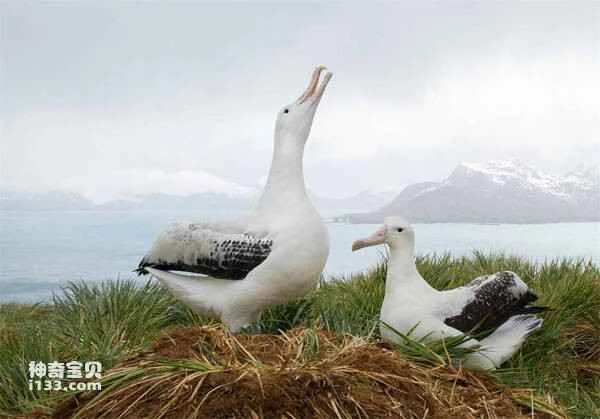
During the breeding season, they occupy loose territories on islands in the Southern Ocean (such as Auckland, New Zealand, and the Prince Edward Islands) to build nests and raise their young. Their nests are volcano-shaped, constructed of plants, and are about one meter wide at the base and half a meter wide at the top.
The wandering albatross is incredibly resilient. Initially, they lived undisturbed and without predators. Discovered by sailors in Chinese waters in the 20th century, they suffered a devastating catastrophe when their eggs and feathers were stolen. They virtually disappeared from the population in the late 1940s and 1950s. In 1954, over 200 were found on Torishima Island, Japan. Later, they were again targeted by the US Air Force, reducing their numbers to just over 40. They then returned to China. Their population has now grown to over 800.
Listed as Vulnerable (VU) in the IUCN Red List of Threatened Species 2018 ver 3.1.
Protect wild animals and ban the consumption of wild game.
Maintaining ecological balance is everyone's responsibility!