Basic Information
Scientific classification
- Chinese name: Albatross
- Scientific name: Phoebetria fusca
- Classification: Waterfowl
- Family and genus: Protocerciformes, Albatrossidae, Albatross genus
Vital signs data
- Body length: 84-89 cm
- Weight: 2.4-2.7kg
- Lifespan: No verification data available.
Significant features
Distribution and Habitat
Distributed in south-central Africa (including the southern Arabian Peninsula and the entire African continent south of the Sahara Desert (Tropic of Cancer), South America (including Colombia, Venezuela, Guyana, Suriname, Ecuador, Peru, Bolivia, Paraguay, Brazil, Chile, Argentina, Uruguay, and the Falkland Islands), Australia and New Zealand (including Australia, New Zealand, Tasmania and their surrounding islands), and Antarctica (including the Antarctic continent, the Antarctic Peninsula, and several islands such as the South Shetland Islands and South Georgia Island).
Appearance
The body length of the albatross is 84–89 cm; wingspan is 203 cm; and weight is 2.4–2.7 kg, with males being slightly larger.
Detailed introduction
The black albatross, scientifically known as Phoebetria fusca, is a medium-sized albatross.
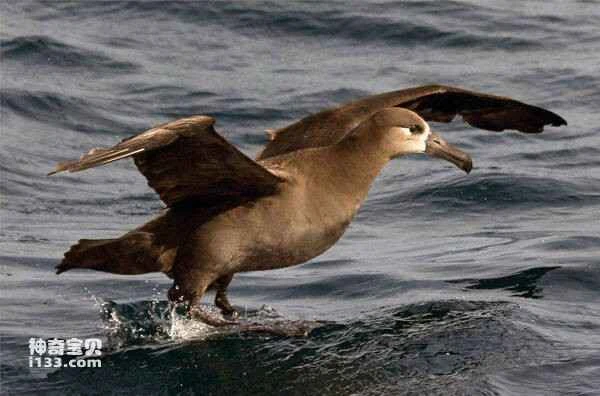
The albatross is a large, nomadic seabird widely distributed across the ocean. Except during the breeding season, it spends almost all its time flying at sea, only soaring over harbors or bays during stormy seasons. At sea, it often follows ships, skillfully using the updrafts generated by the ship's movement to glide and circle. Its wings are almost invisible as it flies, its two small eyes constantly watching the stern. If it spots leftover food discarded by the crew or fish killed or injured by the ship's propeller, it immediately swoops down and snatches the food before seagulls or other birds. Albatrosses are fierce, with a large, powerful, curved beak. Squid, fish, and shrimp are its main prey. Even after catching its prey and escaping the ship, it can catch up with it with just a few flaps of its wings.
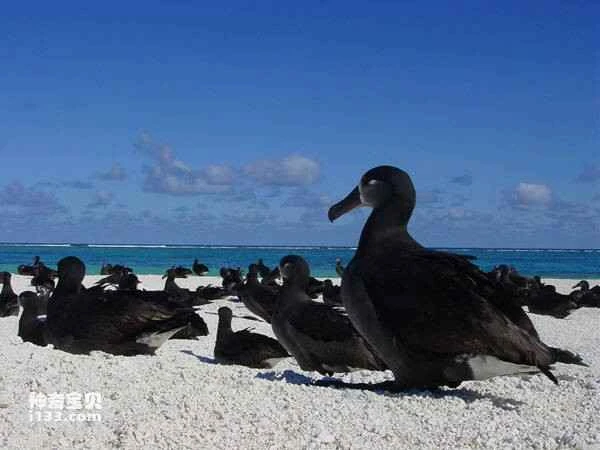
Albatross is monogamous, and its breeding season is from September to December. It lays one egg at a time, which is incubated by the female and takes 65 to 75 days.
It is listed as Endangered (EN) on the IUCN Red List.
Protect wild animals and ban the consumption of wild game.
Maintaining ecological balance is everyone's responsibility!