Basic Information
Scientific classification
- Chinese name: Grey-backed Albatross
- Scientific name: Phoebetria palpebrata, Light-mantled Albatross
- Classification: Waterfowl
- Family and genus: Protocerciformes, Albatrossidae, Albatross genus
Vital signs data
- Body length: 79-89 cm
- Weight: 2.5-3.7kg
- Lifespan: Approximately 40 years
Significant features
Feather color similar to Siamese cats
Distribution and Habitat
Grey-backed albatrosses are found in the oceans and islands surrounding Antarctica, as well as along the southern coasts of South America, Australia, and New Zealand.
Appearance
The grey-backed albatross is primarily coal brown or black, with a darker head that lightens in color from the nape to the upper tail coverts, ranging from grey to pale grey. The cape and back are also lighter in color, and this plumage has been described as resembling that of a Siamese cat. Part of the eye is surrounded by a thin crescent-shaped band of very short grey feathers. The beak is black with a blue groove and a greyish-yellow line along the lower jaw (beak), measuring approximately 105 mm (4.1 inches) in length. Measurements indicate that males and females are similar in size, with an average body length of 79–89 cm (31–35 inches), a wingspan of 183–218 cm (72–86 inches), and a weight of 2.5–3.7 kg (5.5–8.2 lbs).
Detailed introduction
The Light-mantled Albatross, scientifically known as *Phoebetria palpebrata*, is a small albatross belonging to the family Phoebetriaceae in the order Procellariiformes. It is a bird with mostly black plumage.
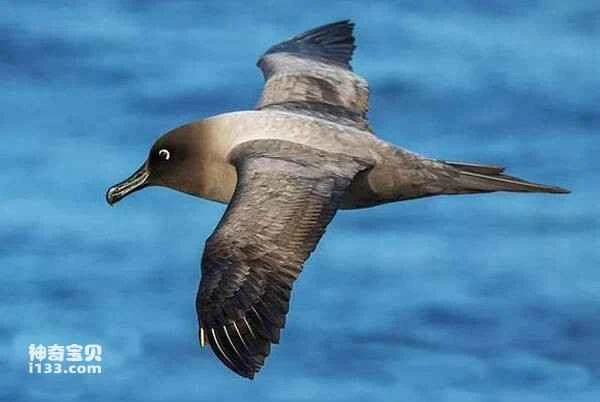
The grey-backed albatross digs up soil and plants, piling them up to form a deep, cup-shaped pit on top. It can glide long distances with its wings spread, floating on the sea surface to feed on fish, squid, and crustaceans. During courtship, they fly in pairs or face each other on the ground, displaying their white crescent-shaped eye stripes and stripes on their beaks. They build nests in pairs on steep, protruding sections of islands in the Southern Hemisphere.
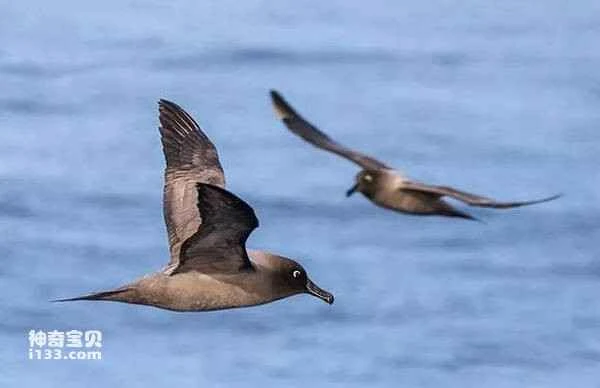
It is currently classified as Near Threatened by the International Union for Conservation of Nature (IUCN).
Protect wild animals and ban the consumption of wild game.
Maintaining ecological balance is everyone's responsibility!