Basic Information
Scientific classification
- Chinese name: Fence-shaped skink
- Scientific name: Cryptoblepharus virgatus
- Classification: Squamata
- Family and genus: Skinkaceae, Scalypsus
Vital signs data
- Body length: Adults typically have a snout-vent length of about 4–6 cm, and a total length including the tail of about 10–15 cm, which is a small and slender skink.
- Weight: Weight varies from person to person, with most adults weighing only a few grams to a dozen grams.
- Lifespan: Individuals in the wild can generally live for several years, and may live even longer in areas with less disturbance and suitable climate.
Significant features
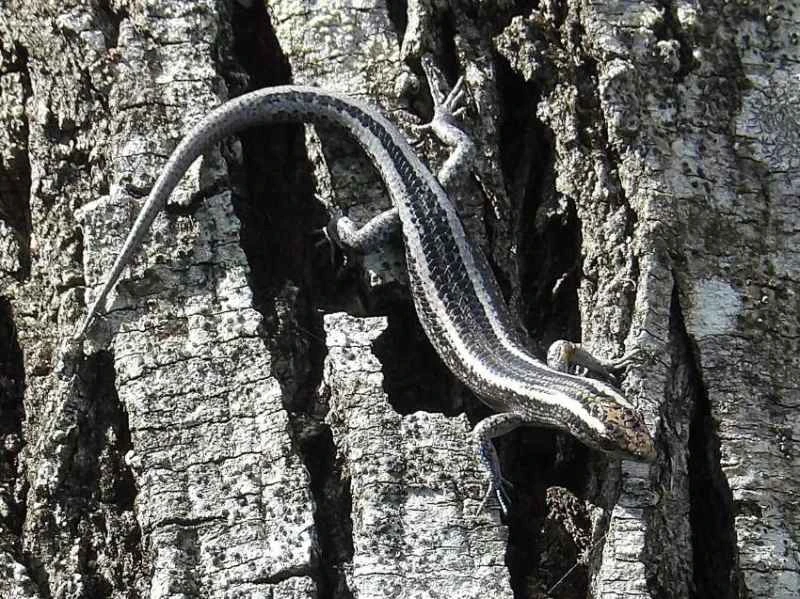
Small in size and extremely agile, they are often found on vertical surfaces such as fences, walls and tree trunks in residential areas. When startled, they quickly burrow into crevices. They are a typical small skink in urban and suburban environments.
Distribution and Habitat
They are mainly distributed in parts of the eastern coastal and near-inland areas of Australia. They prefer environments such as forest edges, rocky slopes, and fences, walls, tree trunks, and piles of stones around human settlements. As long as there are rough surfaces and hidden crevices, they are suitable for their activities and habitats.
Appearance
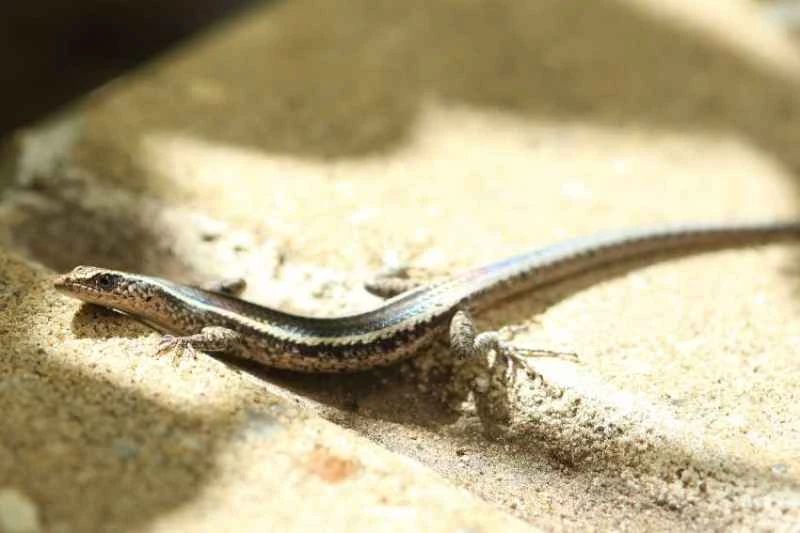
The body is slender, the head is slightly triangular, and the eyes are covered with transparent scales, appearing to lack movable eyelids. The back is mostly grayish-brown or brownish-gray, often with light-colored longitudinal stripes and dark edges along the sides, and some individuals have scattered small spots; the belly is lighter, white or light gray, and the body surface is covered with fine and smooth scales.
Detailed introduction
Fence skinks (commonly referring to species in the genus *Cryptoblepharus virgatus *, etc.) are a group of small, extremely agile skink lizards. They are widely distributed in parts of Australia, especially common in residential areas, garden fences, stone walls, and tree trunks, hence the name "fence skink" or "wall lizard." Because of their ability to run quickly and swiftly across vertical surfaces, fence skinks are among the most easily "noticed but elusive" small lizards in urban and suburban environments.
Classification and nomenclature
Fence skinks belong to the class Reptilia, order Squamata, family Scincidae, and genus Cryptoblepharus . One of the characteristics of Cryptoblepharus skinks is the presence of transparent scales covering the outer edges of their eyes, making them appear as if their eyelids have disappeared, hence the name "snake-eyed skink" or "snake-eyed lizard." "Fence skink" is not a common Chinese name specific to a single species; in everyday science popularization, it is generally used to refer to small Cryptoblepharus lizards commonly found on fences and walls in residential areas. Here, Cryptoblepharus virgatus is used as a representative species for introduction.
Appearance features
The fence skink is small and slender, with a snout and vent length typically only a few centimeters, and a relatively long tail, giving an overall impression of being "slender and light." The head is slightly triangular, with small eyes covered in transparent scales, making it appear as if it lacks movable eyelids. The back is mostly grayish-brown, brownish-red, or olive-brown, with one or more light-colored longitudinal stripes (such as cream or yellowish-white) contrasting with the dark edges along the sides of the body; some individuals also have small spots scattered on their sides. The underside is lighter in color, mostly white or light gray. The scales on the body are dense and smooth, slightly glossy under sunlight, which facilitates rapid gliding and maneuvering through narrow gaps.
Distribution range and habitat
The fence skink, represented by * Cryptoblepharus virgatus* , is mainly distributed in parts of the coastal and near-inland areas of eastern Australia, and can be found on forest edges, rocky slopes, coastal grasslands, and around human settlements. They exhibit a strong preference for vertical surfaces, frequently appearing on fences, stakes, brick walls, rock walls, tree trunks, and even the exterior walls of houses, using rough surfaces and crevices to avoid predators and extreme weather. In cities and suburbs, the fence skink has adapted well to habitats altered by humans; given sufficient vegetation, rocks, and fence structures, it can establish stable small populations.
Lifestyle Habits and Behaviors
The fence skink is a typical diurnal lizard, most active during the day when the sun is shining and the temperature is suitable. They like to bask in the sun at dawn and afternoon, climbing to the top of fences, wall protrusions, or tree branches, then quickly darting along vertical or sloping surfaces to forage. Once they sense a human or predator approaching, they will swiftly slip into a crevice or onto the other side of the wall, making them difficult to catch. The fence skink is extremely agile, adept at moving in narrow spaces, among branches and leaves, and in corners, sometimes even making short "jumps" to avoid threats. During the colder season, their activity decreases significantly, spending more time hiding in crevices or under fallen leaves and branches.
feeding habits
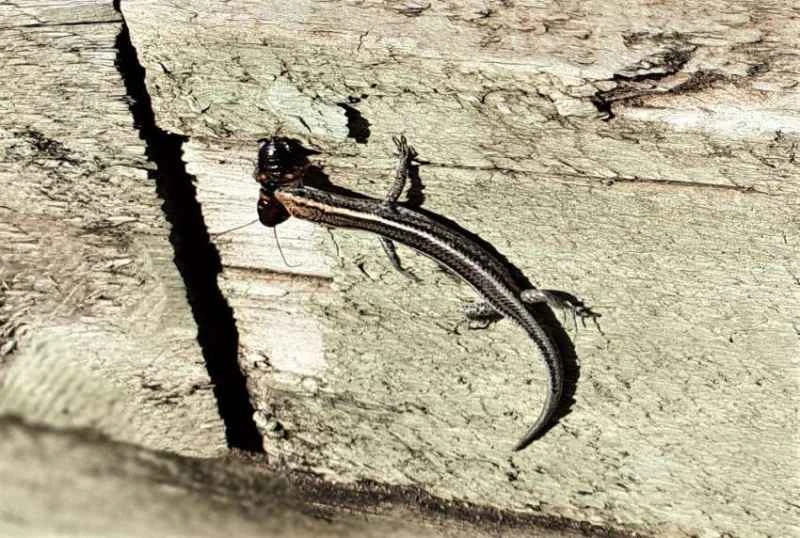
The fence skink primarily feeds on insects and other small invertebrates, and is a typical carnivorous or partially carnivorous predator. Its main diet includes ants, small beetles, aphids, mosquitoes, flies, small moths and their larvae, spiders, and other arthropods living on walls, tree trunks, and the ground. They typically spot small prey by sight, quickly approaching and snapping them in one swift motion. In residential areas and gardens, the fence skink indirectly helps reduce the population of some small insects, acting as an "invisible little helper" for humans.
Reproduction and life cycle
The fence skink is an oviparous lizard. The breeding season is generally from spring to summer. Males will search for females within their range, courting them through chasing and displaying physical postures. After mating, the female will lay a small number of eggs (usually a few) in a damp, safe hiding place (such as under rocks, in crevices, or under decaying wood), which will then incubate under the influence of ambient temperature and humidity. The hatchlings are very small but resemble adults, and quickly begin to hunt small insects independently. The fence skink grows relatively quickly, reaching sexual maturity within a few years. Their lifespan in the wild is typically several years, and may be longer in undisturbed environments.
Relationship with humans
Fence skinks are non-toxic and pose no direct threat to humans. In fact, by preying on ants, small insects, and spiders, they can help control arthropod populations around residential areas. They are commonly found on yard walls, fences, and house exteriors, and are sometimes mistaken for small animals "invading" homes. However, in most cases, they simply remain on walls and outdoor structures without causing damage. In some areas, fence skinks are also used for ecological education and nature observation, showcasing the diversity of urban wildlife to the public.
Protecting the status quo and threats
Overall, the fence skink and its close relative, the snake-eyed skink, are relatively stable in many parts of Australia and are generally assessed as "Least Concern" or not listed as critically endangered. However, local populations may still be affected by factors such as habitat hardening due to urban expansion, lack of natural vegetation and rock structures in yards and parks, predation by domestic cats, and increased pesticide use. Practical measures to protect this small lizard include preserving some shrubs, leaf litter, and rock piles in residential areas and parks, reducing unnecessary pesticide spraying, and encouraging awareness that the fence skink is a beneficial and harmless native small reptile.
Frequently Asked Questions
Q1: Are fence skinks poisonous? Will they bite?
The fence skink lacks venom glands and is not a venomous lizard, posing no threat to humans. They are generally extremely wary of people and will immediately flee rather than attack if someone approaches. Even in the rare cases where they are caught and bite, it usually only causes minor skin scratches.
Q2: Why do we often see fence skins on the exterior walls or fences of houses?
Fence skinks prefer vertical or sloping surfaces, such as wooden, brick, or concrete fences and walls. These locations provide ample sunlight for basking, offer crevices and structures for hiding, and often attract large numbers of insects, making them ideal foraging and habitat environments.
Q3: Will the skinks on the fence get inside? Should they be driven away?
Most fence skinks confine their activity to outdoor structures, but may occasionally wander indoors. In such cases, simply shoo them away gently or open doors and windows to let them leave on their own. They do not gnaw on furniture or attack humans unprovoked, so there is generally no need to worry excessively or attempt to exterminate them.
Q4: How to protect fence skinks in courtyard and urban environments?
To mitigate the risk of poisoning, it is advisable to preserve some shrubs, leaf litter, and rock piles to provide shelter; reduce the use of highly toxic pesticides to lower the risk of poisoning by insects and small reptiles; control the outdoor hunting behavior of domestic cats as much as possible; and inform family and neighbors about the ecological value and harmlessness of fence skinks to avoid accidental killing.


