Basic Information
Scientific classification
- Chinese name: Buzzing Frog
- Scientific name: Cophixalus bombiens
- Order: Anura
- Family: Microhylidae Cophixalus bombiens
Vital signs data
- Body length: Adults typically measure 18–25 mm in length, making them small terrestrial frogs.
- Weight: Individual weight is only a few grams, depending on sex, season and nutritional status.
- Lifespan: It is estimated that the animal can survive for several years in its natural environment, but the actual lifespan varies depending on habitat conditions and predator pressure.
Significant features
A small tadpole commonly found on the ground in the rainforests of northeastern Australia. The male tadpole makes a buzzing sound similar to an electric current during the wet season. The eggs are laid in moist, sheltered places on land and develop directly into small frogs without a free-swimming tadpole stage.
Distribution and Habitat
Endemic to the mountain and hilly rainforests of the high-rainfall region in northeastern Queensland, Australia, they mainly live in moist microhabitats on the surface formed by thick layers of fallen leaves, decaying wood, tree roots and rock crevices, and are mostly active at dusk and night.
Appearance
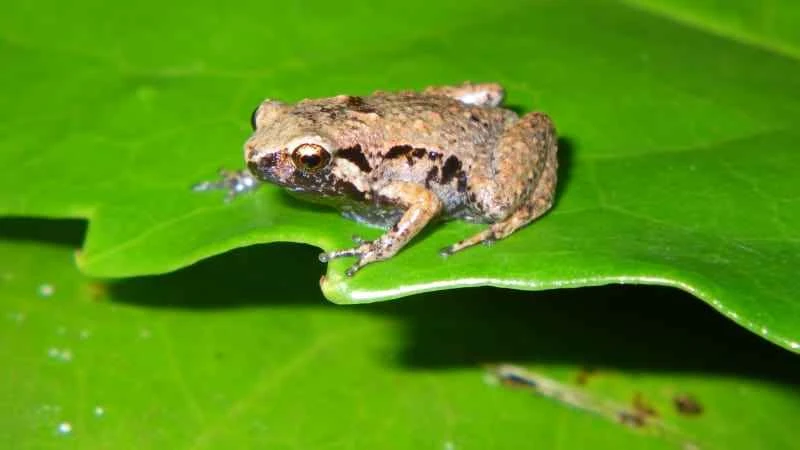
It has a short, round body and slender limbs. Its back is brown or grayish-brown with irregular markings, similar in color to fallen leaves and bark. Its ventral side is lighter in color, and the tips of its fingers and toes are slightly enlarged to form small discs, which helps it grasp moist leaves.
Detailed introduction
The Buzzing Nursery Frog ( Cophixalus bombiens ) is a small, terrestrial frog found in the rainforests of northeastern Australia. It belongs to the family Microhylidae . It gets its name from the distinctive buzzing call of the male and its reproductive method of laying eggs in moist, sheltered terrestrial locations, nurturing the early development of the young like a nursery.
Classification and nomenclature
Common Chinese name (common translation): Buzzing Baby Frog (tentative translation)
English name: Buzzing Nursery Frog
Scientific name: Cophixalus bombiens
Family: Microhylidae → Genus: Cophixalus
Appearance and Identification Features
The buzzing brood frog is a typical "rainforest ground frog," small in size but with excellent camouflage.
Size: Adults typically measure 18–25 mm in length, classifying them as small frogs;
Body shape: The body is slightly short and round, the snout is blunt and short, and the limbs are slender but suitable for climbing among fallen leaves and tree roots;
Body color: The back is mostly brown, grayish-brown or olive, often with spots or irregular stripes of varying shades, which are very similar to the color of wet fallen leaves and tree bark.
Abdomen: The abdomen is relatively light in color, mostly grayish-white or pale yellow, with scattered small spots;
Other features: The tips of the fingers and toes are slightly enlarged, forming small discs, which helps to grasp slippery leaves and twigs; the eyes are relatively large, which is beneficial for movement in dark environments.
Overall, it looks like a small, unassuming brown frog that is very good at hiding on the rainforest floor.
Distribution range and habitat
The humming brood frog is endemic to Queensland in northeastern Australia , primarily inhabiting hilly and mountainous rainforests with high rainfall.
Their distribution areas are mostly located in humid tropical or subtropical rainforests;
They are commonly found in rainforests on hillsides, along streams, and in moss-rich understory environments.
They prefer surface microenvironments with thick layers of fallen leaves, decaying wood, tree roots, and rock fissures.
They spend most of their time hiding in piles of fallen leaves, under rotten wood, and in crevices between tree roots , only coming out to be active and chirp during damp weather, at dusk, and at night.
Habits and calls
The buzzing brooding frog is a typical nocturnal small frog :
During the day, they hide under thick layers of dead leaves or decaying wood to prevent moisture loss from their bodies.
Active at dusk and night, moving slowly or leaping short distances across the rainforest floor;
The male frog croaks after rain or during the wet season, making a sound similar to a "buzzing" electric current or a soft buzzing , hence the name "Buzzing Nursery Frog".
Because of their small size and good camouflage, people often hear their calls first and then painstakingly search among the fallen leaves for the real "source of the sound".
feeding habits
The babbling frog primarily feeds on various small invertebrates.
Insects such as ants, small beetles, and springtails that live on the ground;
Small spiders and other arthropods;
They also occasionally feed on mollusc larvae or very small insect larvae.
They use their vision and sensitive receptors for vibrations to spot prey moving on the leaf litter, then quickly extend their mucus-covered tongues to capture it.
Reproduction strategies and parenting methods
The name "Nursery Frog" comes from the unique terrestrial reproduction and direct development method of this genus of frogs:
Breeding usually takes place during the rainy season or high humidity period, with male frogs calling out in hidden places on the ground to attract female frogs.
Female frogs do not lay their eggs directly in ponds or bodies of water , but rather in moist cavities under fallen leaves, beside tree roots, or in cracks in decaying wood.
The eggs develop in the moist environment on land, and the embryo completes the process from "egg" to "frog".
The frogs hatch directly from their four limbs , without the typical free-swimming tadpole stage.
This "direct development" allows the babbling frog to break free from its dependence on stable water bodies, making it highly adaptable to the seasonally variable and still water-limited environment of mountain rainforests.
Protecting the status quo and threats
According to current assessments, the Buzzing Frog is listed as Least Concern (LC) on the International Union for Conservation of Nature (IUCN) Red List, and the overall population remains relatively stable.
Potential threats include:
Rainforestation and habitat fragmentation have disrupted the continuous understory environment available to small terrestrial frogs.
Road construction and tourism development have led to the drying up and increased pollution of marginal habitats;
Climate change is causing changes in rainfall patterns, which may affect the high-humidity environment that they depend on for reproduction.
The key to protecting the babbling frog is to maintain the integrity of the rainforests in northeastern Australia and the moisture and cover of the surface microhabitats.
Frequently Asked Questions
Q1: Do humming babbler frogs really "care" for their young?
The name "baby frog" primarily emphasizes its unique reproductive method.
The eggs are laid in a moist terrestrial environment and develop directly into small frogs, rather than undergoing a long tadpole stage in the water.
In some related species, female frogs were also observed lingering near the egg mass and exhibiting a certain degree of guarding behavior towards the eggs.
However, they do not "raise their young" for extended periods like mammals.
Q2: Why is it so difficult to see the buzzing tadpole in the wild?
They are small in size, have excellent camouflage, and prefer to hide in piles of fallen leaves and under decaying wood.
They are mostly active at night or after rain, so even if there are many of them, they are not easy to spot.
In the rainforest, "listening to the sound to find frogs" is often more effective than simply looking for them.
Q3: Is the humming brood frog poisonous? Is contact with it dangerous?
There is currently no evidence that the buzzing tadpole is significantly toxic to humans; the skin secretions of small frogs are mainly for defense against predators.
If movement or observation is required, it is recommended to gently transfer the item using damp gloves or a container, and then wash your hands.
Q4: What role does this small frog play in the ecosystem?
The buzzing tadpole feeds on large numbers of small arthropods, which helps control invertebrate populations.
It also provides food for snakes, birds and small mammals, making it an important part of the rainforest surface food web.