Basic Information
Scientific classification
- Chinese name: Bibrown toad
- Scientific name: Pseudophryne bibronii
- Order: Anura
- Family: Myobatrachidae Pseudophryne bibronii
Vital signs data
- Body length: Adults are about 25–35 mm in length, belonging to small terrestrial frogs.
- Weight: Individual body weight is usually only a few grams, but varies depending on sex and body condition.
- Lifespan: It is estimated that they can live for several years in the natural environment, and an individual can experience multiple breeding seasons.
Significant features
A small terrestrial frog common in eastern Australia, it has a dark back, distinct black and white marbled patterns on its belly, and orange-red patches on its sides and groin. During breeding, the eggs are first laid in a moist terrestrial environment, and the tadpoles then enter the water to develop after being submerged by heavy rain.
Distribution and Habitat
Native to eastern and southeastern Australia, it is commonly found in woodlands, thickets, grasslands, and heather thickets from southeastern Queensland to New South Wales, Victoria, and parts of South Australia, often among leaf litter, rocks, and deadwood.
Appearance
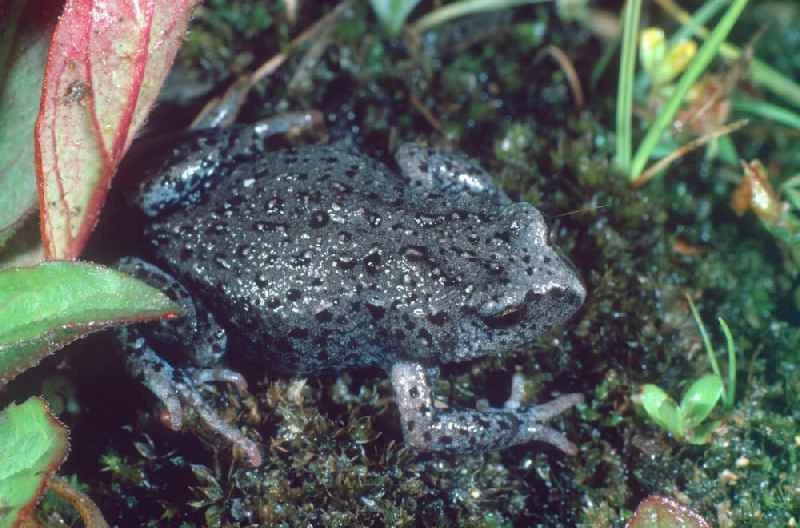
It is small and slightly stout in size, with a brownish-black to almost black back with light-colored markings, a black and white marble pattern on the abdomen, and small orange or reddish-brown spots on the sides of the body and limbs.
Detailed introduction
Bibron's Toadlet is a small, terrestrial frog belonging to the family Myobatrachidae , scientifically named *Pseudophryne bibronii *. Native to eastern and southeastern Australia, it is a typical "ground frog," often found quietly in leaf litter, grass, and under bushes.
Classification and nomenclature
Common Chinese name: Bibrown toad (also translated as Bibrown toad, small local frog, etc.)
English name: Bibron's Toadlet
Scientific name: Pseudophryne bibronii
Family and genus: Myobatrachidae (Family of Australian frogs) → Pseudophryne (Genus of toads)
Appearance and Identification Features
The smaller than Brown toad is small in size but has distinctive markings and a strong contrast between its back and belly, making it very recognizable.
Size: Adults typically measure about 25–35 mm in length, classifying them as small frogs;
Body shape: The body is slightly stout and the limbs are relatively short. The overall shape is somewhat similar to a small toad, hence the "toadlet" in the English name;
Body color and pattern: The back is mostly dark brown, grayish brown or nearly black, with irregular light-colored spots or cloud-like patterns scattered on it; bright orange or reddish-brown small patches are often visible on the sides of the body, limbs and groin.
Ventral side: The abdomen usually has a distinctive black and white marble pattern , with black spots forming a strong contrast with the white background, which is one of the typical characteristics of the genus *Bufo*.
Skin texture: The back is slightly rough with scattered small bumps; the ventral side is relatively smooth.
This black and white color scheme with orange and red is believed to have a certain warning effect, alerting predators that the food may taste bad or be slightly poisonous.
Distribution range and habitat
The Bibrown toad is found only in Australia , roughly ranging from southeastern Queensland along the eastern coast and inland highlands to parts of South Australia.
Woodlands, grasslands and scrublands in New South Wales and Victoria;
Sandy shrubland and heathland near the coast.
The edges of open woodlands and farmland in the inland highlands;
Areas with shallow depressions, seasonal ponds, or drainage ditches.
They are not "water frogs" that spend all day in the water, but rather spend most of their time on the ground, among fallen leaves, rocks, and dead branches , only becoming more closely connected with water during the breeding season.
Habits and calls
The Brown toad is most active in damp weather or at dusk and night.
During the day, they usually hide in piles of fallen leaves, under rocks, or in weeds to reduce moisture evaporation;
When the temperature is suitable and the humidity is high, they will move slowly on the ground and prey on small invertebrates.
During the breeding season, male frogs will make short "chirp" or "click" sounds, usually from hidden places on the ground rather than squatting on the open water surface.
They are very secretive, and their actual numbers are often much greater than what the naked eye can see.
feeding habits
Like many small terrestrial frogs, the Bibrown toad primarily feeds on a variety of small invertebrates:
Insects such as ants, small beetles, and midges;
Small spiders, springtails, and other terrestrial arthropods;
They also occasionally feed on young mollusks or insect larvae.
They sense small prey moving nearby through sight and smell, and quickly extend their sticky tongues to capture them in their mouths.
Reproduction and Development
The breeding strategy of the Bibrown toad is quite unique, similar to that of many native Australian frogs:
Reproduction usually takes place during the rainy season or a season with heavy rainfall;
Male frogs attract female frogs by calling out in shallow depressions, along drainage ditches, in grass, or in leaf litter.
Female frogs do not lay their eggs directly in the water, but rather in hidden cavities in damp soil or leaf litter .
The eggs develop in a moist environment, waiting for the next heavy rainfall; when a rainstorm comes and the egg mass is submerged, the hatched tadpoles will enter the newly formed temporary pond to continue developing.
This method of "completing fertilization and early development on land first, and then entering water bodies with the help of heavy rain" helps them seize the brief, seasonal opportunities in water bodies and successfully reproduce in arid and changeable environments.
Protecting the status quo and threats
In the assessment of the International Union for Conservation of Nature (IUCN), the Bibrown toad is currently listed as Least Concern (LC) , indicating that its overall population remains relatively stable and has a wide distribution range.
However, local populations may still be affected by the following factors:
Habitat fragmentation: Urban expansion, farmland development, and road construction have led to the fragmentation of woodlands and shrublands;
Pollution and changes in drainage: Changes in pesticides, fertilizers, and drainage patterns may affect the quality of temporary water bodies required for reproduction;
Invasive alien species: such as some alien fish or frogs, which may prey on tadpoles or compete for resources.
Protection measures include maintaining natural shrublands and woodlands, preserving shallow depressions and small ponds that naturally form during the rainy season, and retaining ecological buffer zones in farmland and urban planning.
Frequently Asked Questions
Q1: Is the Butterfly Toad a "toad" or a "frog"?
From a classification perspective, it belongs to the Australian frog family, which is different from the more common "toad family".
More accurately, it is a small terrestrial frog. It is characterized by its short, stocky body and slightly rough skin.
Its shape is somewhat like a small toad, hence the use of "toadlet" in its English name.
Q2: Are these small frogs poisonous? Is it dangerous to touch them?
Some species in the genus *Pseudobulbus* may have skin secretions that are slightly irritating or have an unpleasant odor to predators.
However, it usually does not pose a serious danger to people. It is not recommended to handle or play with it for extended periods without proper care if you encounter it in the wild.
After a brief observation, let it leave on its own.
Q3: Are the Brown Toads easy to spot in the wild in Australia?
They are small, well-camouflaged, and mostly live in leaf litter and grass.
Therefore, even if there are a lot of them, they may not be easy to detect.
During the rainy season, at dusk, or at night, it's easier to find frogs by listening for croaking sounds coming from the ground.
Q4: What role does this small frog play in the ecosystem?
The Bibron toad feeds on ants, small insects, and other small animals, which helps control some invertebrate populations.
It is also a food source for birds, snakes, and small mammals.
It is an important part of Australia's surface ecosystem.