Basic Information
Scientific classification
- Chinese name: Sunfish (Mambo fish)
- Scientific name: *Mola mola* Linnaeus, 1758
- Classification: Large fish
- Family: Oceanopodidae; Genus: Oceanopoda
Vital signs data
- Body length: Commonly 1.8–2.3 m; Maximum ~3.3 m (disc length)
- Weight: Common 250–1,000 kg; Record >2,000 kg
- Lifespan: Approximately 20–30+ years
Significant features
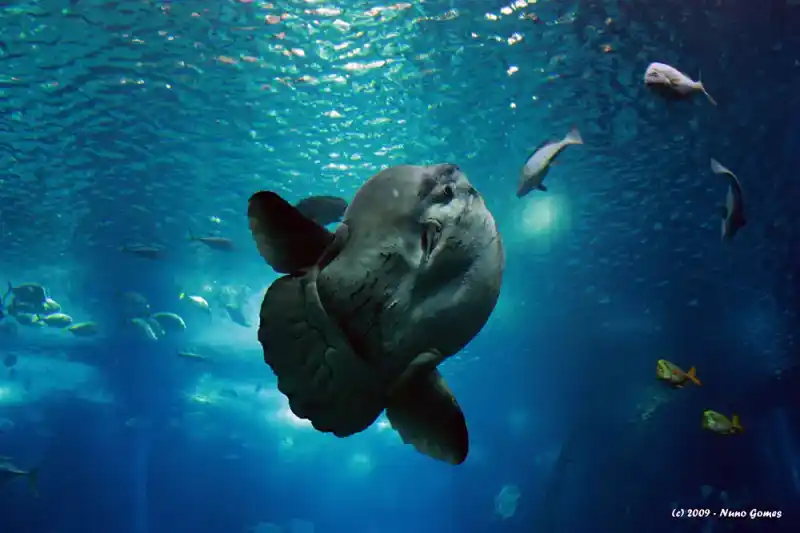
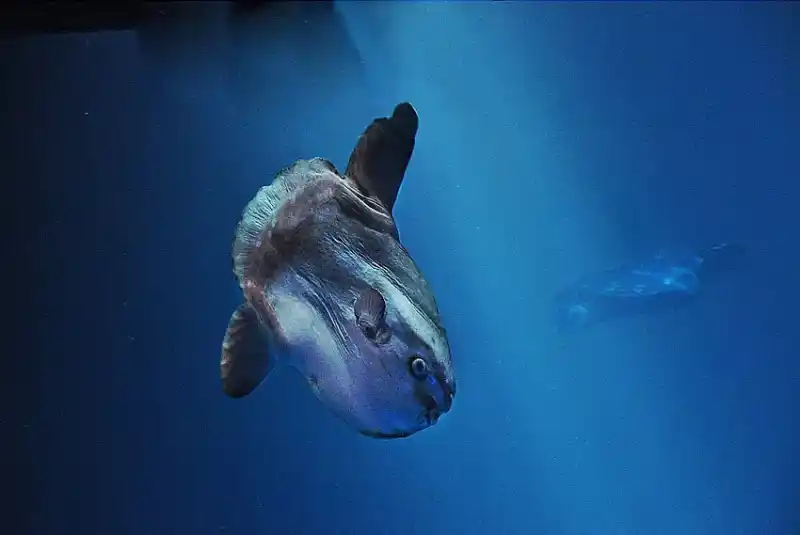
It has a disc-shaped body and a tail fin that has degenerated into a false tail; it feeds on gelatinous plankton; it basks on the surface after diving deep; and it has an extremely high reproductive rate.
Distribution and Habitat
Global temperate to tropical offshore and continental slopes; surface to middle layers (0–800 m).
Appearance
Tall and symmetrical dorsal/anal fins for propulsion; rough skin; small mouth with fused teeth; similar to but distinguishable from M. alexandrini.
Detailed introduction
The ocean sunfish ( Mola mola ) is one of the heaviest bony fish in the world, belonging to the family Molidae . It is known for its enormous disc-shaped body , its tail fin which has degenerated into a clavus , and its frequent basking at the surface. It primarily feeds on gelatinous plankton (jellyfish, sea squirts, comb jellies), but also consumes small fish, cephalopods, and crustaceans. IUCN: Vulnerable (VU) .
Ecology and Behavior
Extreme reproductive capacity: a female fish can lay hundreds of millions of eggs at a time; the eggs and fry are buoyant.
Diurnal vertical migration: During the day, it dives deep to feed and returns to the surface to bask and warm up ; it is related to the thermocline/front.
Cleaning is mutually beneficial: parasites are removed at the "cleaning station" by wrasse/damselfish; seabirds also peck at the parasites.
Morphology and Recognition
The body is disc-shaped (round/elliptical), lacking a true caudal fin ; the dorsal and anal fins are tall and symmetrical; the skin is rough with dermal teeth; the mouth is small and the dental plates are fused. It is similar to the closely related southern ocean sunfish ( M. alexandrini ) and can be distinguished by the head outline and the morphology of the false tail.
Body size and lifespan
Body length: Commonly 1.8–2.3 m; Disc length: Extreme value ~3.3 m.
Weight: Common 250–1,000 kg; Record >2,000 kg.
Lifespan: 20–30+ years in the wild; even longer in captivity.
Distribution and Habitat
Almost all global temperate to tropical offshore and continental waters; surface to middle layer (approximately 0–800 m).
Threats and Protection
Secondary catches: drift gillnets, longline fishing, purse seines; utilization on land varies greatly by region.
Marine debris: Ingested plastic bags and entangled in discarded fishing gear.
Vessels/Noise: Surface activities are susceptible to impact and disturbance.
Classification confusion: Impact assessment and management of confusion with closely related species.
Recommendations: Reduce by-product catches (improve fishing gear and avoidance), limit speeds/buffer zones during peak seasons, and strengthen species identification/monitoring and plastic pollution control.
Frequently Asked Questions
Q1: Why sunbathe your back? It helps you re-warm up after deep diving and makes it easier to clean off parasites.
Q2: Will it hurt people? It will not attack unless provoked; however, it is huge, so be aware of the risk of collision when sailing.
Q3: How to distinguish it from M. alexandrini? Look at the head outline, the ratio of the dorsal and anal fins, and the edge of the false tail; use genetic testing if necessary.
Q4: Why is it rated as vulnerable? The causes of death are compounded by by-catch and plastic pollution, and the confusion reduces management efficiency.