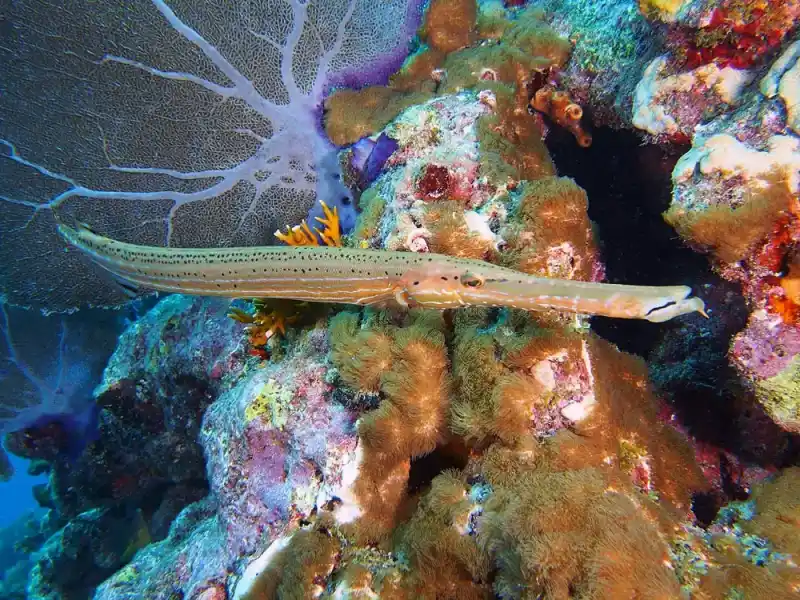
Basic Information
Scientific classification
- Chinese name: Atlantic small fish
- Scientific name: Aulostomus maculatus
- Classification: Small fish
- Family and genus: Aulostomidae Aulostomus
Vital signs data
- Body length: Commonly 40–80 cm; Maximum ~100 cm
- Weight: Increases with body length; large individuals can weigh several kilograms.
- Lifespan: Approximately 6–10 years (estimated)
Significant features
Extremely slender body shape; trumpet-shaped long snout for instantaneous capture; hovering and vertical stealth; shadow hunting method to approach prey.
Distribution and Habitat
Tropical western Atlantic—Caribbean; reef slope, reef crown, outer reef wall and seagrass/sea fan zone, 2–60 m.
Appearance
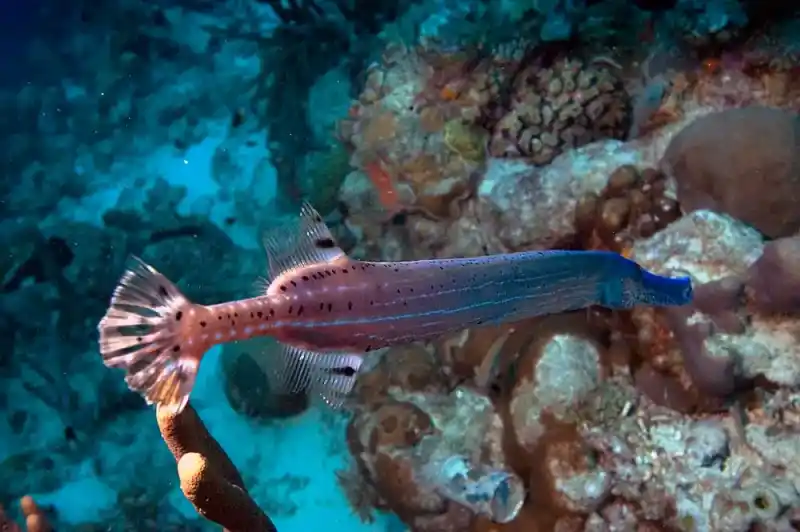
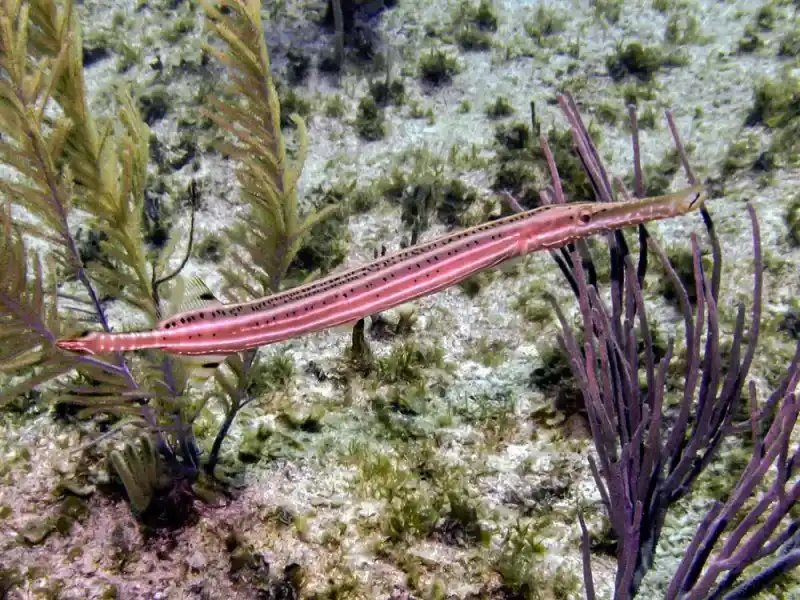
Body color can vary (brown/olive/yellow); fine spots/lines on the sides; short spines before and soft rays after the dorsal fin; large pectoral fins for easy hovering.
Detailed introduction
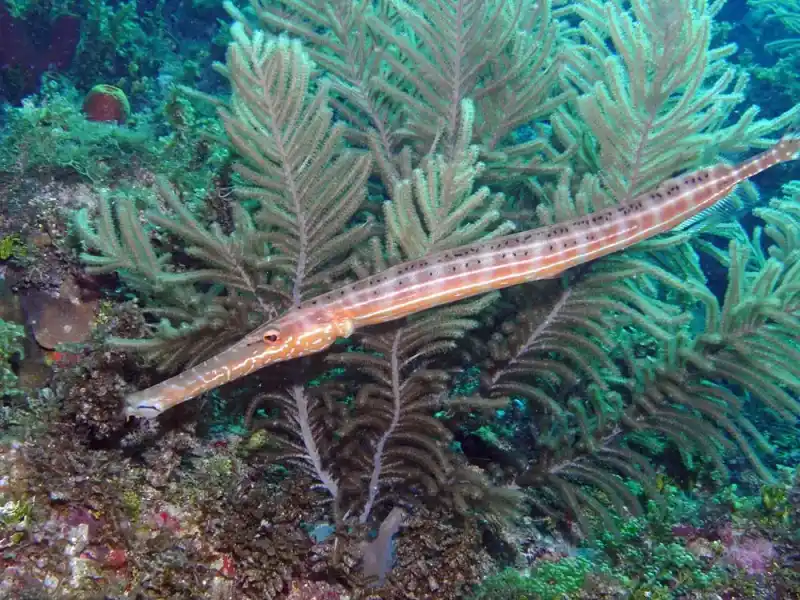
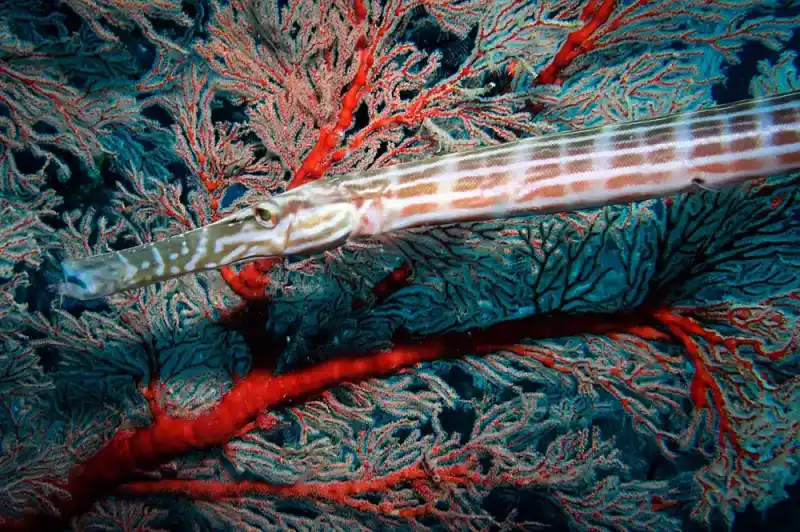
The Atlantic trumpet fish ( Aulostomus maculatus , also known as the trumpet fish or small tubefish ) belongs to the family Aulostomidae and is a well-known ambush predator on the coral reefs of the Caribbean and Atlantic Ocean. It has an extremely slender body and a long, tubular snout, allowing it to hover above the reef or camouflage itself vertically close to sea fans/sea whips and seaweed before suddenly lunging forward to use suction to catch small fish and crustaceans.
Ecology and Biology
Diet: Small fish (such as juvenile wrasse, goby, larvae of damselfish, etc.) and crustaceans such as shrimp/small crabs; feeds by rapidly inhaling through the expansion of the anterior end .
Behavior: Common "shadow-stalking" : closely following larger non-predatory fish to approach prey; also vertically concealing itself next to sea fans.
Reproduction: Eggs and sperm are released in the open sea. The eggs and fry are buoyant and drift with the ocean currents until they settle down.
Morphology and Recognition
Body shape: extremely slender cylindrical; snout is a long, trumpet-shaped tube , with the mouth located at the end.
Body color: Can change color rapidly (brown, olive, yellow, etc.); fine spots/lines are commonly seen on the sides of the body, and some individuals are entirely yellow .
Fins: The anterior part of the dorsal fin has short hard spines , and the posterior part has soft rays; the caudal fin is rounded to truncate; the pectoral fins are large, which facilitates hovering and fine-tuning.
Body size and lifespan
Body length: Commonly 40–80 cm , with a maximum of ~100 cm .
Lifespan: 6–10 years in the field (regional variation).
Distribution and Habitat
Distributed in the tropical western Atlantic to Caribbean Sea : Florida-Bahamas-Bermuda to the Caribbean islands and the northern coast of Brazil ; commonly found on coral reef slopes, reef crowns, outer reef walls and seagrass/sea fan zones , at depths of 2–60 m .
Conservation and Human Interaction
Threats: Habitat degradation, coral bleaching and coastal pollution; occasional by-fishing and ornamental collection.
Conservation: Overall resources are stable ; marine protected areas and reef restoration can maintain its prey and habitat.
IUCN: Least Concern (LC) (subject to the latest authoritative assessment).
Frequently Asked Questions
Q1: Why is it called "trumpet fish"? Because its long, tubular snout opens like a trumpet, which can expand instantly to create suction when it catches prey.
Q2: Is the all-yellow individual a different species? No, it is a color type ; this species can switch between brown, olive, yellow and other color combinations for camouflage.
Q3: Are they easier to see during the day or at night? They are mostly active during the day/dusk and hover to hunt. They are also active at night, but not as easily as during the day.
Q4: Will it attack people? No; it usually keeps its distance from divers.


