Basic Information
Scientific classification
- Chinese name: Blue-winged Goose
- Scientific name: Blue-winged Goose, Cyanochen cyanopterus
- Classification: Waterfowl
- Family: Anseriformes, Anatidae, Blue-winged Goose
Vital signs data
- Body length: 60-75 cm
- Weight: No verification information available.
- Lifespan: No verification data available.
Significant features
It is named for the grayish-blue feathers on its wings.
Distribution and Habitat
The blue-winged goose is endemic to Ethiopia and is found only in the Ethiopian highlands of Africa.
They inhabit subtropical and tropical rivers, freshwater lakes, and swamps.
Appearance
Blue-winged geese are birds belonging to the genus *Gastrodon* in the family Anatidae, order Anseriformes. This genus contains only one species. They are named for their greyish-blue wings. Males and females are similar in appearance and they are found only in the Ethiopian highlands of Africa. They are omnivorous, primarily feeding on various aquatic plants, mollusks, and fish. The blue-winged goose is 60-75 cm in length. Its head and upper neck are pale greyish-brown; the lesser and median coverts are light grey, the greater coverts are pale blue, and the primary and secondary flight feathers are black.
Detailed introduction
The Blue-winged Goose (scientific name: Cyanochen cyanopterus) is a bird belonging to the genus Cyanochen in the family Anatidae of the order Anseriformes.
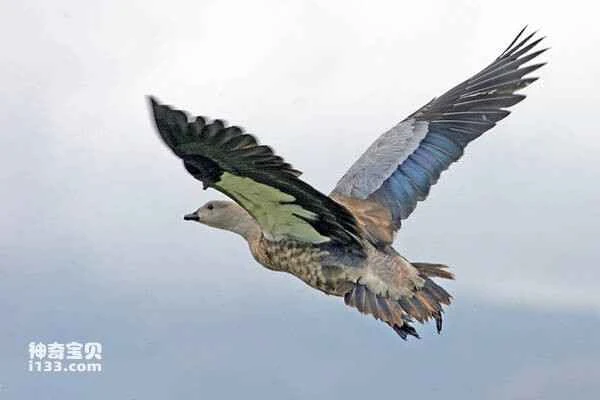
Blue-winged geese typically inhabit high-altitude grasslands or meadows, around 1800 meters above sea level. They graze and forage near water, primarily feeding on grasses, seeds, various aquatic plants, mollusks, and fish.
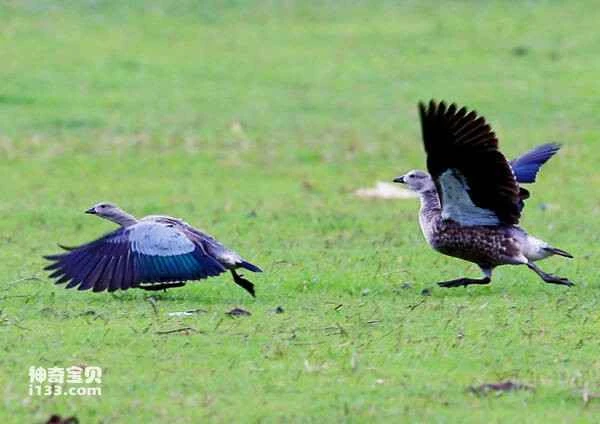
Blue-winged geese typically breed near the edges of lakes, rivers, ponds, and marshes. Because the Ethiopian highlands are relatively cold, they build their nests in dense bushes, using thick layers of straw as nesting material. After laying eggs, the female plucks a large amount of down feathers from her own body and places them in the nest. Each clutch contains 4-9 pinkish-gray eggs, with an incubation period of 30 to 34 days.
Listed as Vulnerable (VU) in the IUCN Red List of Threatened Species, 2009 ver 3.1.
Protect wild animals and ban the consumption of wild game.
Maintaining ecological balance is everyone's responsibility!