
Basic Information
Scientific classification
- Chinese name: Cook Island Emerald
- Scientific name: Mangaia Island Emerald, Tanga Emerald, *Todirhamphus ruficollari*, *Halcyon ruficollaris*, *Mewing kingfisher*
- Classification: Climbing birds
- Family and genus: Order Coraciiformes, Family Kingfisher, Genus Cook Island Kingfisher
Vital signs data
- Body length: No verification information available.
- Weight: No verification information available.
- Lifespan: No verification data available.
Significant features
It is a bird species unique to Mangaiat Island, the largest island in the Cook Islands.
Distribution and Habitat
It is found in the Cook Islands of New Zealand.
They typically inhabit dense forests and riverbanks near water.
Appearance
It has blue-green feathers, a narrow yellow-orange band on its head, black eyes, yellow eyebrows, and an orange collar that extends further into its chest. Its underparts are white, while its powerful, black, straight, dagger-shaped beak is perfectly suited for handling its prey.
The beak is thick and long, resembling a chisel, with a relatively wide base, a straight beak peak, a rounded ridge, and no nasal grooves on either side; the wings are rounded, with the first primary flight feather being the same length as or slightly shorter than the seventh primary flight feather, and the second, third, and fourth primary flight feathers being nearly the same length; the base of the primary flight feathers has white spots; the tail is rounded.
Detailed introduction
The scientific name of the Cook Islands jadeite is *Todirhamphus ruficollari* or *Halcyon ruficollaris*, and its foreign name is *Mewing kingfisher*. It has no subspecies.
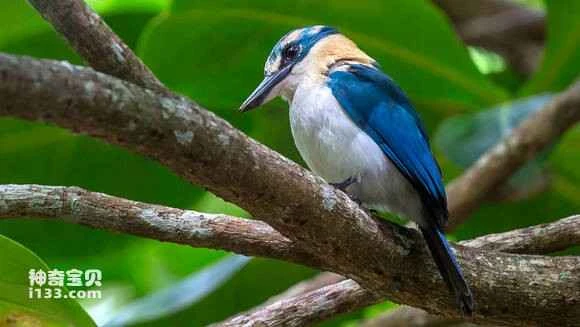
The Cook Islands Emerald's call is characterized by a "tanga-eeeoo" pattern, repeated 3 to 5 times, hence its traditional name, Tanga'eo. The Cook Islands Emerald is sometimes considered a subspecies of the Bora Emerald (Todirhamphus tutus).
Cook Island kingfishers typically hunt alone or in pairs. Like most forest kingfishers, they are entirely carnivorous, foraging for prey in leaves or soil. Their main diet consists of invertebrates such as crickets, spiders, scorpions, and snails. They also eat small vertebrates such as small fish, snakes, and lizards.
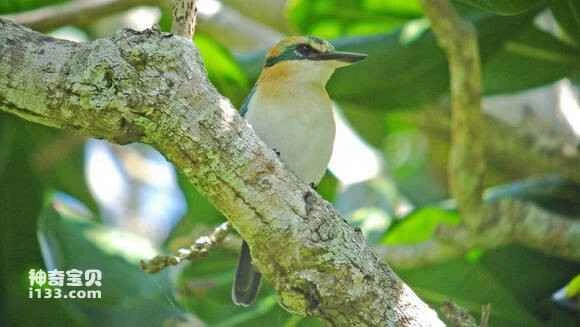
Cook Island emeralds nest on earthen cliffs or river embankments, using their beaks to dig tunnel-like burrows, 60 cm deep, 20 cm wide, and 10 cm high, with an oval shape. These burrows are generally unlined. Eggs are laid directly on the ground inside the nest. The eggs are nearly round, pure white, and approximately 29.4 × 26.2 mm in size.
Listed in the IUCN Red List of Birds, ver 3.1: 2008.
Protect wild animals and ban the consumption of wild game.
Maintaining ecological balance is everyone's responsibility!


