
Basic Information
Scientific classification
- Chinese name: Pacific Loon
- Scientific name: Pacific Loon (Gavia pacifica)
- Classification: Waterfowl
- Genus and family: Loons, order Loons, family Loons, genus Loons
Vital signs data
- Body length: 60-68 cm
- Weight: 1.8-2.5kg
- Lifespan: No verification data available.
Significant features
Slightly smaller than the Black-throated Loon, with a straighter, thinner, and shorter bill, and a more slender body.
Distribution and Habitat
Pacific loons breed in the Indigirka River in northeastern Siberia, then eastward through the Kolyma River, the Anadyr Basin, the Chukchi Peninsula, across the Bering Sea to St. Lawrence Island and the Aleutian Islands, reaching Alaska and Kodiak Island in the south. They continue eastward through Canada to Hudson Bay and Baffin Island, and southward to James Bay and the Ungava Peninsula in southern Canada. They winter in the southern waters of their breeding grounds, the Russian Far East, the Kuril Islands, California, and the Liaodong Peninsula and southeastern coast of China.
Distribution in China: Northeast (Ussuri River), Liaodong Peninsula (Liutun), Shandong (Jiaozhou), Jiangsu (Cheniushan, Lianyungang).
Native distribution: Canada, Japan, Mexico, and the United States.
Migratory birds are distributed in Bermuda, mainland China, Greenland, and Hong Kong.
Undetermined distribution: North Korea, South Korea.
During the breeding season, Pacific loons inhabit open lakes, rivers, and large ponds in the Arctic tundra, as well as rivers and large lakes in the forest edges of the subarctic region. In winter, they mostly inhabit coastal waters, large lakes, and estuaries.
Appearance
The upper tail coverts and tail feathers are black with a green metallic sheen; the upper back and shoulders are covered with rectangular white patches arranged in a tile-like pattern; the wing coverts have small white spots; the chin, throat and foreneck are black with a purple sheen, and there is a discontinuous horizontal band composed of short white longitudinal stripes on the throat; there are black and white longitudinal stripes on the sides of the neck; the breast and belly are white, the sides are black, and the underwing coverts are white; the axillaries are white with blackish-brown shaft streaks at the tips. [2]
In winter plumage, the forehead, crown, and nape are blackish-brown; the chin, throat, area below the eyes, and foreneck are white, clearly demarcated from the black nape, creating a striking contrast; the back to tail is blackish-brown with indistinct grayish-white transverse bars; the throat has a fine blackish-brown transverse band. The underparts are white, with fine black longitudinal stripes on the sides of the breast; the flanks are blackish-brown.
The juvenile birds resemble the winter plumage, with pale feather edges on the back and shoulders, paler feathers on the crown and nape, and no dark brown horizontal band on the throat; otherwise, they resemble the winter plumage of the adult birds.
The iris is chestnut brown, the beak is black, and the tarsus is dark brown.
Size measurements: Weight: ♂ 2500 g, ♀ 1800-2400 g; Body length: ♂ 613-680 mm, ♀ 600-610 mm; Bill length: ♂ 35-66 mm, ♀ 34-63 mm; Wing length: ♂ 285-312 mm, ♀ 271-300 mm; Tail length: ♂ 55 mm, ♀ 54-56 mm; Tarsus length: ♂ 76 mm, ♀ 76 mm. (Note: ♂ male; ♀ female)
Detailed introduction
The Pacific loon (scientific name: *Gavia pacifica*) is a large waterbird belonging to the genus *Gavia* in the family Lovinidae of the order Loviniformes. The Pacific loon is very similar to the Black-throated Loon, and for a long time, some scholars considered it a subspecies of the Black-throated Loon. However, studies by Portenko (1939) and Bailey (1948) showed that the breeding areas of the Pacific loon and the Black-throated Loon overlapped in the Anadyr Basin of Eastern Siberia and Alaska, and no intermediate type has been observed for a long time. Therefore, most scholars believe it should be considered a separate species.
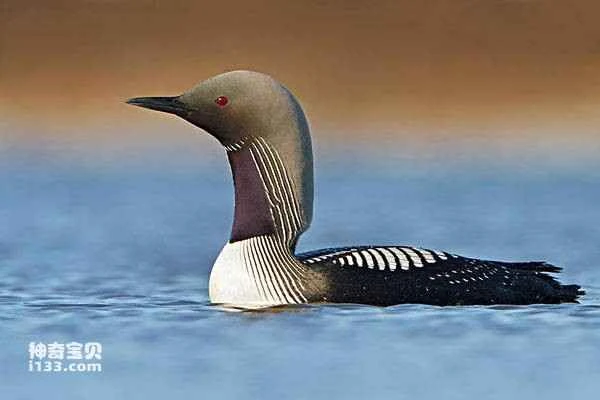
Pacific loons are found in pairs or small flocks, and occasionally singly. They are adept swimmers and divers. When on the surface, most of their body is submerged, with their tail close to the water's surface. Sometimes they even submerge their entire body, leaving only their head and neck above the water to move around, constantly swaying their heads from side to side to observe their surroundings. If danger is detected, they submerge completely to escape. They can also fly, and fly quickly, but taking off from the water is difficult, so they generally do not fly.
Pacific loons primarily feed on fish, but also consume insects and their larvae, crustaceans, mollusks, and other aquatic invertebrates. They forage by diving, are excellent divers, and use their legs to propel themselves and their wings to accelerate and chase schools of fish. Insects and small fish are swallowed underwater, while larger prey is consumed at the surface. They are usually silent.
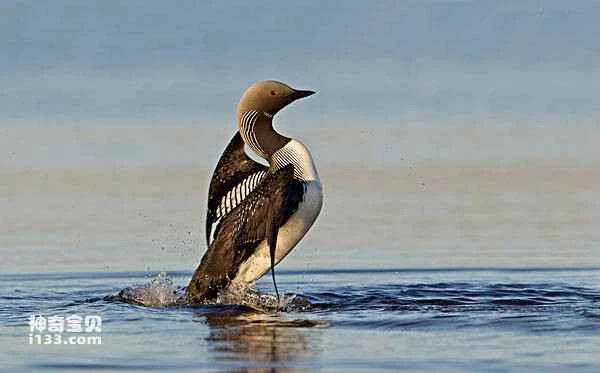
Pacific loons migrate north from their wintering grounds from late March to late April, arriving at their breeding grounds by the end of May. In autumn, they begin their southward migration from September to October, reaching the eastern coast of China in November and December. During migration, they often travel in pairs or small flocks, crossing the Nenjiang and Ussuri Rivers, and overwintering on the Liaodong Peninsula and the eastern coast.
The Pacific loon breeds from June to July. They breed in the Arctic and subarctic tundra and tundra forests, nesting on coastlines, estuaries, riverbanks, and lakeshores. Nests are extremely rudimentary, often constructed from piles of dead aquatic plants. Each clutch contains 1-2 eggs, measuring 68.5-87 mm × 44-51 mm, with an average of 75.7 mm × 47 mm. Older chicks usually have priority in feeding in the nest. During periods of food scarcity, parents typically feed the older chicks first, while younger chicks may die. For the first 5-7 weeks, chicks are completely dependent on their parents. Around the 8th week, they begin to learn to fish and live independently. Parents exhibit protective behavior, shielding the chicks with their wings to prevent attacks from predators. During the breeding season, males may become aggressive in competition for females, frequently attacking rivals with their beaks and sometimes inflicting fatal wounds.
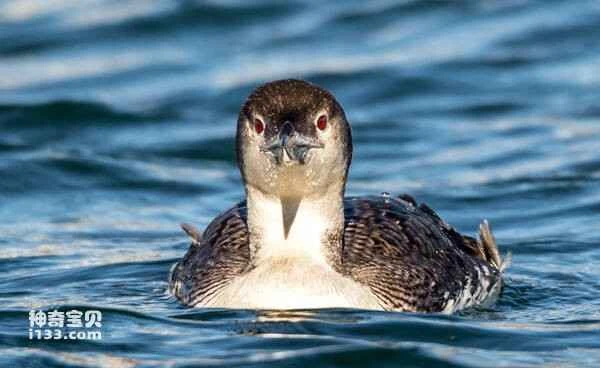
The Pacific loon is rare in China, with only occasional reports. One female was recorded being collected near the coast of Xiaoping Island in Dalian on December 1, 1983. In 2006, Wetlands International estimated the global population of the Pacific loon at 930,000–1,600,000 individuals. In 2009, population estimates in some countries were as follows: 50–10,000 Pacific loons wintered in Japan; 100–10,000 flocks of adults and 1,000–10,000 individuals wintered in Russia.
During winter, the population density of Pacific loons is relatively low, while it is higher during the breeding season. Research has found that some chemicals in Pacific loons may originate from pollution in their ecosystem, which ultimately reaches higher-level members of the food chain. Pacific loons have adapted relatively well to human-induced stress, but their habitat is shrinking due to human encroachment.
It is listed in the China Species Red List (2004), with an assessment level of "Not assessed" (NA, China is the edge of the distribution area).
It is listed as Least Concern (LC) in the IUCN Red List of Threatened Species 2018 ver 3.1.
Protect wild animals and ban the consumption of wild game.
Maintaining ecological balance is everyone's responsibility!


