
Basic Information
Scientific classification
- Chinese name: Black-throated Loon
- Scientific name: Black-throated Diver (Gavia arctica, Arctic Loon)
- Classification: Waterfowl
- Genus and family: Loons, order Loons, family Loons, genus Loons
Vital signs data
- Body length: 56-76.5 cm
- Weight: 2.37-3.793kg
- Lifespan: No verification data available.
Significant features
Larger than the Red-throated Loon, it has a straight bill, a thick and long neck that often curves into a graceful S-shape.
Distribution and Habitat
The Black-throated Loon breeds in northern Eurasia, extending to the subarctic and Arctic regions, south to central former Soviet Union, Lake Issyk-Kul, Lake Balkhash, the Altai Mountains, Mongolia, and China's Xinjiang, Heilongjiang, Changbai Mountains in Jilin, the Far East, Sakhalin Island, and eastern Siberia, all the way east to Alaska in North America. It winters in central Europe, the Mediterranean, the Black Sea, the Caspian Sea, Japan, California, and the southeastern coastal areas of China, including the Liaodong Peninsula, Fujian, and Taiwan.
Native distribution: Albania, Austria, Azerbaijan, Belarus, Belgium, Bosnia and Herzegovina, Bulgaria, Mainland China, Croatia, Czech Republic, Denmark, Estonia, Finland, France, Georgia, Germany, Greece, Hungary, India, Iran, Ireland, Italy, Japan, Kazakhstan, North Korea, South Korea, Kyrgyzstan, Latvia, Lithuania, Macedonia, former Yugoslavia, Mexico, Moldova, Mongolia, Montenegro, Netherlands, Norway, Poland, Romania, Serbia, Slovakia, Slovenia, Spain, Svalbard and Jan Mayen, Sweden, Switzerland, Taiwan, Turkey, Turkmenistan, Ukraine, United Kingdom, United States.
Migratory birds are distributed in Algeria, Armenia, Faroe Islands, Gibraltar, Israel, Jordan, Luxembourg, Morocco, and Portugal.
Undetermined distribution: Monaco.
During the breeding season, the Black-throated Loon inhabits inland lakes, rivers, and large ponds in the Arctic and subarctic tundra and islands, as well as rivers and large lakes in mountain forests, especially those with dense coastal vegetation and abundant fish. In winter, it inhabits coastal waters, bays, and estuaries.
Appearance
The Black-throated Loon's summer plumage features a grey forehead, crown, and nape; greyish-black cheeks; black shoulders and back with a bluish-green sheen, and rectangular white patches arranged in a tile-like pattern on the sides of the upper back and shoulders; paler rump feathers; black wing coverts with fine white spots; dark brown wings, with darker, glossy outer webs and tips; and a short, black tail. The chin, throat, and foreneck are black with a green sheen, and a discontinuous white band runs between the lower throat and foreneck; the sides of the neck and breast are black, but all feathers have broad white longitudinal stripes on both sides, creating alternating black and white longitudinal stripes on the sides of the neck and breast; the rest of the underparts are white, with black flanks and white hind flanks. In winter plumage, the upperparts are black, the crown and nape are greyish-black, the tail feathers have white edges, the underparts are white, with fine black longitudinal stripes on the sides of the breast and dark brown markings on the flanks.
The iris is red; the mouth is gray in winter, with a black tip and cupule, and black in summer; the outer tarsus is black, and the inner tarsus is gray.
The young bird's plumage resembles that of winter plumage, but the crown and nape are paler and more brownish, and the back has pale gray feather edges.
Size measurements: Weight: ♂ 3280-3793 g, ♀ 2037-3075 g; Body length: ♂ 700-765 mm, ♀ 560-720 mm; Bill length: 50-68 mm; Wing length: ♂ 290-338 mm, ♀ 273-330 mm; Tail length: 57-60 mm; Tarsus length: 67-75 mm. (Note: ♂ male; ♀ female)
Detailed introduction
The Black-throated Loon (scientific name: *Gavia arctica*), also known as the Arctic Loon, Black-throated Diver, or Black-throated Loon, is a large waterfowl belonging to the order Loons. Regarding subspecies differentiation, some scholars classify it into three subspecies: the nominate subspecies *G. a. arctica*, the northern subspecies *G. a. viridigularis*, and the Pacific subspecies *G. a. Pacifika*. However, other scholars believe that the Pacific subspecies has overlapping breeding areas and no intermediate type, thus it should be considered a separate species, and therefore only divides it into two subspecies: the nominate subspecies and the northern subspecies. In China, only the northern subspecies is distributed, breeding in Xinjiang, Heilongjiang, and Jilin provinces.
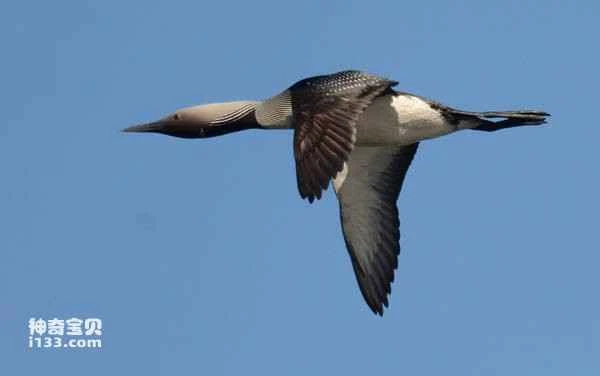
Black-throated loons are often found in pairs or small flocks. They are excellent swimmers and divers, often bending their necks into an S-shape while swimming. They typically fly in a straight line, possessing strong, fast, and powerful flight capabilities, with their head and neck extended, legs stretched out behind their tails, and wings flapping rapidly, but they cannot change speed. Taking off from the water is difficult, requiring a running start over a considerable distance, therefore they generally do not prefer to inhabit small ponds. They cannot take off on land at all, and walking is also very difficult; they usually crawl, and therefore generally do not come ashore except during the breeding season. They live entirely on the water, escaping danger by diving, submerging their bodies quite deep, with only their heads and necks above the surface.
The Black-throated Loon's diet consists mainly of various fish, but it also eats dragonflies and their larvae, beetles and their larvae, crustaceans, mollusks, and other aquatic insects and invertebrates. It primarily forages by diving, but also chases schools of fish on the surface. A single dive can last 90-120 seconds and cover a distance of over 400 meters. The Black-throated Loon's call consists of repeated croaking sounds resembling snoring and a gull-like "aah-oww" sound.
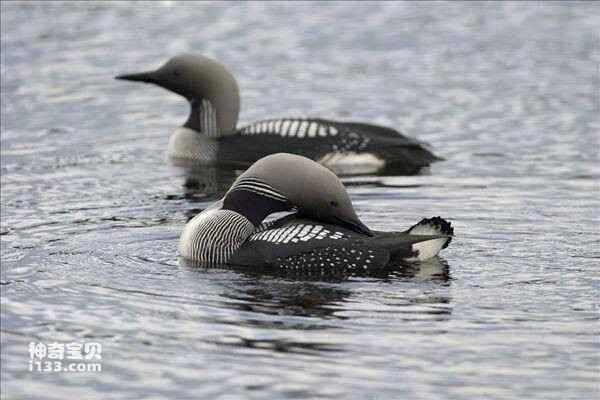
Black-throated loons migrate in spring, arriving at their breeding grounds at different latitudes from early to late May. Autumn migration begins as early as late September, with large numbers occurring from early to mid-October, typically proceeding slowly along coastlines, rivers, or lakes. The nominate subspecies mainly migrates from east to west, while the northern subspecies mainly migrates south. The migration distance is approximately 6,000 kilometers. They usually migrate in pairs.
Black-throated loons typically arrive at their breeding grounds in pairs, and the pairings and breeding sites are relatively fixed. The breeding season in Changbai Mountain is from May to July. Single and paired black-throated loons have been spotted multiple times from mid-May to early July in the forest rivers of Naitou River, Linjiang River, and the upper reaches of the Yalu River in Changbai Mountain, indicating that they breed there. The breeding season begins later the further north one goes, reaching as late as June in the Arctic tundra.
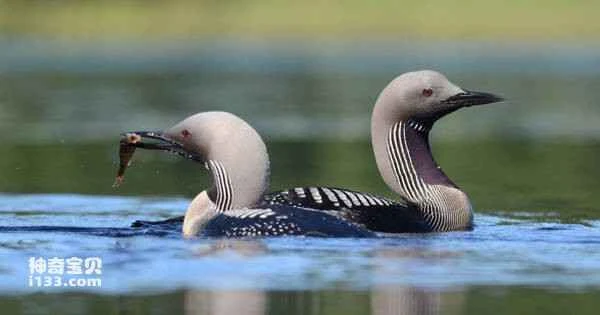
They nest in grassy areas close to the water's edge, creating very simple nests made of piled-up dry grass, some even slightly trampled. The nests are 50-60 cm in size and about 10 cm high. Some also build floating nests in emergent vegetation near the water's edge, using the support of aquatic plants and dry grass. Each clutch contains 1-2 eggs, occasionally up to 3. The eggs are olive-brown with black and dark gray spots; they measure 75-95 mm × 45-46 mm, averaging 84.5 mm × 51.74 mm. If eggs are lost or reproduction fails, compensatory eggs are usually laid. Incubation begins immediately after the first egg is laid, shared by both parents, and lasts 25-29 days. The chicks are precocial, and after about 40 days of chick life under parental guidance, they are capable of flight.
The Black-throated Loon was historically only occasionally seen in the Liaodong Peninsula and Fuzhou in China, making it a rare winter visitor and migratory bird. Since 1983, specimens have been repeatedly spotted and collected in the Changbai Mountains during the breeding season, indicating that it may breed there. One individual was also captured in Taiwan between 1970 and 1971. A 1992 survey of Asian midwintering waterbirds organized by the International Bureau of Waterfowl Research found only two individuals in China, highlighting its extremely small population and need for conservation. In 2006, Wetlands International estimated the global population of the Black-throated Loon at 280,000–1,500,000. In 2009, approximately 100–1,000 pairs of adult birds and 1,000–10,000 individuals were found wintering in Russia.
During the breeding season, the breeding of black-throated loons is threatened by water acidification, heavy metal pollution, and water level fluctuations in their breeding areas, especially during the incubation period. Human disturbance and changes in breeding locations have led to a decline in their fertility. In winter, black-throated loons are highly vulnerable to coastal oil spills, particularly in hotspot development areas. Furthermore, fishing nets in the water can entangle them and cause drowning, coastal wind farms significantly disrupt their lives, and they are also susceptible to avian influenza outbreaks.
On January 12, 2020, a black-throated loon was discovered in Xinglong Lake, marking a new bird record for Sichuan Province. It is understood that black-throated loons breed in inland lakes on Arctic and subarctic tundra and islands, and winter inhabit coastal waters, bays, and estuaries. This bird had never been observed in Chengdu before. The discovery of the black-throated loon in Xinglong Lake is significant, and to some extent confirms the improving ecological environment of Chengdu. In January 2023, staff from the Taishan Scenic Area Management Committee in Shandong Province also discovered a black-throated loon during a winter wildlife survey on Mount Tai.
It has been included in the "List of Terrestrial Wild Animals of Beneficial or Important Economic and Scientific Research Value under State Protection" (Item 2) issued by the State Forestry Administration of China on August 1, 2000.
It has been included in the China Species Red List (2004) and is assessed as Least Concern (LC).
It is listed as Least Concern (LC) in the IUCN Red List of Threatened Species 2018 ver 3.1.
Protect wild animals and ban the consumption of wild game.
Maintaining ecological balance is everyone's responsibility!


