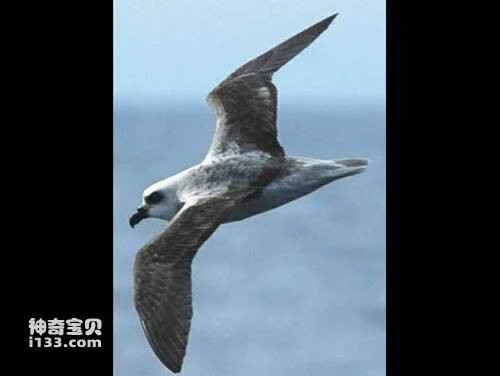
Basic Information
Scientific classification
- Chinese name: Red-throated Loon
- Scientific name: Red-throated Loon, Gavia stellata
- Classification: Waterfowl
- Genus and family: Loons, order Loons, family Loons, genus Loons
Vital signs data
- Body length: 56-69 cm
- Weight: 1.25-2.5kg
- Lifespan: No verification data available.
Significant features
The beak is thin and pointed, slightly upturned. In summer plumage, the crown, sides of the head, throat, and neck are pale gray, while in winter plumage, the sides of the head below the eyes, the sides of the neck, the neck, the throat, and the entire underparts are white.
Distribution and Habitat
The red-throated loon breeds in Arctic or subarctic regions (north of 50°N) from northern Europe and northern Asia to northern North America. It winters in the Mediterranean, Black Sea, Caspian Sea, Florida, California, Japan, and coastal areas of China, including the Liaodong Peninsula, Guangdong, Fujian, Hainan Island, and Taiwan.
Native distribution: Austria, Azerbaijan, Belgium, Bulgaria, Canada, China, Croatia, Czech Republic, Denmark, Estonia, Faroe Islands, Finland, France, Georgia, Germany, Greece, Greenland, Hungary, Iceland, India, Iran, Ireland, Italy, Japan, Kazakhstan, North Korea, South Korea, Latvia, Lithuania, Macedonia, former Yugoslavia, Mexico, Moldova, Montenegro, Netherlands, Norway, Pakistan, Poland, Portugal, Romania, Saint Pierre and Miquelon, Serbia, Slovakia, Slovenia, Spain, Svalbard and Jan Mayen, Sweden, Switzerland, Turkey, Turkmenistan, Ukraine, United Kingdom, United States.
Migratory birds are distributed in Algeria, Armenia, Belarus, Bosnia and Herzegovina, Gambia, Gibraltar, Israel, Liechtenstein, Luxembourg, Malta, Mongolia, Morocco, and Tunisia.
Undetermined distribution: Albania, Bahamas, Monaco.
During the breeding season, the red-throated loon mainly inhabits lakes, rivers, and ponds in the Arctic tundra and forest tundra zone. During migration and winter, it mostly inhabits coastal waters, bays, and estuaries.
Appearance
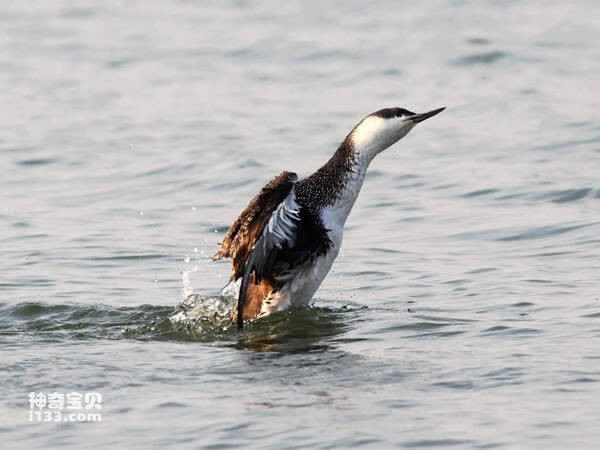
The breeding plumage of the Red-throated Loon features a pale grey head and neck with black shaft streaks on the forehead and crown, and alternating black and white longitudinal stripes on the nape. The upperparts and wing coverts are greyish-brown, sometimes with fine white markings. The foreneck has a prominent chestnut triangular patch extending from the lower throat to the upper breast; below the chestnut triangular patch and down to the entire underparts, the underparts are white with black longitudinal stripes on the sides of the breast and black markings on the flanks. The undertail coverts have black transverse bars. In winter plumage, the forehead, crown, nape, and tail are dark brown, with fine white spots on the back; the sides of the head, chin, throat, foreneck, and entire underparts are white.
Juveniles and non-breeding birds have similar plumage, but the crown and nape are darker with pale white edges, brown markings on the sides of the head and neck, and white spots on the shoulders and upper back.
The iris is red or chestnut, the beak is black or pale gray, thin and slightly upturned, the feet are greenish-black, and the back of the tarsus and toes are adorned with white or yellow.
Size measurements: Weight: ♂ 1400-2500 g, ♀ 1250-2300 g; Body length: ♂ 640-690 mm, ♀ 560-640 mm; Bill length: 51-53 mm; Wing length: 260-310 mm; Tail length: 50-75 mm; Tarsus length: 71-74 mm. (Note: ♂ male; ♀ female)
Detailed introduction
The Red-throated Loon (scientific name: *Gavia stellata*), also known as the Red-throated Loon or Red-throated Diver, is a large waterfowl belonging to the Loonidae family. Some scholars believe that the Red-throated Loon populations breeding in the Svalbard archipelago and Bear Island in Norway have slightly paler plumage than the nominate subspecies, thus classifying it as a separate subspecies, *G. s. sguamata*. However, most scholars agree that there are no significant differences between the two subspecies and therefore consider them monotypic.
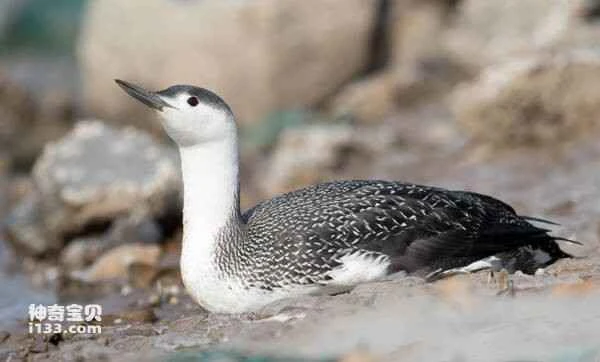
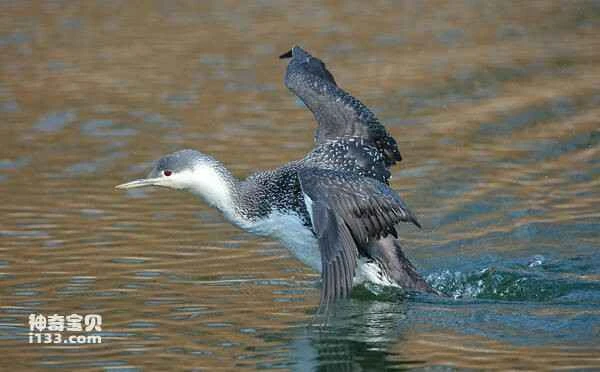
The red-throated loon is a skilled swimmer and diver. When swimming, it stretches its neck very straight and often looks around. It also flies very fast and in a straight line. It is more agile in taking off than other pochards, and can fly directly out of the water without a running start. Therefore, it can take off even in smaller ponds. However, it has more difficulty walking on the ground and often crawls forward.
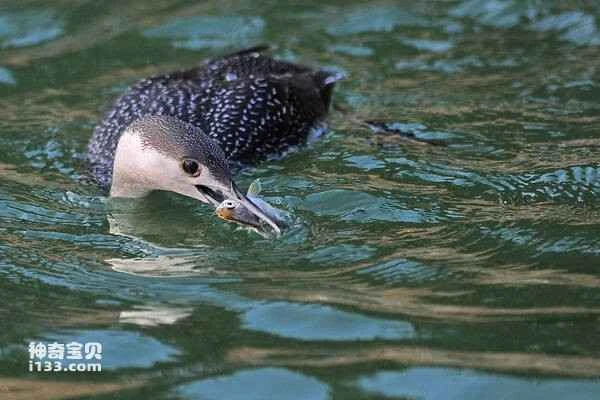
The red-throated loon primarily feeds on various types of fish. It also consumes crustaceans, mollusks, fish eggs, aquatic insects, and other aquatic invertebrates. It forages by diving and rapidly swimming underwater to chase schools of fish, remaining submerged for 60-90 seconds at a time. When in flight, the red-throated loon emits a call similar to a goose's cry, called "gwuk-gwuk-gwuk."
Red-throated loons migrate late in spring, leaving their wintering grounds in early to mid-April to reach their northern breeding grounds. Some remain along the coast of Fujian, China, as late as the end of April. Their autumn migration is also late, usually beginning in early to mid-October after the ice has formed in their breeding grounds, and arriving at their southern wintering grounds in late October to November. They migrate mostly in pairs or small groups, but some migrate alone.
The Red-throated Loon breeds in inland lakes, rivers, and ponds in the northern hemisphere. They nest on the ground close to the water's edge. Pairs arrive at their breeding grounds in late April and early May, as soon as the northern snow melts. Pairing is relatively consistent; once formed, they usually do not change partners. The breeding season is from May to August. During mating, the male and female first swim and chase each other, flapping their wings, and occasionally leap out of the water to stand on the surface, lowering their heads to their chests, then extending their heads vertically while continuously calling. Courtship behavior lasts for 2-3 hours at different times of the day. The nest is very simple and small, 20-60 cm in diameter. The base of the nest is cup-shaped, close to the water's edge, less than 1 meter from the water. Egg laying begins in late May and early June, with two eggs per clutch, occasionally as few as one or as many as three. The eggshell is relatively rough, dark olive green with blackish-brown spots; it measures 68-82 mm × 43-48 mm, averaging 73.8 mm × 44.8 mm; and weighs 73-89.7 g, averaging 82.7 g. Both parents take turns incubating the eggs, with an incubation period of 24-29 days. The chicks are precocial, covered in down feathers immediately after hatching, and can swim within 10-12 hours. After a chick period of about 40 days under the guidance of their parents, they are able to fly.
The Red-throated Loon was once a common sight in the southeastern coastal areas of China during winter, but reports of its presence became scarce in the late 20th and early 21st centuries. According to the Asian Midwintering Waterbird Surveys conducted by the International Waterfowl Research Bureau (IWRB) in 1990 and 1992, only 280 individuals were observed in China in 1990, and a mere 17 in 1992, indicating a very small population requiring conservation. In 2006, Wetlands International estimated the global population of the Red-throated Loon at 200,000–590,000. In 2009, population estimates for the Red-throated Loon in some countries and regions were as follows: fewer than 50 Red-throated Loons migrated to China and wintered there; fewer than 1,000 wintered in Taiwan; 50–10,000 wintered in Japan; and 10,000–100,000 pairs of adult birds and 1,000–10,000 individuals wintered in Russia.
The breeding of red-throated loons is threatened by fluctuating water levels, water acidification, heavy metal pollution, and wetland afforestation in their breeding areas. They are also susceptible to habitat disruption from human recreational activities and coastal development, leading them to abandon their original habitats. In winter, red-throated loons are highly vulnerable to coastal oil spills, especially in hotspot development areas, and are also highly sensitive to coastal wind farms. In the ocean and large lakes, they can become entangled in fishing nets near the shore and drown, increasing the species' mortality rate. Furthermore, red-throated loons are also susceptible to avian influenza outbreaks.
It has been included in the "List of Terrestrial Wild Animals of Beneficial or Important Economic and Scientific Research Value under State Protection" (Item 1) issued by the State Forestry Administration of China on August 1, 2000.
It has been included in the China Species Red List (2004) and is assessed as Least Concern (LC).
It is listed as Least Concern (LC) in the IUCN Red List of Threatened Species 2018 ver 3.1.
Protect wild animals and ban the consumption of wild game.
Maintaining ecological balance is everyone's responsibility!