Basic Information
Scientific classification
- Chinese name: White-backed duck
- Scientific name: Thalassornis leuconotus, White-backed Duck
- Classification: Waterfowl
- Family and genus: Anseriformes, Anatidae, White-backed Duck
Vital signs data
- Body length: 36-41 cm
- Weight: 450-907g
- Lifespan: Approximately 15 years
Significant features
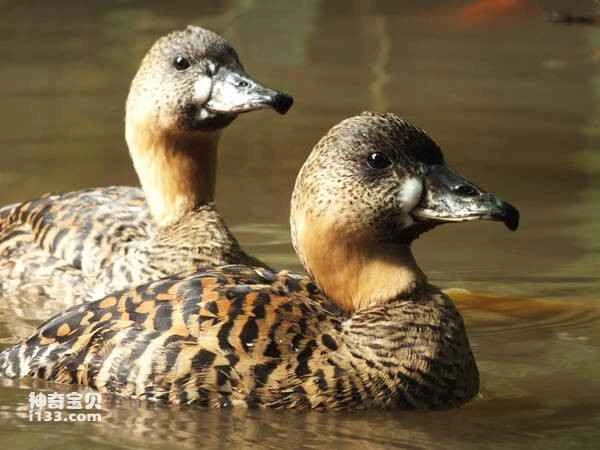
It has a white patch on each corner of its mouth, and its feathers are also covered in brown and black markings.
Distribution and Habitat
The White-backed Duck is distributed across Africa, with one subspecies on the African mainland and another on the island of Madagascar. It inhabits the area between Senegal and Chad in southern Africa, particularly in western Ethiopia and eastern South Africa.
They inhabit various types of inland rivers, lakes, ponds, and swamps.
Appearance
A medium-sized waterfowl, measuring 36–41 cm in length and weighing 450–907 g, with a lifespan of 15 years. It has a white patch on each corner of its beak and its plumage is a mix of brown and black markings. Closely related to tree ducks, it shares some characteristics with hard-tailed ducks. Its white back is not normally visible, only during flight.
Its most distinctive feature is the white spot on each corner of its mouth, and its feathers are also covered with brown and black markings.
Detailed introduction
The White-backed Duck (scientific name: Thalassornis leuconotus) has two subspecies and is the only species in the genus Thalassornis in the family Anatidae.
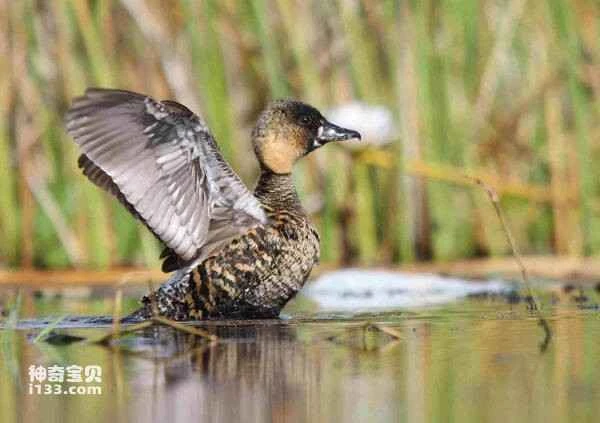
White-backed ducks live in flocks mixed with other duck species and are adept swimmers and divers. They are extremely wary of humans and will take flight at the slightest disturbance. They are skilled swimmers and divers, often remaining submerged for only 3-5 minutes. When taking off from the water, they often skim the surface for a considerable distance before leaving it. They generally do not venture onto land and rarely fly. They rarely make calls. They feed on aquatic plants, particularly bulbs, as well as insects, fish, frogs, crustaceans, mollusks, and worms.
The breeding season for white-backed ducks can occur at any time of year. The female lays one egg per day, with a typical nest containing 4-9 eggs, but sometimes up to 11, although other females may also lay eggs in the nest. Incubation lasts 29-33 days. The female usually incubates at night, while the male incubates at other times. The nest is a floating nest built on water. Ducklings can swim and dive immediately after hatching. They reach about 50% of their adult size in 27 days. Their feathers are fully developed by 34 days, and they appear to be the same size as adult birds by 55 days.
Listed in the International Union for Conservation of Nature (IUCN) Red List of Birds, 2009 ver 3.1.
Protect wild animals and ban the consumption of wild game.
Maintaining ecological balance is everyone's responsibility!