
Basic Information
Scientific classification
- Chinese name: Black-breasted Muscovy Duck
- Scientific name: Paradise Duck (Tadorna variegata)
- Classification: Waterfowl
- Family and genus: Anseriformes, Anatidae, Muscovy
Vital signs data
- Body length: No verification information available.
- Weight: No verification information available.
- Lifespan: No verification data available.
Significant features
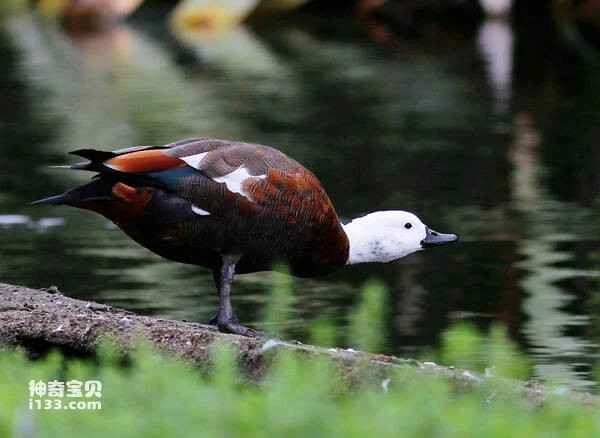
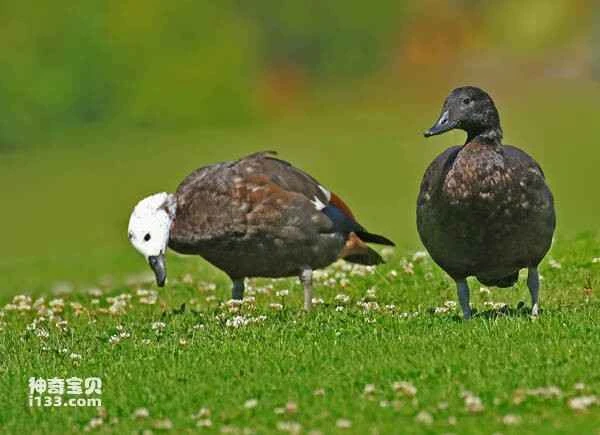
The male duck has a black head and a nearly black body, while the female duck has a white head and chestnut-colored plumage.
Distribution and Habitat
It is found in Australia and New Zealand, including Tasmania and its nearby islands.
It inhabits various habitats including rivers, lakes, estuaries, ponds, and nearby grasslands, wastelands, swamps, beaches, farmlands, and sparse forests on plains, with a particular preference for lake areas on plains. It mainly lives in inland freshwater, but is sometimes also found on coastal beaches, in saltwater lake areas, and in open grasslands far from water bodies.
Appearance
The Muscovy duck is a sexually dimorphic bird, with both sexes possessing brightly colored plumage. The male has a black head and nearly black body, while the female has a white head and chestnut-colored plumage. Adult ducks have wings with patches of various colors: blue, grey, brown, green, and black; their beaks, eyes, and legs are all black. Juvenile ducks are brightly colored with distinct variegation.
Detailed introduction
The Paradise Duck (scientific name: Tadorna variegata) is a bird of the Anatidae family.
During the breeding season, Muscovy ducks live in pairs; outside the breeding season, they live in family groups or small flocks, sometimes forming large groups of dozens or even nearly a hundred. They graze on grasslands and weeds, and attack crops, especially during molting. Their diet consists mainly of aquatic plant leaves, buds, and seeds, crop seedlings, and grains, but they also eat insects, crustaceans, mollusks, shrimp, water frogs, earthworms, small frogs, and small fish. They forage mostly at dusk and dawn, sometimes during the day, especially in autumn and winter. Small groups of a few to more than 20 are often seen foraging for scattered grains on farmland along riverbanks, as well as in shallow water near the water's edge and on the surface.
The Black-breasted Muscovy Duck reaches sexual maturity at 2 years of age. They typically breed once a year, occasionally twice. The breeding season is from August to December. Breeding usually takes place in open plains, and pair pairings are relatively stable. Mating occurs in water or on land. Before mating, the female duck stretches her neck forward, lowers her head to the ground, and makes a 'quack' sound, pacing back and forth around the male. The male then stretches his neck towards the female, takes her shoulder feathers, and mounts her back for mating. They nest in natural burrows or abandoned animal burrows and graves in open plains and grasslands, as well as in earthen burrows and rock crevices in mountains and lakes/islands. They are also found nesting in burrows in grasslands and deserts, and in poplar tree cavities. The nest consists of a small amount of dry grass and a large amount of down feathers. The clutch size is 9 eggs. The female raises the eggs alone, while the male guards the nest, calling loudly to warn of danger. Sometimes the male will even fly towards intruders and adopt an aggressive posture to scare them away. When the female bird leaves the nest, she covers the eggs with her downy feathers before going out to forage with the male. After foraging, the male accompanies the female back to the nest before leaving to roost nearby as a watchdog. The incubation period is 27-30 days, with chicks hatching as early as the beginning of May. The hatched chicks swim with their parents in ponds and streams, immediately hiding in the grass near the bank when they see people. The chicks are precocial, covered in downy feathers immediately after hatching and able to swim and dive. After about 50 days of chick life under the guidance of their parents, the chicks are able to fly.
Listed in the International Union for Conservation of Nature (IUCN) Red List of Birds, 2009 ver 3.1.
Protect wild animals and ban the consumption of wild game.
Maintaining ecological balance is everyone's responsibility!


