Basic Information
Scientific classification
- Chinese name: Ansho Grey Duck
- Scientific name: Andaman Grey Duck, White-throated Duck, Andaman Islands Grey Duck, Anas albogularis, Andaman Teal
- Classification: Waterfowl
- Family: Anseriformes, Anatidae, Anatidae
Vital signs data
- Body length: No verification information available.
- Weight: No verification information available.
- Lifespan: No verification data available.
Significant features
Distribution and Habitat
It is distributed in the Indian subcontinent and southwestern China, including India, Bangladesh, Bhutan, Nepal, Pakistan, Sri Lanka, Maldives, and southeastern Tibet, China. It is also found in the Indochina Peninsula and southeastern coastal China, including Myanmar, Vietnam, Laos, Cambodia, Thailand, as well as Hong Kong and Hainan Island.
Appearance
The Andaman Duck is a species of duckling found in the Andaman Islands of India.
The species has pale yellow plumage with dark brown spots. Its chin and throat are pale white, its beak is bluish-grey, and its iris is red.
Detailed introduction
The Andaman Teal (scientific name: Anas albogularis) is a small duck species found in the Andaman Islands of India. It is considered a subspecies of the Javan Grey Duck.
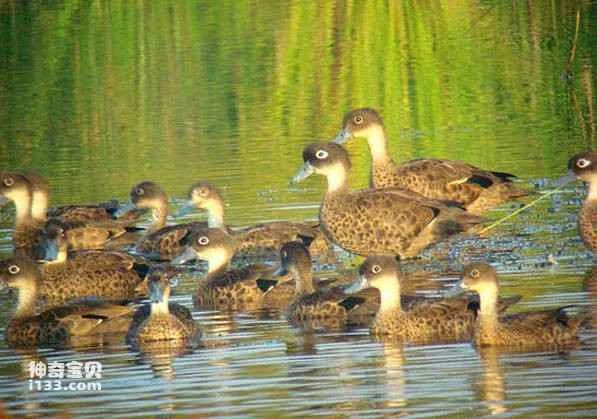
The Antoinette Duck is found in inland lakes, mangroves, and lagoons. They feed on rice paddies at night. Their diet consists mainly of mollusks and arthropods. A survey conducted between 1995 and 1998 estimated the Antoinette Duck population to be between 500 and 600 individuals.
The Angolan Grey Duck mainly floats on the water's surface and rarely dives. It inhabits freshwater environments, is adept at diving, and obtains food underwater, primarily feeding on plants but sometimes also consuming animal matter. Its webbed toes allow it to swim and play in the water, keeping its tail above the surface while swimming. It is skilled at foraging, playing, and courtship in the water. Playing in the water helps maintain the cleanliness and growth of its feathers.
The breeding season for the Antoine Grey Shelduck is from July to October, and they nest in reed beds. They lay about nine eggs at a time. It was once thought they nested in tree cavities, but there is no evidence to support this. A survey conducted between 1995 and 1998 estimated the Antoine Grey Shelduck population at 500 to 600 individuals.
Listed in the International Union for Conservation of Nature (IUCN) Red List of Birds, 2009 ver 3.1.
Protect wild animals and ban the consumption of wild game.
Maintaining ecological balance is everyone's responsibility!