Basic Information
Scientific classification
- Chinese name: Osaka Duck
- Scientific name: Anas aucklandica
- Classification: Waterfowl
- Family: Anseriformes, Anatidae, Anatidae
Vital signs data
- Body length: Approximately 48 cm
- Weight: 500-600g
- Lifespan: No verification data available.
Significant features
Both males and females are the same color, with a uniform dark brown face and a thin white ring around the eyes.
Distribution and Habitat
The Auckland Island Duck was first discovered on Auckland Island, a small island in New Zealand. It is distributed throughout Australia and New Zealand, including Australia, New Zealand, Tasmania, and nearby islands. It inhabits the island's coastline, tidal creeks, and coastal forests.
Appearance
The Okama duck is a medium-sized waterfowl, measuring 48 cm in length. Males have a wingspan of 128-152 cm and weigh 600 g; females have a wingspan of 105-137 cm and weigh 500 g. Both sexes are similar in color, with a uniform dark brown face, a fine white ring around the eyes, dark brown feathers edged with white, and a chestnut breast. The beak is bluish-black; the legs and feet are slate gray. During the breeding season, the male's crown feathers turn a glossy green, and there are white spots on the sides.
Detailed introduction
The Auckland duck, scientifically known as Anas aucklandica, has three subspecies.
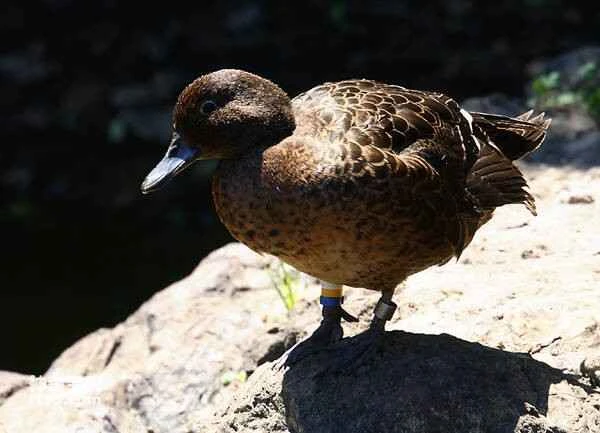
Oasis ducks nest in the dense vegetation along the coast. They are mainly active from dusk to night, feeding on marine invertebrates, as well as insect larvae, small mollusks, algae, and other marine organisms.
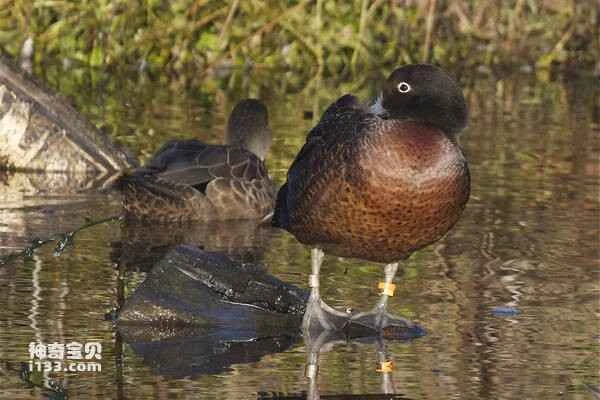
During the breeding season, Oka Island duck flocks mainly consist of subadults and adults. The annual breeding rate is low, with 3-4 eggs laid per nest from late October, and the first chicks seen hatching in December. Captive rearing takes longer than in the wild, with incubation completed in 30-35 days, followed by 60-70 days of parental care and feeding.
Listed as Vulnerable (VU) in the IUCN Red List of Threatened Species, 2009 ver 3.1.
Listed in Appendix I of the 2019 edition of the Convention on International Trade in Endangered Species of Wild Fauna and Flora (CITES) and the Regulations for the Protection of Endangered Species of Fauna and Flora.
Protect wild animals and ban the consumption of wild game.
Maintaining ecological balance is everyone's responsibility!