Basic Information
Scientific classification
- Chinese name: Dark jade
- Scientific name: Talod Islands Emerald, *Todirhamphus enigma*, *Halcyon enigma*, *Obscure Kingfisher*, *Talaud Kingfisher*
- Classification: Climbing birds
- Genus and species: Order Coraciiformes, Family Kingfisher, Genus Aldebaran
Vital signs data
- Body length: No verification information available.
- Weight: No verification information available.
- Lifespan: No verification data available.
Significant features
Distribution and Habitat
Distributed across the Pacific islands (including Taiwan, the Dongsha Islands, Xisha Islands, Zhongsha Islands, and Nansha Islands of China, as well as the Philippines, Brunei, Malaysia, Singapore, Sumatra and Java of Indonesia, and Papua New Guinea), and the Wallace Region (referring to the area east of the traditional Wallace Line (from the eastern waters of Mindanao through the Makassar Strait to the area between Bali and Lombok) and west of Papua New Guinea, including Sulawesi, Nusa Tenggara, the Southwest Islands, the Moluccas (Maluku Islands), and East Timor, among other islands in Indonesia).
They are typically found in primary forests, mixed forests, and secondary forests, and to a lesser extent in shrublands and grasslands. They can also be found along coastlines and riverbanks.
Appearance
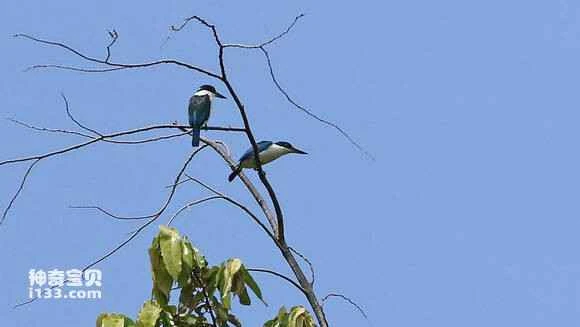
The male's head has a black tip and apex, with the rest bluish-purple. A circular or triangular mark is present at the base of the beak on the forehead, slightly higher than the bill. The neck is white, with folds and wings. The upper body is bluish-purple, more pronounced on the shoulders and back. The tail is a different bright blue. The underparts are pure white. The wings covering the face are white, with a greyish-black tail. The bill is black, the iris is dark brown, and the legs are greyish-black.
The beak is thick and long, resembling a chisel, with a relatively wide base, a straight beak peak, a rounded ridge, and no nasal grooves on either side; the wings are rounded, with the first primary flight feather being the same length as or slightly shorter than the seventh primary flight feather, and the second, third, and fourth primary flight feathers being nearly the same length; the base of the primary flight feathers has white spots; the tail is rounded.
Detailed introduction
The dark kingfisher, scientifically known as *Todirhamphus enigma* or *Halcyon enigma*, and also called *Obscure Kingfisher* or *Talaud Kingfisher*, is a bird belonging to the kingfisher family.

The Dark Emerald preys on lizards, reptiles, geckos, insects, small crustaceans, worms, newborn mice, and locust larvae. It is a shrewd and deliberate predator. Usually standing motionless on a low branch, it swoops vertically down with a piercing scream when it spots prey. If it catches a bass, it will repeatedly thrash it with its mouth until it kills it and swallows it whole.
The Dark Emerald reaches maturity at two years old. The breeding season extends from November to August. During this time, the pair is highly territorial and their calls can be heard very actively. The nest is a hollow cavity in a dead tree, more than 6 feet above the ground. The female lays three white eggs at a time. Incubation occurs twice a year, lasting 21 days. The chicks are not visible after hatching. Both parents feed them until they are 35 days old and can fly independently.
Listed in the IUCN Red List of Birds, ver 3.1: 2008.
Protect wild animals and ban the consumption of wild game.
Maintaining ecological balance is everyone's responsibility!