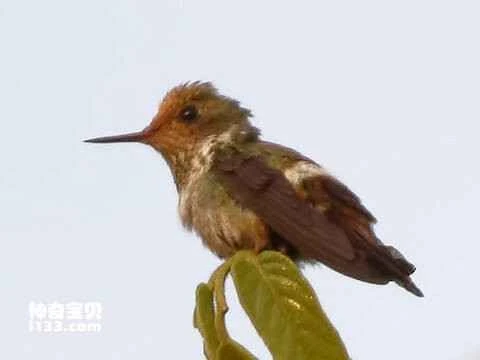
Basic Information
Scientific classification
- Chinese name: Osmanthus Red Jade
- Scientific name: Micronesian kingfisher, *Todirhamphus cinnamominus*, Guam kingfisher
- Classification: Climbing birds
- Genus and species: Order Coraciiformes, Family Kingfisher, Genus Aldebaran
Vital signs data
- Body length: No verification information available.
- Weight: No verification information available.
- Lifespan: No verification data available.
Significant features
This is the only bird that can perch on telephone poles at the edge of the forest.
Distribution and Habitat
They are found in Guam, Micronesia, and Palau in the Pacific Ocean.
Appearance
With a wingspan of 20cm and a weight of 60g, the sexes show significant differences. Adult males have a reddish-brown crown, neck, all outer coat, and lower body. They have a broad, bluish-black eye stripe that runs across the entire eye, including the ears and the back of the neck. The scapula, back, and wings are bluish-green, while the hindwing and tail are blue. The legs are brown, and the beak is black.
The female differs; her chin and throat are ivory white. Her tibia and wing feathers are pale cinnamon. Her back and shoulders are olive green. Her breast and neck are decorated with black feathers.
The beak is thick and long, resembling a chisel, with a relatively wide base, a straight beak peak, a rounded ridge, and no nasal grooves on either side; the wings are rounded, with the first primary flight feather being the same length as or slightly shorter than the seventh primary flight feather, and the second, third, and fourth primary flight feathers being nearly the same length; the base of the primary flight feathers has white spots; the tail is rounded.
Detailed introduction
The scientific name of the 'Guam Kingfisher' is Todirhamphus cinnamominus, and it has three subspecies.
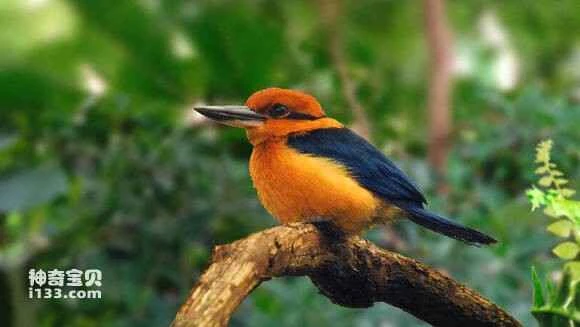
The red jade lizard preys on lizards, reptiles, geckos, insects, small crustaceans, worms, newborn mice, and locust larvae.
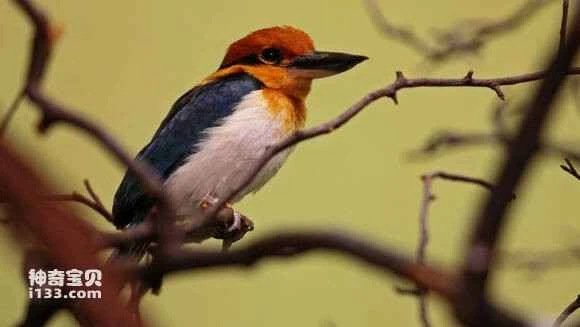
The Crimson Emerald reaches sexual maturity at 2 years old. The breeding season extends from November to August. During this time, both pairs are highly territorial and their calls can be heard frequently. The nest is a hollow cavity in a dead tree, more than 6 feet above the ground. The female lays 3 white eggs at a time. Incubation occurs twice a year, lasting 21 days. The chicks are not visible after hatching. Both parents feed them until they are 35 days old and can fly independently.
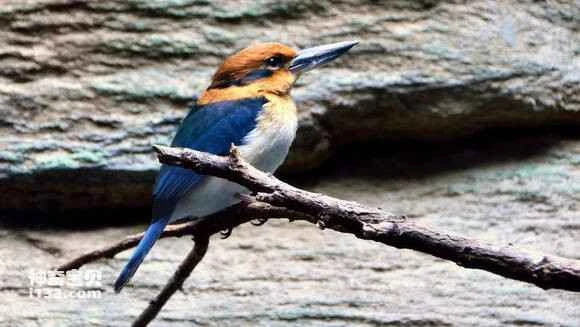
Both subspecies of the Red-crowned Crane are threatened with extinction. The Guam subspecies, driven to extinction by the invasive brown tree snake, is now listed as endangered in the United States. They exist only in captive populations, numbering fewer than 100 individuals. Plans are underway to reintroduce them into Guam's protected areas and forests. The Pohnpei subspecies declined by 63% between 1983 and 1994. The cause of the decline in Pohnpei birds is unknown.
Listed in the IUCN Red List of Birds, ver 3.1: 2008.
Protect wild animals and ban the consumption of wild game.
Maintaining ecological balance is everyone's responsibility!