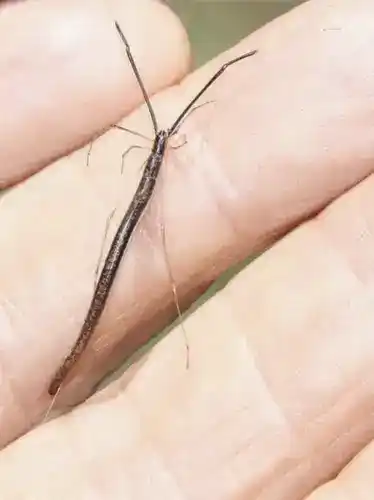
Basic Information
Scientific classification
- Chinese name: Whip Spider
- Scientific name: Amblypygi (order Whip Scorpionae, commonly known as whip spider or tailless scorpion)
- Classification: Arthropoda
- Genus and species: Amblypygi (whip spider)
Vital signs data
- Body length: Most species are about 2–5 cm in length, while some larger species can exceed 6–7 cm.
- Weight: Weight varies depending on body size and species, ranging from a few grams to more than ten grams, with most being light-bodied flat arthropods.
- Lifespan: Estimated to be several years, with some species able to survive 3–5 years or even longer in favorable conditions.
Significant features
Its forelegs are extremely elongated and whip-like, used for sensing the environment and communicating; its body is flat and it ambushes insect prey at night; it looks frightening but is very weakly toxic to humans.
Distribution and Habitat
It is mainly distributed in tropical and subtropical regions, and is commonly found in rainforests, limestone caves, bark crevices and abandoned buildings. It prefers dark, humid and secluded environments.
Appearance
Its body is flat and broad, and its body color is mostly brown or grayish-brown; the first pair of legs are slender and whip-like, while the second pair of legs and pedipalps are thick and spiny, making it look like a "tailless flat scorpion".
Detailed introduction
Whip spiders, also known as tailless scorpions or whip-shaped spiders , belong to the order Amblypygi within the class Arachnida. They are not true "spiders" in the strictest sense, but belong to the same large group of arthropods as spiders and scorpions. Their most distinctive feature is their extremely elongated forelegs, which are thin and whip-like and used for navigation and sensing their environment, hence the name "whip spider."
Classification and nomenclature
Common Chinese names: Whip spider, Tailless scorpion, Whip-shaped spider
Common English names: Whip Spider / Tailless Whip Scorpion
Scientific name (group): Amblypygi
Belongs to: Phylum Arthropoda → Class Arachnida → Order Amblypygi
Appearance and Identification Features
Whip spiders look like "flattened scorpions with extra-long antennae," but they actually have neither venomous claws nor a stinger.
Size: The body length varies greatly among different species, generally about 2-5 cm, with the largest species reaching 6-7 cm or more;
Flat body shape: The body is wide and flat, which is suitable for moving between rock crevices and tree bark;
"Flogger forelegs": The first pair of legs become extremely long and thin, losing their walking function and becoming highly sensitive "sensory tentacles" that can extend very far to touch, explore, and communicate with other animals.
Predatory legs: The second pair of legs and the forelegs are large and have sharp, spiny projections, like a pair of "grabbing arms" used to quickly clamp prey;
No stinger: Unlike real scorpions, whip spiders have no tail or stinger , and look like a tailless, flat scorpion.
Their body color is mostly brown, grayish-brown, or dark brown, with mottled textures that help them camouflage themselves in environments such as tree bark, rocks, or caves.
Distribution range and habitat
Whip spiders are mainly distributed in tropical and subtropical regions , including:
Rainforests and limestone caves in Central and South America;
Tropical forests and caves in Africa and Madagascar;
Mountain rainforests, tree trunk crevices, and caves in Southeast Asia and parts of South Asia;
A few species live in rock crevices and abandoned buildings in drier regions.
They prefer dark, damp, and secluded environments , hiding in rock crevices, tree bark, and cave wall cracks during the day, and coming out at night to hunt and hunt.
Life habits and hunting methods
Whiplash spiders are typical nocturnal ambush hunters :
During the day: camouflage yourself by clinging to rock walls, tree trunks, or cave ceilings, remaining motionless;
At night: It extends its slender "whip-like forelegs" to probe back and forth around, sensing tiny vibrations in the ground and air like radar;
When insects or other small arthropods approach, they suddenly attack, using their spiny forelimbs and second pair of legs to firmly grasp their prey before feeding with their mouthparts.
Common prey includes cockroaches, crickets, moths, beetles, and other spiders, and they play the role of insect predators in both natural environments and building ruins.
Sensory and behavioral characteristics
Whiplash spiders don't have particularly good eyesight, but the receptors on their forelegs and bodies are extremely sensitive.
The whip-like forelegs can extend in all directions to detect airflow, touch obstacles, and potential prey.
In some species, these forelegs also participate in "tentacle-like communication" with their own kind, playing an important role in courtship and territorial behavior;
Some whip spiders exhibit certain "parental behavior," where the female will carry the newly hatched whip spiders on her back for a period of time until they can move independently.
Toxicity and its effects on humans
Despite its "frightening" appearance, the whip spider has no stinger or known venomous claws that are harmful to humans .
They primarily rely on strength and mouthparts to subdue their insect prey;
When grabbed or pressured, it may use its forelimbs to clamp or try to bite, but this usually only causes brief mechanical pain.
There is currently no record of whip spiders being considered a significant medical threat.
In some areas, people even regard it as a "natural cockroach exterminator," silently reducing the number of cockroaches and other small pests in old buildings, cellars, or caves.
Relationship with and protection of humans
Whip spiders are relatively rare and elusive creatures in many parts of the world. With deforestation, cave tourism, and urban expansion, some populations face habitat loss pressure.
Protective measures include:
Maintain native forest and cave ecosystems, and avoid over-exploitation and destruction;
Control the intensity of human activity in tourist caves to preserve the dark and humid microenvironment;
In popular science education, it is important to correctly introduce the fact that whip spiders "look scary but are basically harmless" to reduce unnecessary fear and accidental killing.
Frequently Asked Questions
Q1: Is a whip spider a spider or a scorpion?
Whip spiders are neither "spiders" in the narrow sense nor scorpions, but rather belong to an independent order within the class Arachnida—the order Amblypygi.
They are related to spiders, scorpions, whip scorpions, etc., but are classified independently.
Q2: Are whip spiders poisonous? Will they attack people?
Whiplash spiders do not have stingers or potent venom like venomous spiders. They generally do not attack humans unless provoked.
When forced, they may use their forelimbs to clamp or bite people, usually causing brief and mild pain.
Q3: What is the purpose of the whip-like forelegs of the whip spider?
These extremely long forelegs are no longer for walking, but rather for highly sensitive sensors.
Used for navigating, touching prey, and communicating with other spiders, the whip spider's most important "sensory tentacles" are...
Q4: Do I need to get rid of whip spiders if I see them in caves or old houses?
They are usually unnecessary. They help prey on cockroaches and other small pests and are essentially harmless to humans.
If you really don't want to "live" with it, you can gently cover it with a container and move it to a secluded place outdoors, without killing it.


