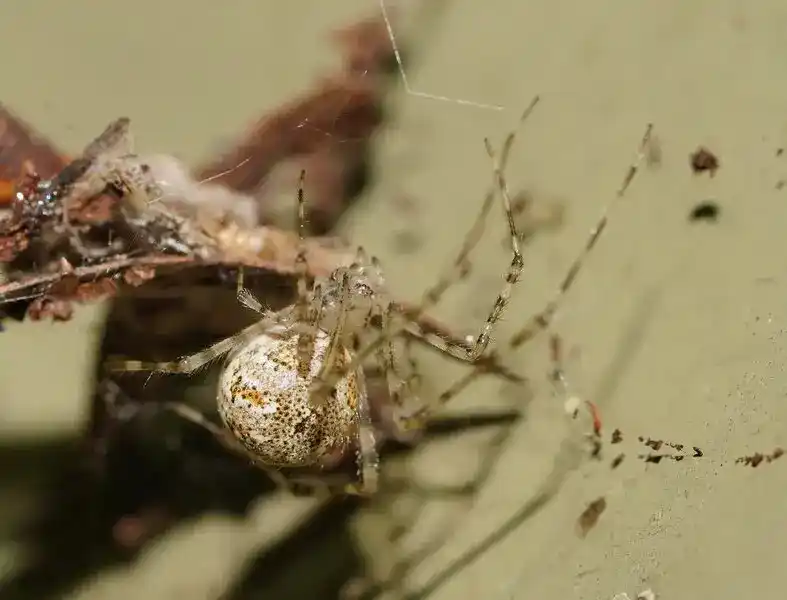
Basic Information
Scientific classification
- Chinese name: White porch spider
- Scientific name: Cryptachaea gigantipes (Keyserling, 1890)
- Classification: Arthropoda
- Family: Cryptachaea gigantipes
Vital signs data
- Body length: Adults are about 6 mm long, with females being slightly larger than males, and their leg span significantly exceeding the length of their torso.
- Weight: Individual spiders weigh only tens of milligrams, small and lightweight house spiders
- Lifespan: Estimated lifespan in the wild is approximately 1–2 years, depending on climate and food conditions.
Significant features
Small, long-legged ball spiders, with light-colored bodies and spotted abdomens, are adept at weaving three-dimensional webs under eaves and porches to catch insects and other spiders. They are relatively weakly venomous to humans.
Distribution and Habitat
Native to southeastern Australia, its natural habitat is sheltered places such as under rock shelters and caves; it is now widely settled in places such as New Zealand, and is often found on house porches, eaves, gaps in exterior walls and other sheltered man-made structures.
Appearance
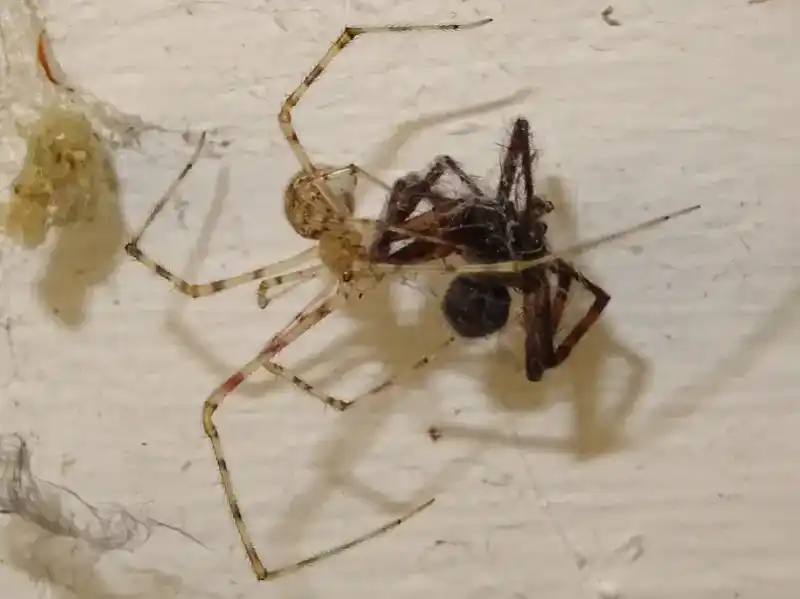
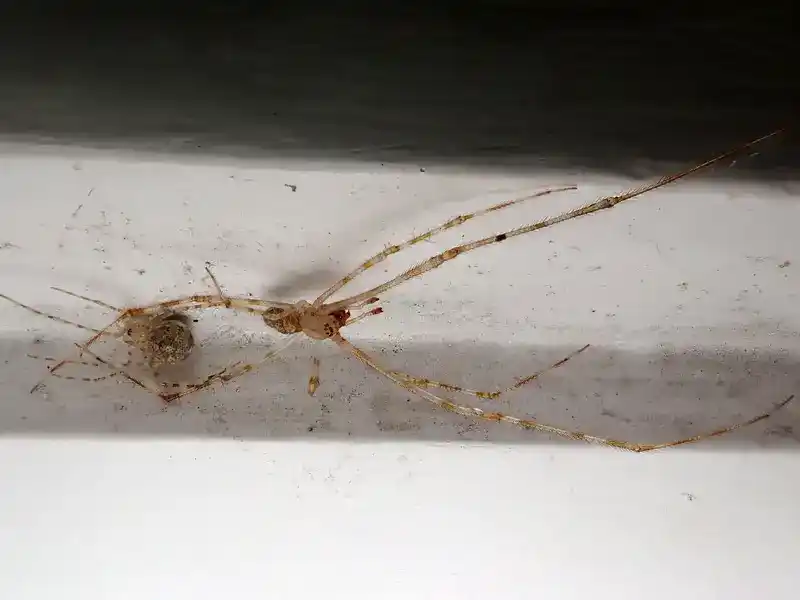
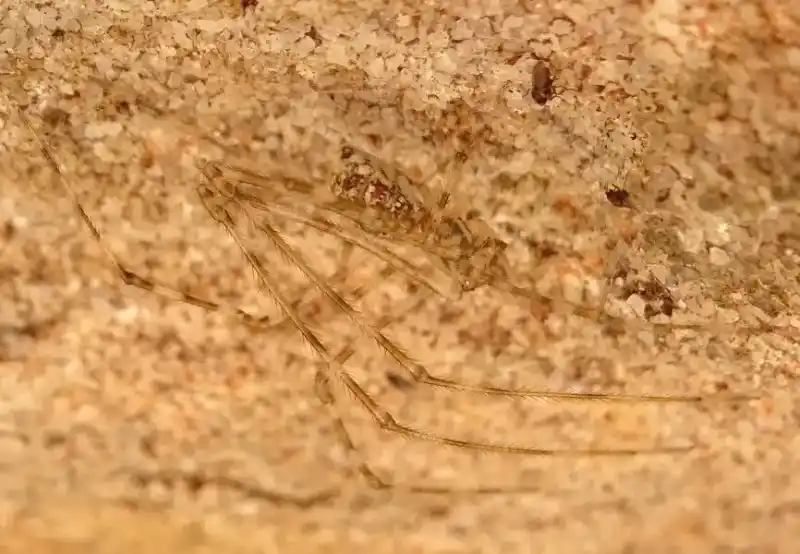
Its body color ranges from amber to creamy white, with a rounded abdomen and small dark spots, and eight slender legs; it often hides above or in corners of messy three-dimensional spider webs.
Detailed introduction
The white porch spider ( Cryptachaea gigantipes ) is a small house spider belonging to the family Theridiidae , the same family as the redback spider. Native to southeastern Australia, it is now also commonly found under eaves and porches in places like New Zealand. It gets its name from its preference for spinning webs in sheltered locations such as porches and eaves.
Classification and nomenclature
Common Chinese name: White Portico Spider
Common English names: White Porch Spider / Long-legged House Spider
Scientific name: Cryptachaea gigantipes (Keyserling, 1890)
Belongs to: Phylum Arthropoda → Class Arachnida → Order Araneae → Family Theridiidae → Genus Cryptachaea
Appearance and Identification Features
The white porch spider is not large, but its long limbs and light-colored body, combined with its messy web, make it look quite typical.
Size: Adults are usually about 6 mm long, with females being slightly larger than males and having legs that are significantly longer than their torso.
Body color: The body color is mostly amber, cream white or light brown, with scattered dark spots on the abdomen, and the overall color is light.
Body shape: The abdomen is rounded, the forebody is relatively small, and the eight legs are slender, giving it the typical appearance of a "long-legged house spider".
Spider web morphology: It is an irregularly woven, three-dimensional cobweb , often hung on eaves, porch tops, corners of walls, or below rock protrusions.
In New Zealand, some sources describe it as resembling the local venomous spider "katipō," but it is lighter in color, has longer legs, and is far less venomous.
Distribution range and habitat
The white porch spider is native to southeastern Australia , and its current recorded distribution includes:
Rocky cliffs, cave entrances, and house facades in several southeastern states of Australia;
Human settlements in parts of New Zealand’s North and South Islands, particularly rooftops, balconies and porches;
Buildings and natural rock formations on islands in the southwestern Pacific, such as Norfolk Island.
In their natural environment, they inhabit sheltered places such as under rock shelters, cave entrances, and rock crevices ; in urban and rural environments, they are found in large numbers:
The porch, balcony, eaves, window frames, and gaps in the exterior walls of the house;
Under the ceiling of garages, sheds, terraces, and corridors;
Near lights, in places that attract nocturnal flying insects.
Life habits and hunting methods
White porch spiders are typical nocturnal web-entangled predators :
During the day, they mostly curl up at the top of the net or in a corner, remaining still to avoid being spotted by predators;
At night, they stay in the center or edge of the net, waiting for moths, small beetles and other insects to crash into the sticky silk;
Once it gets entangled with prey, it will quickly approach, continuously casting silk to entangle it, eventually biting and injecting venom, before slowly feeding in a safe corner.
Observations show that it can prey on not only various insects, but also other spiders, including species much larger than itself such as trapdoor spiders, making it a small hunter with considerable "strength and courage".
Reproduction and parenting behavior
Like many members of the ball spider family, the white-porch spider exhibits some degree of parental care behavior :
The female spider lays her egg sac in the web and hangs it inside the web wrapped in multiple layers of silk;
Female spiders often guard the egg sac to reduce the risk of parasitism and predation.
After hatching, spiderlings do not immediately disperse, but instead remain within the mother spider's web, surviving on tiny prey within the "brood web."
The spiderlings leave after they grow to a certain size, building their own small webs and living independently.
This "delayed dispersion" method can improve the early survival rate of spiderlings and also allows a mother spider and a group of baby spiders to coexist in a large web for a period of time.
Toxicity and its effects on humans
Although belonging to the same family as the redback spider, the white-fronted spider is far less venomous to humans:
They are rather timid and, when startled, usually choose to retreat or play dead rather than attack.
The few known cases of biting show that most symptoms are localized pain, redness, swelling, and mild muscle soreness, which usually subside within 24 hours;
It generally does not pose a serious threat to healthy adults, but those with allergies should still take appropriate precautions.
Individuals living under eaves and porches often live very close to humans, yet biting incidents are rare, suggesting they are more inclined to avoid rather than confront.
Ecological significance and its relationship with humans
White porch spiders utilize man-made structures such as porches and eaves to form a typical synanthropic relationship :
They prey on nocturnal insects such as moths, mosquitoes, and small beetles in large numbers around houses;
They also prey on other spiders and small arthropods, indirectly regulating the structure of the surrounding invertebrate community;
Under normal circumstances, it will not damage buildings or damage furniture, and may only leave a small amount of spider webs and insect remains.
Therefore, when you see white porch spiders on the eaves or porch, you usually only need to clean up the excess webs occasionally and avoid them becoming too dense. There is no need to use insecticides to kill them all, and let them continue to quietly help "catch insects" at night.
refer to
Isbyster, GK and Gray, MR (2003) Venom effects of comb-footed spiders of the genera *Steatoda* and *Achaearanea* (Araneae). Journal of Toxicology, 41, 809-819. [NB species included herein are *Achaearanea veruculata*].
Smith, HM, Vink, C., Fitzgerald, BM, and Sirvid, PJ (2012). Redescription and genus location of the spider *Cryptachaea gigantipes* (Keyserling, 1890) (Araneae: Theridiidae), with annotations of related Australian congeners. *Zodiac* 3507:38–56. doi:10.11646/zootaxa.3507.1.2
Frequently Asked Questions
Q1: Are white porch spiders poisonous? Are they dangerous to humans?
It does have venom glands used to subdue prey, but there are very few recorded cases of white porch spiders biting people.
Most cases only cause localized pain, redness, swelling, and temporary discomfort, and generally do not pose a serious danger to healthy adults.
If you have an allergic constitution or obvious symptoms, you should seek medical attention promptly.
Q2: What is its relationship with the redback spider?
The white porch spider and the redback spider both belong to the family Orb-weavers, but the white porch spider is smaller and lighter in color.
It lacks the obvious red-backed warning spots and is much less toxic.
In Australia and New Zealand, it is generally considered a small house spider that poses little threat to humans .
Q3: Why do you see it on the porch and under the eaves?
The porches, eaves, and window frames not only provide shelter from wind and rain, but also often have lights to attract nocturnal flying insects.
It is an ideal "insect-catching platform" for white porch spiders.
Therefore, they often build spider webs and nests for raising their young in these places.
Q4: Do I need to remove the white spiders found on the exterior wall of my house?
Generally, they are not needed. They can help control the populations of moths, mosquitoes, and other insects.
As long as the net is not set up directly above the entrance or in a location with frequent traffic, it will be fine.
Normally, no special cleaning is needed; if it does affect use, you can gently sweep away the cobwebs during the day.
Simply move the spider to another corner.