Basic Information
Scientific classification
- Chinese name: White-tailed spider
- Scientific name: Lampona cylindrata & Lampona murina (Lamponidae family, white-tailed spider complex)
- Classification: Arthropoda
- Genus and family: Lamponidae White-tailed spider
Vital signs data
- Body length: Female spiders are about 12–18 mm long, and male spiders are about 10–15 mm long, with leg spans exceeding 2–3 cm.
- Weight: Individual weight ranges from tens to hundreds of milligrams; these are small to medium-sized, slender spiders.
- Lifespan: It is estimated that it can survive for 1–2 years in the natural environment, depending on climate and food conditions.
Significant features
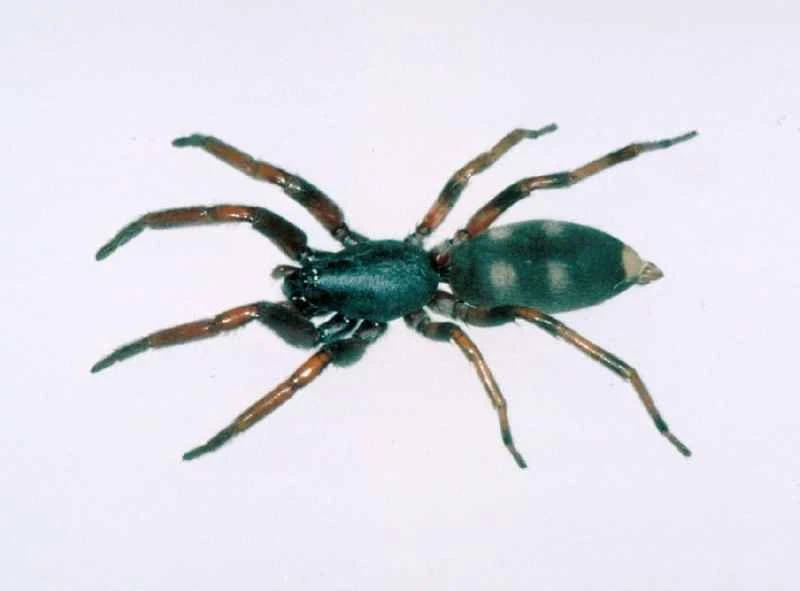
This nocturnal hunting spider has a distinct white patch at the end of its abdomen. It mainly preys on other spiders and small arthropods, and occasionally enters indoor spaces to "live" with humans.
Distribution and Habitat
It is mainly distributed in the eastern and southern regions of Australia, and is commonly found in the leaf litter, bark crevices and under rocks in the natural environment. It is also highly adapted to the warm and secluded environment inside and outside houses.
Appearance
Its body color ranges from dark gray to brownish-black, and its body shape is slender and slightly cylindrical. The most distinctive feature is a clear white or light-colored oval spot at the rear of its abdomen.
Detailed introduction
White-tailed spiders are a general term for a small group of spiders with a distinctive white patch at the end of their abdomen. Common examples include *Lampona cylindrata * and *Lampona murina* , belonging to the family Lamponidae . Native to Australia, they are common indoor and garden spiders, known for their predatory behavior towards other spiders, including redback spiders.
Classification and nomenclature
Common Chinese name: White-tailed spider
Common English name: White-tailed Spider
Representative scientific names: Lampona cylindrata , Lampona murina
Belongs to: Phylum Arthropoda → Class Arachnida → Order Araneae → Family Lamponidae → Genus Lampona
Appearance and Identification Features
White-tailed spiders are not large, but they have slender bodies and dark colors, with a very noticeable white spot at the end of their abdomen.
Size: Female spiders are about 12–18 mm long, male spiders are about 10–15 mm long, and their leg span can exceed 2–3 cm;
Body color: The body is generally dark gray, brownish-black or blackish-brown, with some individuals having slightly lighter markings on the back;
"White tail" characteristics: There is usually a clear white or light-colored oval patch on the rear of the abdomen, and smaller light-colored spots can also be seen on the front of the back of some individuals;
Body structure: The body is slightly cylindrical, with a narrower forequarters, a slender abdomen, and long legs, but not as extremely slender as those of the long-legged spider.
When a flashlight is shone on a spider at night, a dark, slender spider that moves swiftly can often be seen, with a faint bright spot at the end of its abdomen, which is a typical characteristic.
Distribution range and habitat
White-tailed spiders are mainly distributed in eastern and southern Australia , with some populations also found in New Zealand and other regions. They live both in their natural environment and are highly adapted to human habitation.
Natural habitats: woodland leaf litter, under rocks, in bark crevices, decaying wood and rock crevices;
Artificial environment: house foundation, exterior wall gaps, garden landscaping stones, courtyard walls, and storage rooms;
Indoor hiding places: piles of clothes, folds in sheets and blankets, curtain folds, inside shoes, cardboard boxes, and corner gaps.
They prefer warm, dry, and secluded environments and will follow their prey (especially other spiders) into indoor spaces.
Life habits and hunting methods
White-tailed spiders are nocturnal hunting spiders . Unlike orb-weaving spiders that wait for prey to come to them, they are more like "hunters" patrolling the ground and walls.
During the day, they mostly hide in concealed crevices or under objects, and rarely venture into open areas;
At night, they actively wander around the ground, corners, furniture, and garden stones;
Their main prey consists of other spiders, especially web-entangled ball spiders and small house spiders, as well as small arthropods such as insects.
When it spots a spider on its web or a target moving in a corner, the white-tailed spider quickly approaches and bites its prey, then slowly feeds in a secluded spot. This "spider-eating" habit helps control the number of spiders in some households to some extent.
Bites and venom
White-tailed spiders possess venom used to subdue prey, but they do not usually attack humans unless provoked . Most bites occur in the following scenarios:
A person unintentionally puts on clothes or shoes that harbor spiders;
It got crushed while tidying up the sheets, curtains, or moving miscellaneous items;
When grasping with bare hands or attempting to slap.
Historically, white-tailed spiders were widely believed to be associated with severe symptoms such as "skin necrosis and ulceration," but subsequent medical studies have not found clear evidence to support the claim that they cause extensive tissue necrosis. Most reliable case studies show:
The main symptoms after a bite are local pain, redness, swelling, burning sensation or itching;
A small number of people may experience mild discomfort, headache, or nausea, which usually subsides within a few hours to one or two days;
Serious complications are extremely rare and are more likely to be related to individual allergic reactions or secondary infections.
Therefore, the prevailing view is that white-tailed spider bites are uncomfortable, but usually not a serious medical threat . If you suspect you have been bitten, you should:
Wash the wound with soap and water as soon as possible;
Applying a cold compress can reduce pain and swelling.
If persistent, severe pain, pain spreading, fever, or allergic reactions occur, seek medical attention immediately.
Ecological role and its relationship with humans
In the ecosystem, white-tailed spiders are important small predators , helping to regulate population size by preying on other spiders and arthropods. In residential environments, they may be seen as "frightening uninvited guests," but they also quietly reduce the number of small spiders and insects.
Methods to reduce close contact with white-tailed spiders include:
Regularly clean indoor corners and clutter to reduce hiding places for mess;
Shake and inspect clothes and shoes that have not been used for a long time before wearing them;
Seal any visible gaps around doors, walls, and windows to reduce the entry of outdoor spiders.
If you find a single white-tailed spider in your home, you can usually wear gloves or gently cover it with a cup and a piece of paper and move it outdoors. This reduces the risk of accidental bites and preserves its ecological role in the natural environment.
References
Isbister, GK & Gray, MR 2003. White-tailed spider bites: a prospective study of 130 confirmed cases of Lampona spider bites. Medical Journal of Australia 179: 199-202.
Isbister, G. & Gray, M. 2000. Acute and recurrent skin ulcers following spider bites. Australian Medical Journal 172: 303-304.
Platnick, NI (2000). A redefinition and revision of the family Lamponidae (Arachnidae superfamily) in Australia. Bulletin of the American Museum of Natural History, 245: 330.
Sutherland, S. & Sutherland, J. 1999. Poisons in Australia. Oxford University Press, South Melbourne, Victoria.
White, J. 1998. Response to Chan, SW. 1998. Recurrent necrotizing subarachnoid disease. Australian Medical Journal 169: 642-643
Frequently Asked Questions
Q1: Are white-tailed spiders dangerous? Do they really "eat your skin"?
Current research has not confirmed that white-tailed spider bites necessarily lead to severe skin necrosis.
Most bites present with localized pain, redness, and slight swelling, while severe necrosis is more likely related to individual constitution or bacterial infection.
If you have any concerns, you should seek medical attention as soon as possible and have your doctor evaluate your condition.
Q2: Why do white-tailed spiders often appear in clothes and bed sheets?
They prefer warm, dry, and secluded environments.
Folded clothes, bedding, curtains, and the inside of shoes all provide ideal hiding places.
At the same time, there are also plenty of other small spiders and insects indoors for prey.
Q3: How can I reduce the risk of being bitten by a white-tailed spider?
Shake and check clothes or shoes that have been stored away for a long time before wearing them.
Regularly tidy up under the bed, in corners, and away from piles of clutter.
Sealing the gaps in doors and windows can significantly reduce the chances of close contact with them.
Q4: What should I do if I find a white-tailed spider in my home?
You can wear gloves or gently grasp it with a container.
Move to an outdoor garden or a corner away from the residential area.
It is not recommended to pat or pinch it with your bare hands, as this may provoke it to bite defensively.