Basic Information
Scientific classification
- Chinese name: Red-headed Woodpecker
- Scientific name: Melanerpes erythrocephalus, Red-headed Woodpecker
- Classification: Climbing birds
- Family and genus: Order Piliformes, Family Pilidae, Genus *Pterygota*
Vital signs data
- Body length: No verification information available.
- Weight: No verification information available.
- Lifespan: No verification data available.
Significant features
Distribution and Habitat
The red-headed woodpecker is found in North America, including the United States, Canada, Greenland, Bermuda, Saint Pierre and Miquelon, and the transitional zone between North and Central America in Mexico.
Appearance
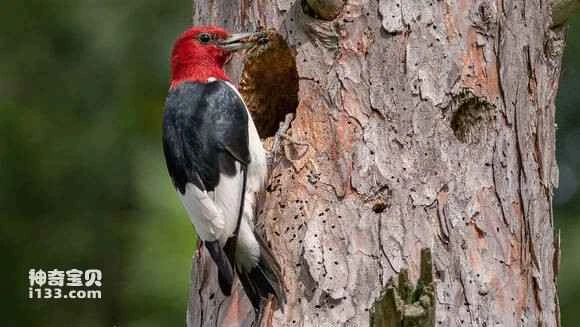
The Red-headed Woodpecker has three distinct colors: a black back and tail, a red head and neck, and a predominantly white underparts. Its wings are black with white secondary wing feathers. Adult males and females have identical plumage. Chicks have similar plumage but with some brown streaks. Non-birdwatchers often confuse the Red-headed Woodpecker with the Red-bellied Woodpecker, as the Red-bellied Woodpecker has some red on its head.
Detailed introduction
The Red-headed Woodpecker, scientifically known as Melanerepes erythrocephalus, is also called the Red-headed Woodpecker.
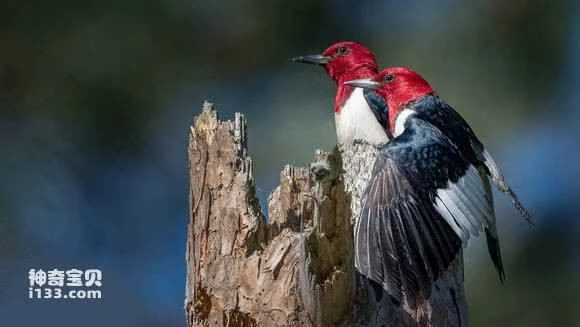
Red-headed woodpeckers prey on insects in the air and on land, and also eat fruit from trees. They are omnivorous, eating insects, seeds, fruits, strawberries, nuts, and even the eggs of other birds. Two-thirds of their diet consists of plants. They nest in tree cavities, lampposts, or dead trees. They lay their eggs in early May, which take about two weeks to incubate. They can raise two chicks at a time each season. Those from the north migrate south, arriving around late April, mostly during their breeding season, and leave in late October before winter begins. Those from the south generally do not migrate.
Listed in the IUCN Red List of Birds, version 3.1, 2009.
Protect wild animals and ban the consumption of wild game.
Maintaining ecological balance is everyone's responsibility!