
Basic Information
Scientific classification
- Chinese name: Oak Woodpecker
- Scientific name: Acorn woodpecker, Melanerpes formicivorus
- Classification: Climbing birds
- Family and genus: Order Piliformes, Family Pilidae, Genus *Pterygota*
Vital signs data
- Body length: 20-23 cm
- Weight: No verification information available.
- Lifespan: No verification data available.
Significant features
Distribution and Habitat
Existing (resident) birds: Belize, Colombia, Costa Rica, El Salvador, Guatemala, Honduras, Mexico, Nicaragua, and Panama.
Current location (breeding grounds): United States.
Existing and roaming (non-breeding grounds): Canada.
It is adapted to a variety of habitats, including foothill woodlands, tropical grasslands, riparian woodlands, dense jungles, mixed evergreen forests, low-altitude mountain vegetation communities, and canyon riparian forests.
Appearance
The Oak Woodpecker is a medium-sized climbing bird, measuring 20-23 cm in length. It has a red crest, a cream-colored face with black patches, a greyish-yellow forehead, and red crown and nape. The lower throat, rump, and abdomen are white, with fine black longitudinal stripes on the abdomen. The rest of its plumage is black. In flight, it displays three white patches: one on each wing and one on the rump. The female has less red on her crest than the male. Its legs and feet are dark grey.
Its legs are strong, with four toes, two pointing forward and two backward, each toe tipped with a sharp claw, making it adept at climbing trees. The shafts of its tail feathers are stiff as thorns, allowing it to grip tree trunks with its tips, aiding in weight-bearing and climbing. Its beak is strong and straight like a chisel. Its tongue is long and slender, capable of retracting freely, with short hooks at the tip.
Detailed introduction
The oak woodpecker, scientifically known as Melanerepes formicivorus, has seven subspecies.
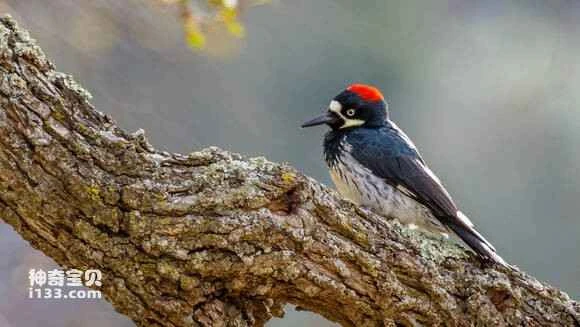
Oak woodpeckers are very unusual woodpeckers; they live in large flocks and cooperate to hoard acorns. Each group member can collect hundreds of acorns and wed them into small holes drilled in tree trunks or telephone poles. They also spend a considerable amount of time catching insects.
Oak woodpeckers are a group of hardworking and united birds that typically live in family groups. Each family has several "helper" woodpeckers who, though not yet breeding, are busy every day gathering acorns and other food for their chicks. They store thousands of acorns each year, with each group member always vigilantly protecting the stockpiled food and preventing theft.
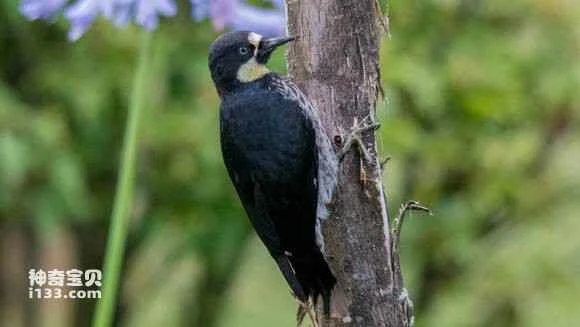
In the spring following a bountiful oak harvest, the average number of new chicks in a family increases, with each helper woodpecker responsible for about 0.7 more chicks on average. However, during poor harvests, the helper birds can slightly decrease the overall breeding success rate.
Oak woodpeckers specifically choose dead trees to store acorns, sometimes even telephone poles and wooden houses, leaving virtually no intact spots after their carving. Their strong, wedge-shaped beaks allow them to spend their days searching, knocking, and chiseling holes in the forest, hiding acorns in the crevices they've created.
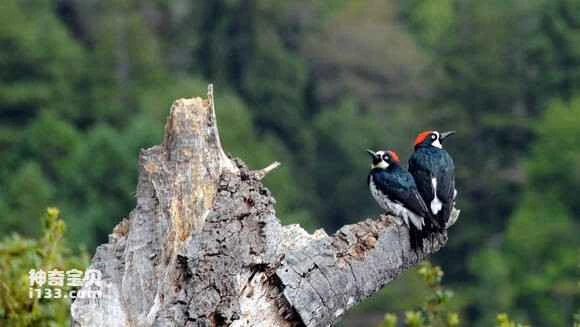
The oak woodpecker's breeding season is from April to June. They nest in tree cavities, lining them with wood shavings and dry grass. Each clutch contains 4-6 eggs, with both parents taking turns incubating. The chicks are altricial.
A study conducted in Santa Clara Valley, California, revealed that acorn woodpeckers are sensitive to urbanization due to a lack of mature trees infested with borers, leading to competition for tree cavities with European starlings. Acorn woodpeckers in the blue oak forests of Sacramento Valley, California, are particularly sensitive to deforestation and pasture expansion, as these human activities significantly alter their habitat. In southern Arizona and New Mexico, acorn woodpeckers provide roosting cavities for birds such as the Common Owl, Purple Sandpiper, Western Blue Robin, and Purple-green Tree Swallow.
Listed as Least Concern (LC) in the IUCN Red List of Threatened Species 2016 ver 3.1.
Protect wild animals and ban the consumption of wild game.
Maintaining ecological balance is everyone's responsibility!


