
Basic Information
Scientific classification
- Chinese name: Little Swift
- Scientific name: Apus affinis, Little Swift, House Swift, Martinet des maisons
- Classification: Climbing birds
- Family and Genus: Apotheales, Apodidae, Apothecium
Vital signs data
- Body length: Approximately 12 centimeters
- Weight: 25-31g
- Lifespan: Approximately 15 years
Significant features
The tail appears round when fully extended.
Distribution and Habitat
Resident birds: Algeria, Angola, Benin, Botswana, Burkina Faso, Burundi, Cameroon, Central African Republic, Chad, Democratic Republic of Congo, Republic of Congo, Ivory Coast, Djibouti, Egypt, Equatorial Guinea, Eritrea, Eswatini, Ethiopia, Gabon, Gambia, Ghana, Guinea, Guinea-Bissau, Iraq, Jordan, Kenya, Lesotho, Liberia, Libya, Madagascar, Malawi, Mali, Mauritania, Morocco, Mozambique, Namibia, Niger, Nigeria, Rwanda, Saudi Arabia, Senegal, Sierra Leone, Somalia, South Africa, South Sudan, Sudan, Syria, Tanzania, East Timor, Togo, Tunisia, Uganda, Zambia, and Zimbabwe.
Breeding grounds: Afghanistan, India, Iran, Israel, Pakistan, Palestine, São Tomé and Príncipe, Spain, Sri Lanka, Tajikistan, Turkey, Turkmenistan, Uzbekistan, and Yemen.
Non-breeding area: Kuwait.
Migratory birds: Lebanon, Oman and the United Arab Emirates.
Wandering (migratory bird): Wanders in Bahrain, Australia, Bulgaria, Greece, Ireland, Italy, Maldives, Malta, Portugal, Seychelles, Sweden and the United Kingdom.
Origin unknown: Azerbaijan.
Found in a wide range of habitats and latitudes, but not commonly found in truly arid regions, and usually near human settlements. Primarily inhabits open areas, most commonly near towns and villages. Sometimes found in canyons, forming its original habitat. Found on rock walls, in caves, and even near buildings in towns. Habitat ranges from approximately 2,100 meters to a maximum of 3,000 meters.
Appearance
The Lesser Swift is about 12 cm long with a wingspan of 32-34 cm and weighs 25-31 grams. It is a small, smoky-black swift with a white throat and rump, a short, square tail, and narrow wings. The tail is flat and slightly concave in the middle. The rump is white with brown shafts, and the upper tail coverts are dark brown with a coppery sheen. The wings are relatively broad and smoky-greyish-brown. The chin and throat are greyish-white, and the cheeks are pale brown. The rest of the underparts are dark greyish-brown. The undertail coverts are greyish-brown, the bill is blackish-brown, and the front of the tarsus is feathered and greyish-brown. The iris is dark brown, the bill is black, and the legs and toes are blackish-brown.
Juveniles resemble adults, but their heads are slightly lighter grayish-brown with pale grayish-brown feather edges, and their underparts are dark brown with grayish-white feather edges and a slight sheen; the shaft streaks of the rump, chin, and throat feathers are not distinct.
The Lesser Swift was once part of the Lesser White-rumped Swift subspecies. It is easily distinguished from other species by its square rather than more or less forked tail (though it appears round when fully extended). The white patch on its rump is large and clearly visible from the side. The white patch on its throat is also large.
Detailed introduction
The little swift (scientific name: Apus affinis), also known as Little Swift, House Swift, and Martinet des maisons, has six subspecies.
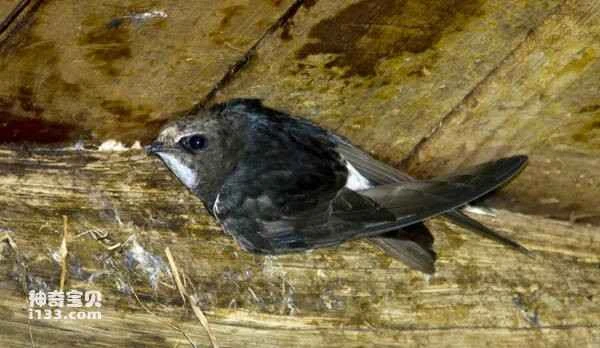
The populations of Little Swifts in the far western Palearctic region and southern Africa are partially or entirely migratory, but those in tropical regions are resident. The Little Swifts living in Turkey are entirely migratory, but their wintering locations are unknown.
The little swift inhabits and moves in flocks, sometimes gathering in groups of several hundred. They frequently fly in mixed flocks with other species, such as barn swallows. Their flight is rapid, often alternating between rapid wingbeats and gliding. Their range is wide, from near villages to dense mountain forests. After rain, they are often seen flying in flocks over cave areas, sometimes circling in synchronized motion. During mating season, the male and female chase each other. They are quite noisy, with a particularly loud "hiss-hiss" call, especially near breeding grounds. From dusk to midnight and at dawn, they emit a rapid, sharp, trilled call.
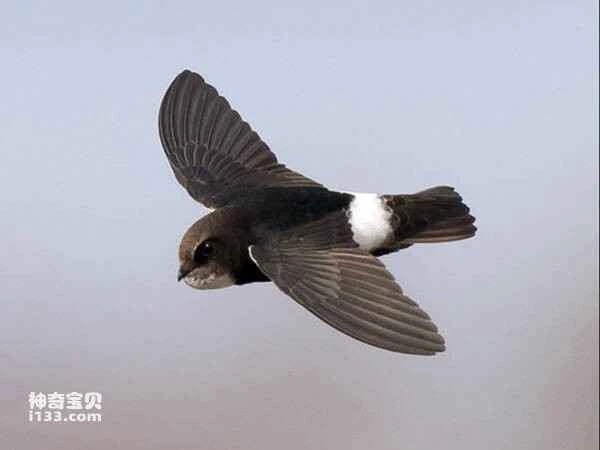
They typically hunt invertebrates at high altitudes, catching various flying insects. Their main diet consists of hymenopteran insects such as mosquitoes. Sometimes they forage at distances of 15-20 kilometers from their nests. They require a permanent body of water for drinking.
The breeding season for the Lesser Swift varies across its distribution: in Mauritania, it breeds from February to May and August to January; in Senegal and Gambia, it breeds from October to July of the following year; and in the rainforests of West Africa, it can breed year-round. They usually nest and breed in pairs or small groups, building nests in dense, often overlapping clusters. Nests are typically built under eaves, beams, and under bridges, and sometimes in cliff remains and abandoned swift (Hirundo) nests, or in the former sites of old swift nests and other birds. There are records of them being forcibly driven away by house sparrows and other birds.
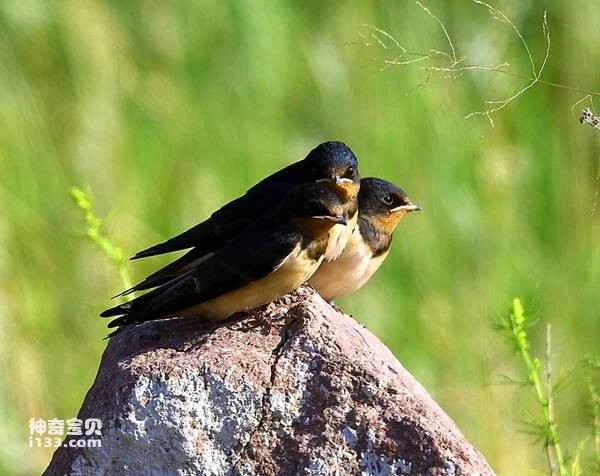
The nest is a sturdy, messy, but neatly smooth hemispherical plant "bag," constructed from fine plant fibers, straw, feathers, kapok fluff, reed fluff, and soil, mixed with the parent birds' saliva or wet mud. Nest shapes vary, including saucer-shaped, cup-shaped, and spherical, depending on the nesting environment. The nest is extremely soft and smooth, especially the entrance. The inside is often lined with fine grass stems and feathers. The outer diameter of the nest is 12-20 cm, and the inner diameter is 7-10 cm. There are up to three entrances, sometimes shared. Each clutch contains 2-4 eggs. The eggs measure (21-26) mm × (14-16) mm, with an average of 22.7 × 15.0 mm. Both parents take turns incubating the eggs. Incubation lasts 22-24 days, and the chicks are fed by both parents for at least 38 days.
The global population size of the swift has not yet been quantified. In Europe, the breeding population is estimated at 900–2,500 pairs, equivalent to 1,800–5,000 mature individuals (BirdLife International 2015), but Europe represents less than 5% of the global range. The population is believed to be increasing due to range expansion resulting primarily from adaptations to nesting in buildings (del Hoyo et al., 1999). It is estimated that the European population is sparse and will decline by at least 10% within 37.5 years (three generations) (BirdLife International 2015).
Listed as Least Concern (LC) in the IUCN Red List of Threatened Species 2016 ver3.1.
Protect wild animals and ban the consumption of wild game.
Maintaining ecological balance is everyone's responsibility!


